Hakkō-ryū Jūjutsu is a modern Japanese martial tradition formally founded in 1941 by Okuyama Ryūhō. Despite its classical Japanese name, it is not a medieval battlefield system passed unchanged through generations, but a twentieth-century art created by a founder who studied older systems, refined their principles, and built something new. It emphasises self-protection, control rather than destruction, and the cultivation of discipline and restraint.
Founding and Approach to Tradition
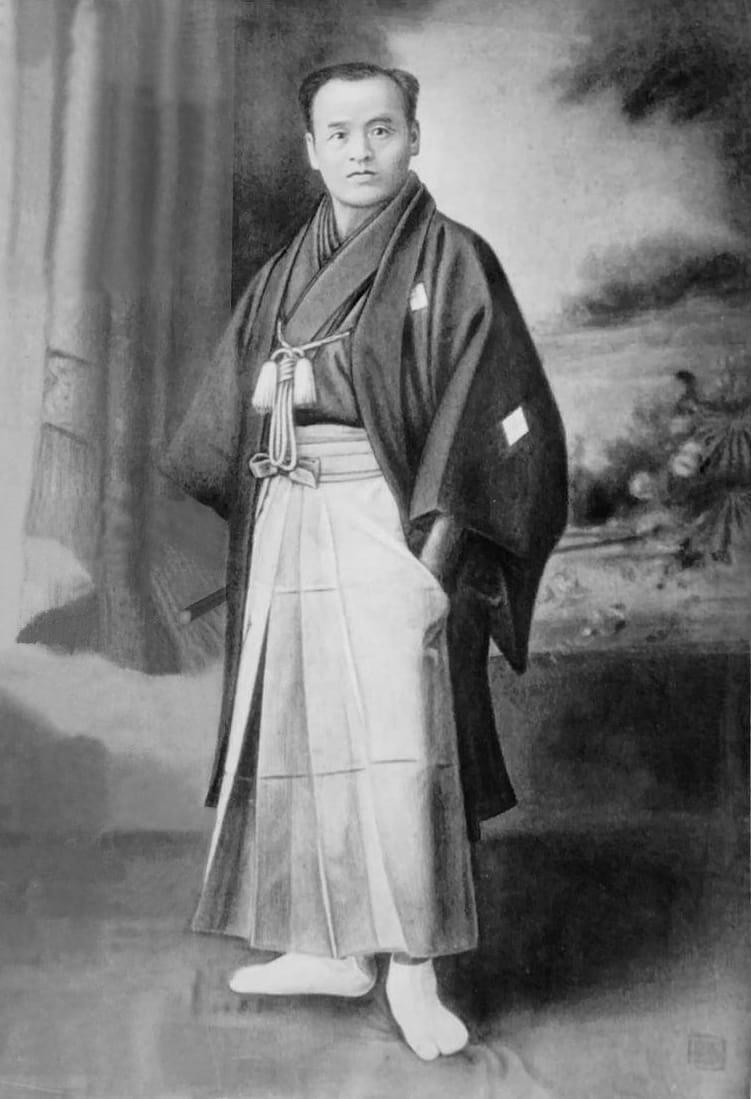
Although some assume from its name that Hakkō-ryū is centuries old, it was established in 1941. Its founder, Okuyama Ryūhō, openly studied older traditions, including Daitō-ryū Aiki Jūjutsu, but rather than copying them he created his own structure, teaching system, and philosophy. His Daitō-ryū training came chiefly through Matsuda Toshimi, who held a kyōju-dairi (teaching licence) in the line of the art's headmaster, Takeda Sōkaku. The art is sometimes described as more honest than systems that present themselves as wholly unchanged, since it does not claim an unbroken ancient lineage. This raises a broader question the school invites: whether tradition is defined by age alone or by remaining a living, evolving practice.
Control rather than destroy, the highest expression of martial skill is making force unnecessary.
Philosophy
Hakkō-ryū was never designed around competition, and its focus is described as survival and self-protection rather than winning medals or achieving fame. A central idea is that self-defence begins long before the first strike, with the most successful confrontation often being one that never occurs. The school places significant emphasis on avoiding conflict whenever possible, on the grounds that unnecessary violence harms everyone involved, including the victor, who may pay a physical, legal, or emotional price.
A defining principle is controlling rather than destroying an opponent. Control is presented as more demanding than either surrender or aggression because it requires precision, timing, awareness, and patience. The art is characterised as living in small details, minute angles, subtle shifts of weight, and slight adjustments of posture, rather than in dramatic or spectacular movements.
Techniques and Characteristics
Rather than relying on brute strength, many Hakkō-ryū techniques focus on balance disruption, joint manipulation, pressure points, pain compliance, and body structure. The approach is rooted in anatomy, leverage, positioning, and sensitivity, with the goal of redirecting, influencing, and guiding an opponent and creating opportunities rather than overpowering. This emphasis on efficiency and refinement over raw force is presented as part of a broader pattern in Japanese craftsmanship, found also in architecture, calligraphy, gardening, and the tea ceremony, in which the aim is to remove waste, refine movement, and seek clarity.
Healing Arts
A feature that often surprises observers is Hakkō-ryū's connection to healing arts. Historically, the relationship between martial knowledge and healing knowledge was not unusual, and understanding how the body breaks naturally leads to interest in how it heals. The school incorporated therapeutic practices alongside its martial curriculum, treating the body as something worth preserving rather than simply as a weapon.
Values and Legacy
Although it emerged in the twentieth century, Hakkō-ryū deliberately preserved ritual, etiquette, structure, and respect. This preservation is presented not on the assumption that old things are automatically good, but on the view that discipline, respect, and self-control remain valuable regardless of the passage of time. The art is characterised as expressing these lessons through its own language of technique, touch, and precision, valuing subtlety over spectacle, and as raising recurring questions about how much force is necessary and whether strength, confidence, and skill can exist without aggression, arrogance, or display.