The history of martial arts in Japan stretches back far before any named style, school, or philosophy existed. Rather than beginning as art, discipline, or structured tradition, what is now called martial arts developed gradually out of survival, organised violence, and the demands of warfare, only later acquiring formal structure and philosophical meaning.
Prehistoric Origins
In the Jōmon period, thousands of years ago, Japan had no standing armies, organised battlefields, or weapons designed specifically to kill other people. Archaeology from this period reveals tools such as arrowheads that appear to be hunting and survival implements rather than specialised instruments of war. In effect, there was a period in which martial arts, even in primitive form, did not exist.
Before it was art, it was survival, and the transformation between those two things changed everything.
This changed in the Yayoi period, which brought agriculture, rice fields, permanent settlements, and the concepts of ownership and territory, followed by conflict. Evidence from this era includes bronze and later iron weapons, arrowheads shaped in ways better suited to fighting than hunting, and skeletal remains bearing injuries difficult to explain as accidents or animal attacks. Violence became organised, though still without an attached philosophy: effective actions were repeated and survived because the body retained what kept it alive under pressure.
Early State and the Emergence of Training
In the Kofun period, power structures appeared and the early Yamato state began to take shape. Weapons became widespread, with swords, spears, and armour buried with the dead as functional tools rather than decorative or symbolic objects. With hierarchy came training, since untrained fighters died quickly and those in power preferred predictable outcomes. Techniques began to stabilise, repeated and refined within families and early warrior groups, marking the early beginnings of lineage even though it would not have been described that way at the time.
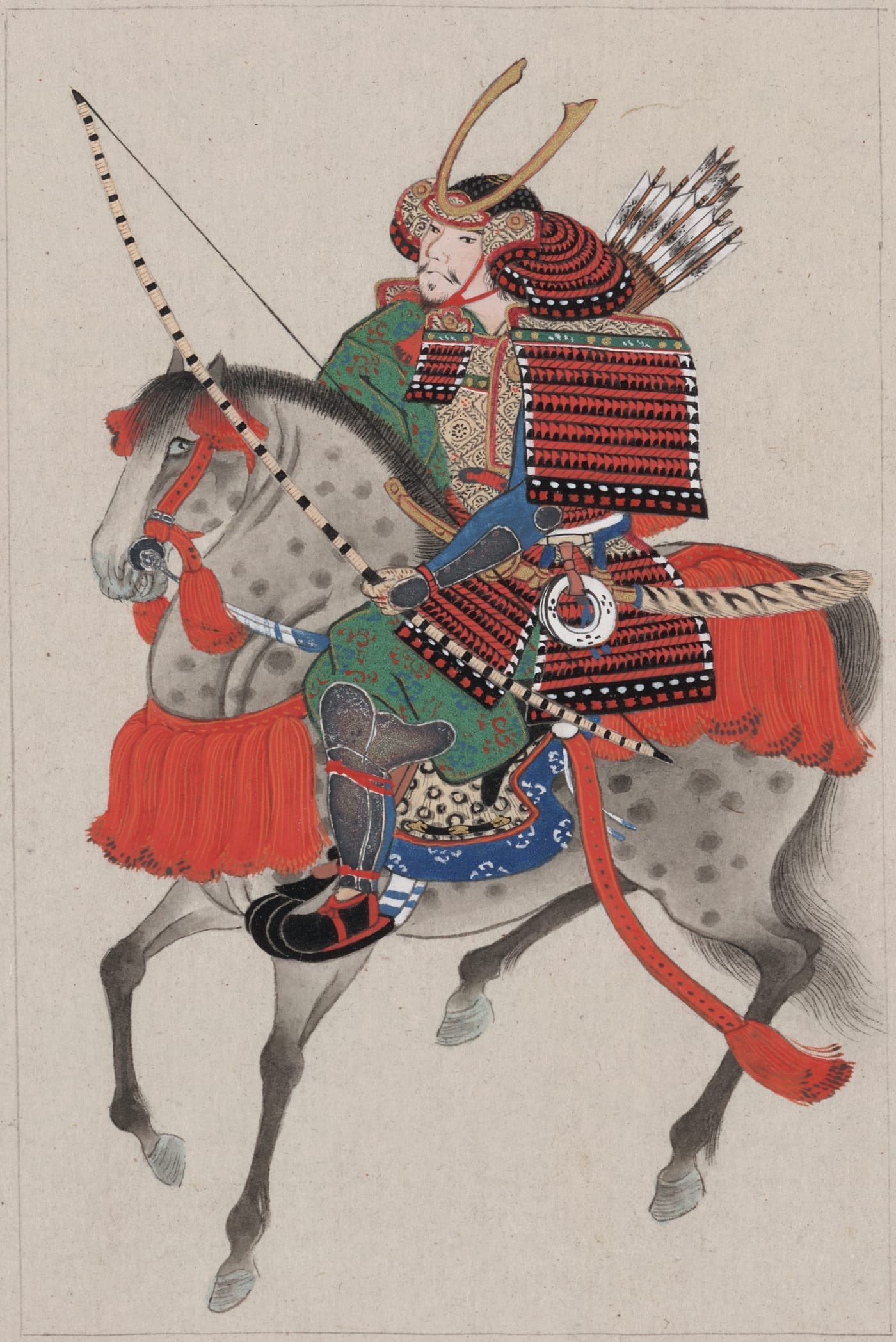
During the Nara and Heian periods, as the state matured, warfare became framed and ritualised. Practices such as mounted archery (yabusame) were performed as ceremony and display, and there are records of court competitions, sumo matches, and archery contests. The state imposed structure through military service, equipment regulations, and early legal codes, though the actual techniques remained largely unwritten and were passed within families.
The Samurai and the Rise of Schools
The Kamakura period saw the rise of the samurai class, which made warfare central and expected. Conflicts such as the Genpei War reshaped the political landscape and increased the demand for skill. From this period, recognisable schools, lineages, and ryūha began to emerge, driven by the need for consistency, reliability, and efficiency when training groups of warriors. Mounted archery traditions such as Ogasawara-ryū were tied to elite warrior culture, and early forms of grappling and close combat were acknowledged, with techniques increasingly grouped, named, and passed on deliberately.
The Muromachi and Sengoku eras brought near-constant conflict, fragmentation, and power struggles, conditions under which martial development expanded enormously. Dozens and then hundreds of schools emerged, including foundational systems such as Nen-ryū, Shintō-ryū, and Kage-ryū, which influenced many others. Alongside weapon-based systems, jūjutsu, close-quarters control used when weapons were lost or impractical, became more defined. Weaponry diversified, with the spear and naginata rising in importance, archery remaining relevant, and firearms appearing in the mid-16th century and gradually altering the dynamics of combat. Throughout, practice remained grounded in survival and conflict rather than personal growth.
The Edo Transformation
The Edo period brought roughly two and a half centuries without constant large-scale war, and the martial systems reorganised rather than disappeared. Schools multiplied because they could exist, and disciplines such as kenjutsu, jūjutsu, archery, and spear work were formalised, written down, and preserved in densho. In the space left by the removal of constant conflict, philosophy and meaning grew. Discipline became a goal in itself, character development became part of the tradition, and the idea of dō, "the way," began to frame what had once been a set of practical solutions. This is characterised as an adaptation rather than a decline.
Modernisation and Spread
The Meiji period brought deeper change, as the social structure supporting these systems collapsed, the samurai lost their status, and carrying swords became illegal. Rather than disappearing, the systems shifted again: jūjutsu became jūdō, and sword training became kendō, restructured not for war but for existence within a modern society. From there, martial arts spread across Japan and beyond, and by the twentieth century they had become culture, education, sport, and identity rather than purely systems of combat.
Continuity Versus Maintenance
A recurring observation about the present is that modern practice often consists of structured, technically precise repetition without the same necessity that originally shaped these systems. This raises a distinction between continuation, which implies movement, adjustment, and engagement with present circumstances, and maintenance, which centres on preserving forms as they are. The whole of this history suggests that martial arts survived not by standing still but through continual change driven by circumstances that could not be ignored, making the absence of such pressure a defining feature of the modern situation.