The Art of War is commonly received as a single book by a single author carrying one clean message, but treated as a historical problem it appears far more complex. Examining the earliest Chinese material alongside the later record and modern archaeology suggests that the text is better understood not as a perfectly preserved masterpiece but as a distilled tradition that endured through copying, questioning, and reshaping.
The Earliest Account
The earliest material, in what Sima Qian wrote, is notably restrained. There is no attempt to mythologise Sun Wu into an untouchable genius, no divine aura, and no dramatic origin story, simply a man from Qi presenting thirteen chapters to a king who had already read them. The quiet, almost dry tone reads as a record rather than a performance.
The supreme art of war is to subdue the enemy without fighting.
Shifting Numbers
Moving forward in time, that clarity fractures. The Hanshu no longer lists thirteen chapters but records eighty-two chapters for the Wu tradition and eighty-nine for a Qi version. These numbers are treated as evidence that what later generations inherited as a "complete" text may already have been a reduced form, that something larger existed, or was believed to exist, and that parts of it were lost over time. The implication is that the received text represents not the full voice of Sunzi but what survived of it: not what was written, but what endured.
The Yinqueshan Discovery
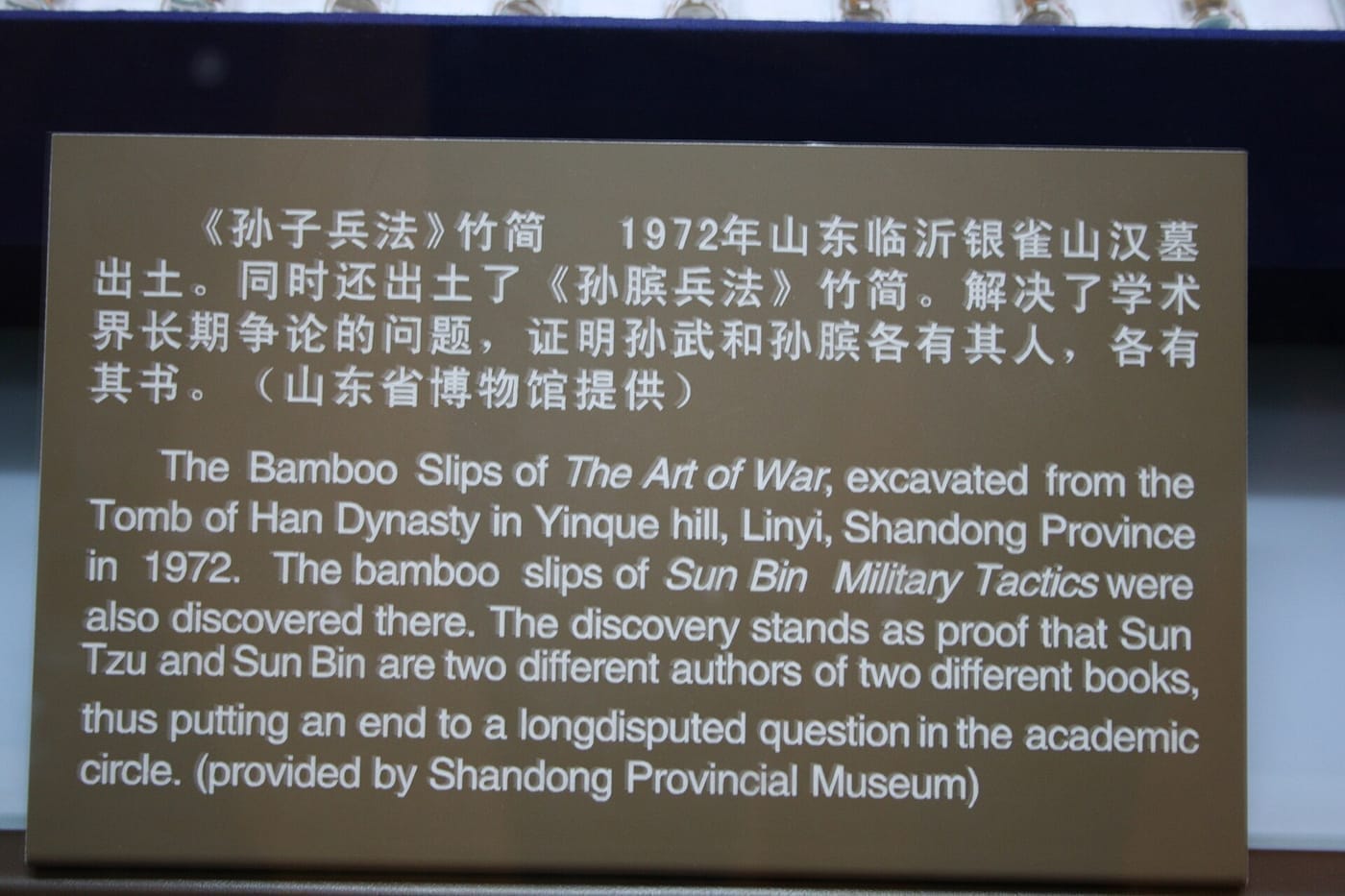
In 1972 the question moved from speculation to physical evidence with the discovery of the Yinqueshan tombs. Among hundreds of bamboo slips sealed away for over two thousand years, the thirteen-chapter structure appears again, as a text that physically existed in the early Han period. This anchors the structure as stable enough by the 2nd century BCE to be copied and buried with intention. Even here, however, the text is not perfectly fixed: the chapter divisions are not identical, some sections are split differently, and there are additional fragments that did not make it into the later standard versions. The result is an imperfect continuity, slightly inconsistent and fragmented, yet consistent enough to recognise its core.
Sun Bin and a Layered Tradition
The same archaeological context produced a second military text associated with Sun Bin. The Shiji already hints at a separation, placing Sun Bin more than a century after Sun Wu, not the same person, time, or context. Later readers nonetheless blurred the distinction, but the sources themselves resist that simplicity. This points toward a broader intellectual environment in which strategic thought evolved across generations rather than being frozen in a single moment, and in which The Art of War sits as a set of ideas shaped by real conflicts and preserved because they were effective.
Character of the Text
The text offers no comforting ideals of honour or fairness. It speaks in terms of advantage, deception, and timing, assuming that conflict is a reality to be navigated with precision rather than a moral playground. Its survival is attributed less to sentiment than to clarity, an attempt to understand how things actually work, without illusion or unnecessary decoration. What endures beneath the often-quoted lines is an underlying discipline of thought and a refusal to indulge in comforting narratives.
Transmission and Endurance
The journey of the text runs from a brief mention in the Shiji, through the inflated chapter counts of the Hanshu, through burial in a Han tomb, and through centuries of commentary in China before transmission into Japan and Korea, with later translation, reinterpretation, and adaptation. Rather than a flawlessly preserved work, this describes something that endured by being copied, questioned, reshaped, and still recognised. Its resilience lies precisely in surviving through variation and partial loss, remaining relevant rather than remaining unchanged.