Motobu-ryū is an Okinawan martial tradition presented, in its own official Japanese framing, as two distinct systems that are not meant to be casually blended: Motobu Udun-dī, tied to the old Motobu-Udun court tradition, and Motobu Kenpō, the karate system associated with Motobu Chōki and later structured as Nihon Denryū Heihō Motobu Kenpō. This separation is central to how the tradition defines itself in modern official presentation, and treating Motobu-ryū as a single generic karate style flattens it from the outset.
Primary Sources
The two most solid anchors for Motobu Chōki's karate are his own books: Okinawa Kenpō Karatejutsu: Kumite-hen (1926) and Watakushi no Karatejutsu (1932). These are period texts, bibliographically documented through the National Diet Library, and they bring readers close to what Motobu and his immediate publishing environment wanted preserved. For serious discussion of curriculum, technical emphasis, and how Motobu's karate understood itself, these texts are foundational. The picture they help build is not sentimental but functional, leaning into kumite logic and technical principles concerned with what works at close quarters.
Real fighting ability is earned through actual contact, not through kata performance.
Techniques and Characteristics
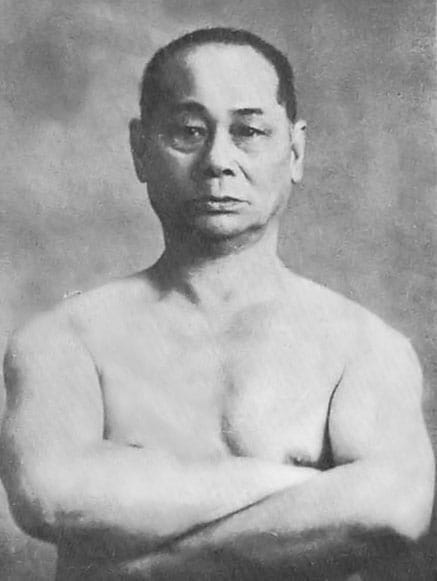
The technical profile described in current Japanese Motobu-ryū material is consistent in placing Naihanchi at the centre, not as a decorative kata but as a core form through which principles are concentrated. The same material stresses close range, hand control, meoto-de, and older kumite practices. The tradition repeatedly returns to what happens near the body rather than at theatrical long range.
A notable element is kake-te, described in the Japanese material as an old free kumite form practised from close contact, beginning from a state in which the arms are already engaged. This differs from sensationalised depictions; the same Japanese explanation explicitly pushes back against equating kake-dameshi with romanticised street violence or "tsuji-giri," noting that part of the confusion comes from a misunderstanding of what "Tsuji" referred to in the Okinawan context. The tradition's own discussion thus acknowledges that later accounts exaggerated and distorted the practice.
Training principles extend beyond kata and kumite. The Japanese material references the makiwara and forms of quiet, controlled conditioning, indicating that supplementary training was integral to how technical ability was forged. The tradition also treats kata analysis (分解, bunkai) as a formal subject; Okinawan cultural reporting identifies it explicitly in official documentation, situating application analysis within a recognised interpretive culture. Here too the emphasis returns to Naihanchi and to economy of movement, the idea that there are no unnecessary motions in the form, and that what matters is how much principle one can compress rather than how much choreography one can collect.
The Kyoto Boxer Story
One of the most famous stories attached to Motobu Chōki concerns a 1925 Okinawa Asahi Shimbun article reporting his victory over a "Russian" boxer in Kyoto. The source situation is not clean. Japanese scholarly work published through J-STAGE examines the uncertainties surrounding the opponent's identity and the newspaper evidence from the Taishō period. There is evidence of the story in Japanese reporting and later discussion, but key details remain contested. One early newspaper reference reportedly contains a name error, identifying the man as "Motobu Chōyū" rather than Chōki, with later commentary noting the mistake, a reminder that primary sources, however valuable, are written by humans and can misprint, misunderstand, or compress events.
Lineage and Official Framing
Official Motobu-ryū presentation insists that Motobu Udun-dī and Motobu Kenpō are preserved as parallel but distinct inheritances. The name "Motobu-ryū" itself is framed as having been redefined in 2003 as an umbrella for both systems, with later succession statements extending into 2025. These are official self-descriptions, valuable for showing how the organisation defines itself, but not automatically the final word on every historical question. Notably, the official Japanese material does not always claim certainty where it is weak; the lineage diagrams reportedly distinguish between links strongly supported in literature and those that are more legendary or indirect.
Historical Context
Motobu-ryū presents itself against the background of the Ryūkyū royal line through Motobu-Udun, while broader Okinawan karate history requires separating later origin stories from more firmly dated evidence such as publications, newspaper reports, and institutional markers. A 1935 Ryūkyū Shinpō piece on the origins and development of "te" is valuable for being early and Japanese, though even there speculative elements and chronological tensions are visible. A 1932 Yomiuri Shimbun notice about the "competitionisation" of karate suggests that ideas around equipment and demonstration were already emerging, complicating the assumption that sporting or protected experimentation appeared only much later. Such evidence shows tradition changing in real time through experiments and partial shifts rather than in a clean before-and-after.
Significance
Motobu-ryū is significant because it resists simplification. It preserves a claim to court-connected heritage while centring a fighter whose reputation is tied to practical kumite; it values kata while refusing to reduce it to empty choreography; it carries famous stories not wholly secure in every detail; and it exists today through official self-definition that still invites critical distance. The tradition does not collapse under scrutiny of its dates, publications, names, and inconsistencies, nor does it become simpler, it remains layered, imperfect, and still standing.