Muay Thai is a modern ring sport defined by rules and fought with fists, elbows, knees, and shins. It is associated with arenas, referees, timed rounds, gloves, ritualised pre-fight culture, music, and state recognition. It was not invented by a single person in a single year, but grew out of older Siamese fighting practices over a long period of time. The modern sport is clearly documented, while the earlier history must be reconstructed from varied and uneven sources, and even official Thai material acknowledges that the exact beginnings are not clearly documented.
Sources and Method
Reconstructing the deep history of Muay Thai requires drawing on different kinds of evidence, each of which performs a different function. A law code is not a technique manual, a chronicle is not a neutral record, a ceramic figure is not a ruleset, and a manuscript copied in the twentieth century is not a direct window into the thirteenth. Because of this, applying the single term "Muay Thai" too casually to the distant past risks flattening centuries of change. The earlier periods contain older combat traditions that clearly matter but were not yet identical to the modern sport, and this distinction is central to treating the history honestly.
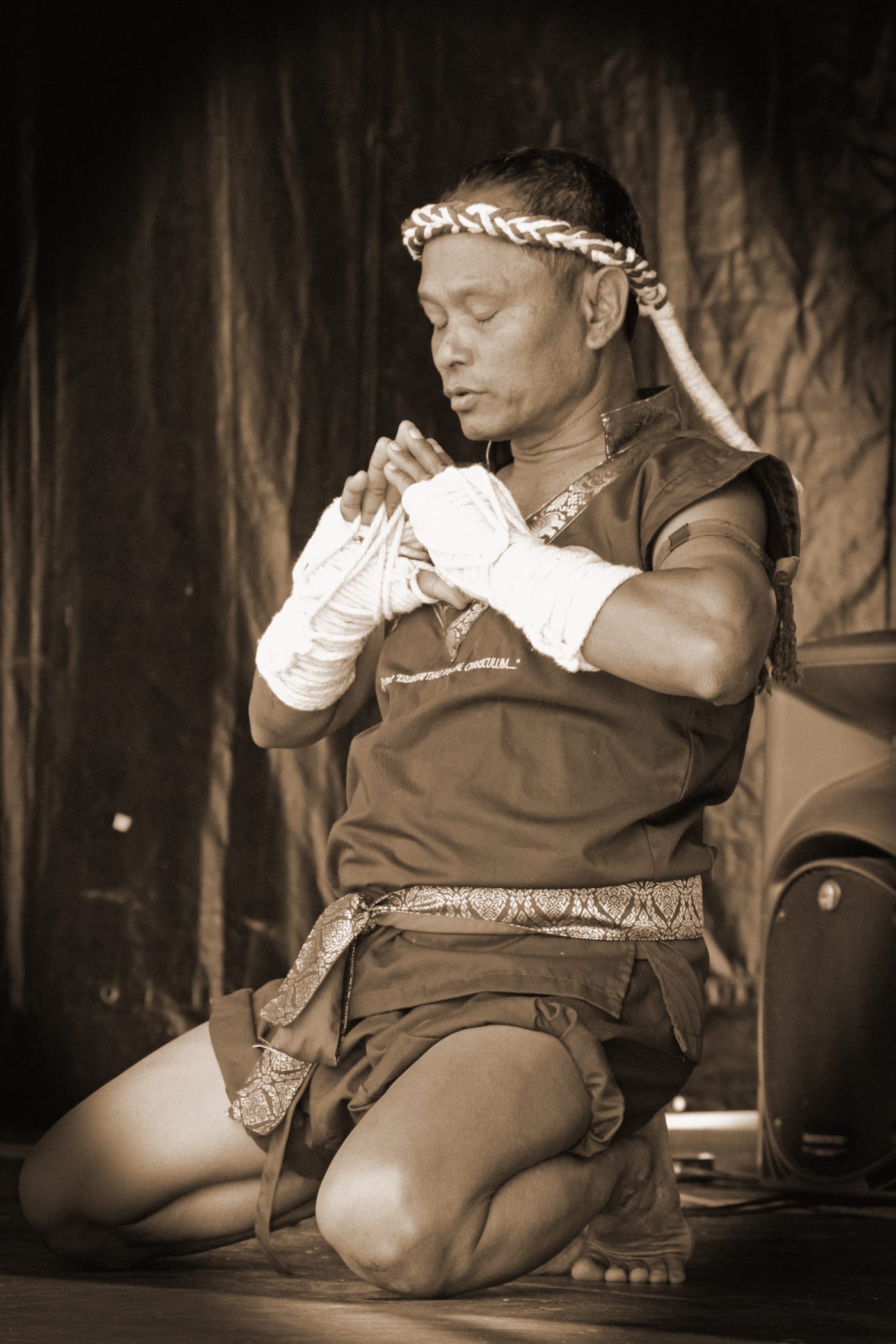
The art of eight limbs, every part of the body is a weapon, conditioned through relentless use.
Early Material Evidence
In the Sukhothai cultural world there are objects such as Sangkhalok figures showing grappling, explicitly rather than a fully formed modern striking sport. These indicate that physical combat was present enough in society to become a representable motif, and that combat play, wrestling, and bodily struggle belonged to the culture. They do not, however, demonstrate that Muay Thai as a codified ring sport already existed. The evidence supports the broader claim that bodily contest was part of the visible social world, not the narrower claim that the modern sport was present.
The Ayutthaya Period
In the Ayutthaya period the story becomes more famous and more uncertain at the same time. One of the most famous figures is Nai Khanom Tom, a Thai fighter remembered for defeating Burmese and Mon opponents and standing as a symbol of national pride and martial excellence. The main written basis for the story lies in chronicle traditions, and outside those chronicle lines the evidence for the historical person is very thin. Chronicles preserve memory, political meaning, cultural self-understanding, and moral framing, and they show how a society chose to remember events, but they are not equivalent to multiple independent contemporary records.
A similar tension surrounds the image of King Sanphet VIII, better known as Phra Chao Suea, the "Tiger King," as a boxing king who entered common contests. When historians compared different chronicle versions, dates and sequences diverged, and the motifs began to look less like solid early fact and more like narrative material shaped over time. Some Thai scholarship has even used Japanese records to check the chronology from the outside.
Combat as Social Practice
Legal sources are particularly revealing. The Three Seals Law frames fighting and grappling in relation to agreed contests, public amusement, risk, and social practice, rather than only battlefield necessity. This indicates that the ancestors of Muay Thai lived not only in war stories or elite masculine symbolism but also in society, among spectators, wagers, and communal acceptance of risk. Fighting existed as skill and embodied ability, but also as spectacle and as something publicly watched and socially recognised.
The language itself reflects this breadth. In older contexts the word "muay" does not behave like a neatly bounded modern sport term; it sits near grappling and can suggest bodily fighting skill more broadly. In the Nai Khanom Tom passage the emphasis is on ability, bodily competence, and fighting prowess even without weapons, rather than "sport" in the modern sense.
Manuscript Tradition and Muay Boran
As the modern period approaches, the manuscript tradition becomes important. The Tamra Chok Muay manuscript, preserved in the National Library, illustrates that traditional knowledge was often written down late. A late written record does not necessarily mean the practice itself was late, since oral traditions and embodied teaching can predate surviving manuscripts. Such manuscripts show a stage of systematisation in which techniques are ordered, categories are named, counters are included, and schools and lineages become part of the interpretive structure, evidence of later traditionalisation and didactic organisation rather than the birth of the practice.
The term "Muay Boran" is best understood as a modern umbrella label for older style traditions, remembered and organised through heritage discourse, lineages, manuscripts, and later training culture, rather than as a single pure ancient original. Regional traditions add further texture: old sayings about heavy punches from Korat, cleverness from Lopburi, good form from Chaiya, and speed from Tha Sao show that Muay was historically imagined as plural, a field of local reputations, emphases, and remembered differences rather than one fixed thing.
The Modern Sport
By the twentieth century the form sharpens into a documented modern sport institution. Rajadamnern Stadium began its modern life in 1945, and Lumpinee followed in 1956. Rules became formalised and arenas became fixed, establishing the features that define the sport today.
Summary
Muay Thai is both older and newer than commonly assumed: older because it grows out of a wide field of Siamese combat practices, and newer because the form recognised today is undeniably modern. The overall story is a long movement from older bodily combat practices (some involving grappling, some striking, some framed as entertainment, and some embedded in local and political cultures) through chronicle memory and manuscript ordering, into modern arenas and state definition.