Musō Jikiden Eishin-ryū (無双直伝英信流) is a Japanese sword tradition (koryū) devoted to iai, the art of drawing the sword and cutting in a single, unbroken motion. It is one of the most widely practised classical iai traditions in Japan and, in the twentieth century, abroad, transmitted for centuries within the Tosa domain (modern Kōchi Prefecture) before spreading nationally and then internationally. Its history is unusually well documented for a martial tradition, and the careful Japanese sources separate what can be evidenced from what survives only as tradition narrative.
Origins and the Founder Question
The school is often summarised as the work of a single founder, but the Japanese material resists that neatness. Hayashizaki Jinsuke Shigenobu (林崎甚助重信), a sixteenth-century figure, is remembered as iai no shiso (居合の始祖), the origin figure of iai as a broad tradition, rather than as the founder of this particular school. The line that came to bear the name Eishin-ryū is instead credited to Hasegawa Chikara-no-suke Eishin (長谷川主税助英信), treated in key sources as the ryūso (流祖), the founder of the specific current. The school's name preserves his own: Musō ("peerless"), Jikiden ("direct transmission"), and Eishin from Hasegawa Eishin.
Ken wa kokoro nari, the sword is the heart; technique exposes character before it ever meets an opponent.
A popular account holds that Hasegawa Eishin transformed iai by drawing from a sword worn edge-up, adapting to the uchigatana. It is widely repeated and sounds plausible, but the older transmission documents (densho) do not confirm it; it appears clearly only in the Shōwa period. It is best treated as a tradition narrative rather than an established fact, a distinction the school's own honest sources are careful to keep.
Tosa and the Domain Tradition
The defining chapter of the school is its transmission into the Tosa domain through Hayashi Rokudayū (林六太夫), usually dated to Enpō 2 (1674). In Tosa the tradition was protected as an otome-ryū (御留流), a domain-restricted school, which helped preserve it across generations. Over time the Tosa line divided into two principal branches, the Tanimura-ha (谷村派) and the Shimomura-ha (下村派), labels applied later rather than from the outset. The Tanimura line feeds directly into the Musō Jikiden Eishin-ryū recognised today, while the Shimomura line is central to the related Musō Shinden-ryū (夢想神伝流), shaped in the modern era through Nakayama Hakudō (中山博道).
Modern Codification
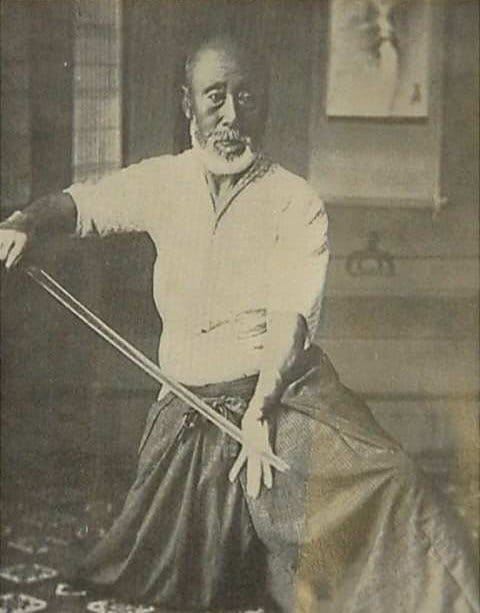
In the Meiji period the collapse of the samurai order threatened many classical traditions. Kōchi accounts credit the Tosa-born statesman Itagaki Taisuke (板垣退助) with noticing the school's decline on returning home in 1893 and helping to revive it. The decisive modern figure, however, is Ōe Masamichi (大江正路), who in the early twentieth century sorted, reorganised, renamed, and consolidated the older material into the structured curriculum that became the modern public form of the school. This act of codification is itself part of the tradition's honesty: the curriculum most students meet today is a deliberately reorganised body, not an untouched survival from the seventeenth century.
Curriculum and Technique
The modern curriculum is organised into graded sets. The seated forms of the Seiza no Bu and the raised-knee Tatehiza no Bu, drawn from the older Eishin material, lead toward the advanced Oku-iai (奥居合), with the Dai Nihon Battōhō serving in many lines as a foundational drawing set. Older and associated material also preserved paired work such as Tachiuchi no Kurai (太刀打之位) and broader arts including kenjutsu and bōjutsu, some of which are now only partly transmitted or reconstructed in particular lines.
Technically the school treats the moment before the sword leaves the scabbard (saya) as decisive. It emphasises posture, breath, maai (間合い, distance and interval), and sen (先, initiative and timing), distinguished as sen no sen, tai no sen, and go no sen. Practitioners are warned that drawing without an understanding of sen reduces practice to katana no odori (刀の踊り), a mere sword dance. The core actions (nukitsuke (the first draw and cut), kirioroshi (the decisive downward cut), chiburi (clearing the blade), and notō (returning the sword)) are studied as questions of decision and restraint rather than display.
Lineages and Documentation
There is no single uncontested headship. After Ōe Masamichi the succession runs in one major line through Hokiyama Namio (穂岐山波雄), Fukui Harumasa (福井春政), Kōno Hyakuren (河野百錬) and later teachers, but other legitimate currents exist, including the Yamanouchi-ha (山内派) associated with Yamanouchi Toyotake (山内豊健). Research on the genealogy of iaidō notes that the sōke system remained strong up to Kōno Hyakuren and grew more diffuse afterwards, as the tradition became national and then international. A claim framed only as a generation number, "the twentieth headmaster", means little without naming the branch, the documents, and the organisation behind it. The tradition is preserved through densho, makimono, and menkyo, and modern works are held in the National Diet Library; documents can fix a name, a phrase, or a diagram, but the living art is transmitted body to body.
Philosophy
The phrase most associated with the school is Kōno Hyakuren's "Ken wa kokoro nari" (剣は心なり), "the sword is the heart." Within the tradition it functions less as decoration than as a standard: technique is held to expose the practitioner's character, impatience in a rushed notō, vanity in posture, fear in the grip. Iai begins from the assumption that danger has already entered the room while the blade is still sheathed, and trains the practitioner to move before panic, cut without hatred, and finish without gloating. Readiness, in this reading, is quiet, and discipline is measured against self-importance rather than against an imagined opponent.