Shōtōkan is a style of karate developed from Okinawan Tōde (唐手術) and shaped on mainland Japan in the 20th century by Funakoshi Gichin. Japanese sources present it not as a frozen tradition but as an art that was deliberately and continuously shaped, adapted, and organized over time.
Founding and Transition
Funakoshi Gichin is described in Japanese sources, such as the histories of the Japan Karate Association (日本空手協会) and the Shōtōkai (松濤會), in restrained rather than heroic terms. An Okinawan schoolteacher from Shuri, he studied Tōde under Asato Ankō (安里安恒, 1827–1906) and then under Itosu Ankō (糸洲安恒), whom he regarded as his principal teacher. He brought Okinawan Tōde to mainland Japan, demonstrated it in Kyoto in 1917 and again in 1921 before the visiting Crown Prince, and in May 1922 was invited by the judo founder Kanō Jigorō to perform at the first national athletic exhibition in Tokyo, after which he remained in the capital to teach. The emphasis in these accounts is on transition, adaptation, and deliberate change rather than combat superiority or dominance.
Karate ni sente nashi, there is no first attack in karate. Character before technique.
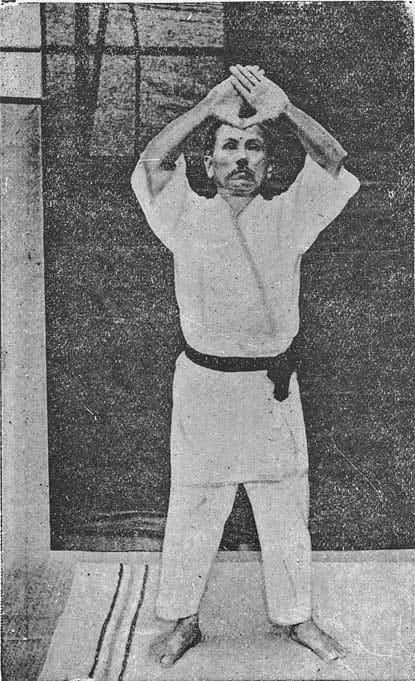
The name shift from 唐手 to 空手 is presented in Japanese material less as a mystical philosophical awakening and more as a conscious cultural decision, a repositioning intended to align the art with Japanese budō ideals. Funakoshi also replaced several Okinawan kata names with Japanese readings, Pinan becoming Heian, Kūshankū becoming Kanku, Naihanchi becoming Tekki, and adopted the kyū/dan grading system that Kanō had devised for judo. From its beginnings, then, Shōtōkan was an art that was shaped, and that shaping continued.
Organization
The structures around the art grew in stages. Funakoshi helped form the Dai Nihon Karate-dō Kenkyūkai in 1930, renamed the Dai Nihon Karate-dō Shōtōkai (松濤會) in 1936, and around 1938–1939 his students built him a dōjō in Tokyo that they called the Shōtōkan, "Shōtō's hall", after the pen-name Shōtō (松濤, "pine waves") with which he signed his calligraphy. That original dōjō was destroyed in an air raid in 1945. After the war, senior students established the Japan Karate Association (日本空手協会) in 1949 with Funakoshi as supreme master (最高師範); under chief instructor Nakayama Masatoshi (中山正敏, 1913–1987) it codified the syllabus, introduced tournament competition, and trained professional instructors who carried the style to more than a hundred countries. Later groups such as SKIF under Kanazawa Hirokazu and WSKF under Ueda Haruo represent further developments. Japanese sources acknowledge these expansions as part of the art's evolution rather than as departures from an original purity, presenting tradition as fluid and contextual.
Training and Techniques
Japanese sources describe training through the "three pillars" (三本柱): kihon (基本), kata (形), and kumite (組手), basics, forms, and sparring. These are presented as more than their surface descriptions: kihon as more than repetition, kata as more than choreography, and kumite as more than fighting. Much of the technical character now associated with Shōtōkan (its long, deep stances, extended kicking, and dynamic lines) is credited in the histories not to Funakoshi himself but to his third son, Funakoshi Yoshitaka (Gigo, 1906–1945), who reshaped the art in the 1930s before dying young of tuberculosis.
Japanese sources describe around 26 standard kata in Shōtōkan, including Heian, Tekki, Bassai Dai, Kanku Dai, Enpi, Hangetsu, and Gankaku, among others. These are presented not as finished answers but as structured forms requiring interpretation. Because interpretation introduces responsibility rather than fixed meaning, instructors, even within Japan, have historically disagreed on applications, emphasis, and timing.
Philosophy
The concept of ikken hissatsu, often rendered as "one strike, certain kill," is treated in Japanese discussions with emphasis not on killing but on commitment, the idea that a technique must be delivered with full intent, full focus, and no hesitation. Within this framing, intent that is trained as decisive also demands restraint, so that power requires control and intent requires responsibility.
Japanese texts on Shōtōkan are noted for their absence of theatrics. They make little effort to elevate the art into something mystical and do not emphasize secret techniques hidden from outsiders, focusing instead on relentless, repetitive training and a steady caution against exaggeration.
Schism and Succession
Funakoshi died in 1957, and his followers divided almost immediately, a split documented not only in the organisations' own records but in independent histories of karate. Part of the quarrel was practical: the older, more traditional Shōtōkai opposed the free sparring (jiyū kumite) and the tournament direction the JKA was taking, which Funakoshi himself had discouraged. Part was personal, beginning with a dispute over who should arrange his funeral. The two bodies went their separate ways, the JKA under Nakayama, and the Shōtōkai under Funakoshi's eldest son and then Egami Shigeru (江上茂, 1912–1981), remembered for a softer, deliberately non-competitive reinterpretation of the art.
The fragmentation did not end there. After Nakayama's death in 1987 the JKA itself divided into rival factions, and the disagreements were contested in the Japanese courts through the 1990s. Today "Shōtōkan" names a style rather than a single organisation: it is taught by the JKA, the Shōtōkai, SKIF, the ISKF, the World Shōtōkan Karate-dō Federation, and many smaller groups, with no single recognised head. Independent histories treat this plurality as the ordinary outcome of a teacher who never appointed an organisational successor.
Modern Practice
Modern Shōtōkan is understood as one version of the art, shaped heavily by university systems, post-war organization, and later international expansion. Japanese sources are described as open about this history, neither pretending nothing changed nor treating change as a betrayal. Stripped of its organizations, politics, and debates over competition versus tradition, the practice is characterized by showing up, training, refining, and questioning, an art that, despite being one of the most structured and widely spread karate systems, is presented in its source material as still evolving rather than fixed.