Takeda-ryū (武田流) is not a single school so much as a single name carried by several Japanese traditions. Three main streams bear it today. The first is an old bow-and-horse line of mounted archery, military ceremony and warrior etiquette, kyūba gunrei kojitsu (弓馬軍礼故実), whose yabusame (流鏑馬) is performed as a Shintō rite. The second is an aiki and strategy line presented as Takeda-ryū aiki no jutsu (武田流合氣之術) or Takeda-ryū heihō (武田流兵法). The third is Takeda-ryū Nakamura-ha (武田流中村派), a modern branch descended from the aiki stream that added competitive match formats to its curriculum. The bow-and-horse side rests on a documented archive studied at the University of Tokyo Historiographical Institute; the deeper origin claims of the aiki line are traditional accounts rather than established history. The three fields are institutionally separate, and treating them as one school flattens what the record actually shows.
A name that branches
The word 武田 (Takeda) is a family name, and 流 (ryū) means a stream, current, style or lineage. The image of the stream is apt: lines carrying the Takeda name split, merged, moved between provinces and reappeared under new institutions across several centuries. In the Japanese sources at least three major fields must be kept apart: the bow-horse-etiquette tradition, the aiki and heihō tradition, and the Nakamura branch. They share a name and a body of origin language reaching back to the Takeda clan and its claimed Seiwa Genji ancestry, but they are transmitted by different organisations with different curricula, and the evidence for each stream is of a different kind.
Stillness inside speed in the saddle, command over sparing and destroying in the hand, and the conviction that form must meet pressure without losing principle.
Mounted archery as ritual
The Dainippon Kyubakai (大日本弓馬会), the association that transmits the Takeda line of yabusame from Kamakura, describes yabusame as a shinji (神事), a Shintō rite, in which the archer shoots at three targets from a galloping horse; the shooting is performed not merely as a display of martial skill but as prayer for peace under heaven (tenka taihei, 天下泰平), abundant harvest (gokoku hōjō, 五穀豊穣) and the well-being of all people (banmin sokusai, 万民息災). Within the wider field of mounted shooting (kisha, 騎射) the sources distinguish yabusame from kasagake (笠懸), with its differing target arrangements, and from inuoumono (犬追物), the medieval dog-chasing exercise; yabusame, as a rite, stands apart from both.
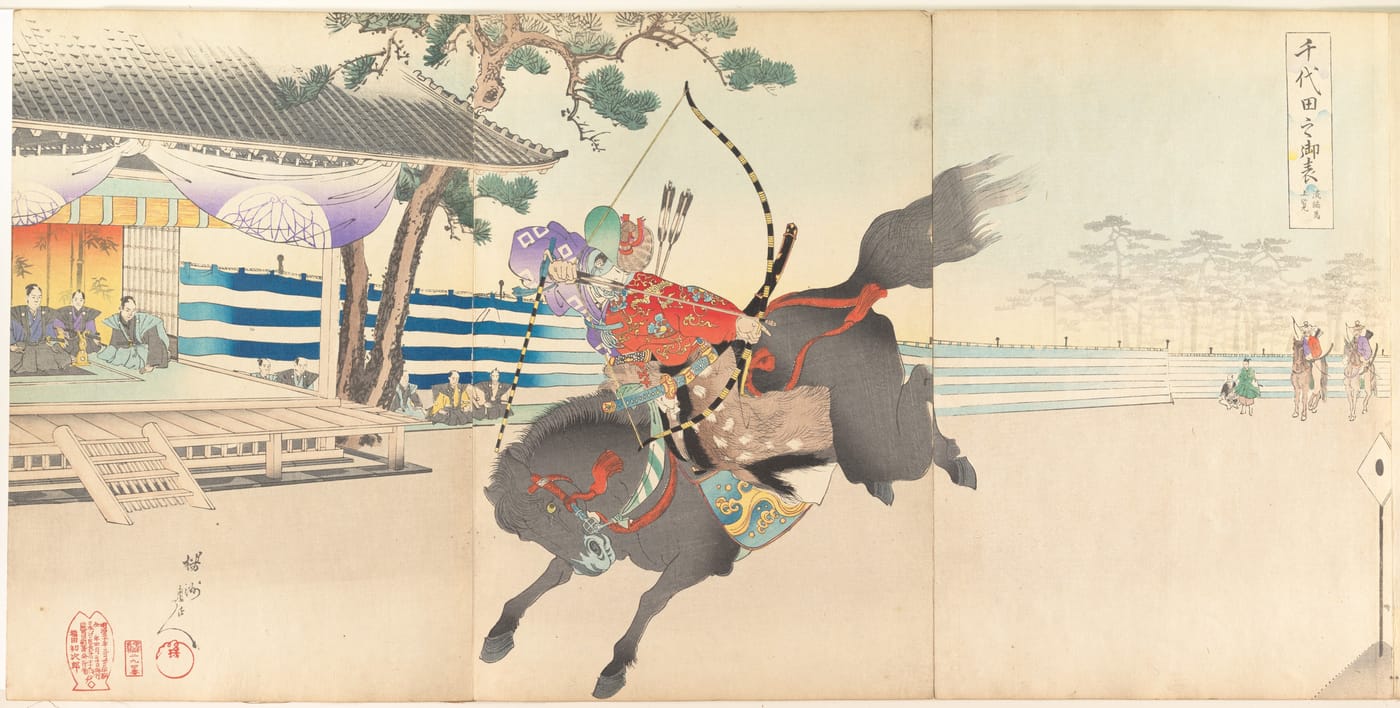
The school's riding method is called tachisukashi (立ち透かし): the archer does not grip the horse with the legs, and keeps the hips floating a paper-thin distance above the saddle, so that the upper body remains still enough to draw and shoot while the horse runs at full speed. The ideal attached to this seat is the phrase anjō hito naku, anka uma nashi (鞍上無人 鞍下無馬): above the saddle no rider, below the saddle no horse. It describes a state of human-horse unity (jinba ittai, 人馬一体) in which the movements of the two are so harmonised that neither is felt as separate from the other.
The rite itself has a fixed ceremonial structure. The Kyubakai's event explanations describe the tenchō chikyū no shiki (天長地久の式), in which a representative archer draws toward heaven and earth in prayer; subase (素馳), a full-speed run without shooting; hōsha (奉射), shooting offered to the deity; kyōsha (競射), competitive shooting among archers who performed well; and gaijin no shiki (凱陣の式), a concluding inspection. The material culture is equally specific: the rattan-wrapped shigetō bow (重籐の弓), the jindōya (神頭矢) whistling arrows used without iron heads because blood is avoided in the rite, the Japanese saddle (和鞍) and the Japanese stirrups (和鐙). The association notes that the production techniques for some of these horse fittings have largely died out, so old pieces are repaired and reused; preservation here is a matter of maintenance as much as of memory.
The documentary ground
The strongest historical footing lies on the bow-and-horse side. Research at the University of Tokyo Historiographical Institute describes the formation of bow-horse precedent from the Sengoku into the Edo period as quite complex and not yet fully clarified, and notes that the modern yabusame traditions are mainly divided into two lines, Takeda-ryū and Ogasawara-ryū. The Institute's catalogue of the Takeda-ryū Kaneko family materials (武田流金子司家史料), completed after three rounds of investigation and running to 329 items, mostly booklets, records that the Takeda bow-and-horse precedent was transmitted from the Wakasa Takeda house (若狭武田氏) through Takeda Nobunao (武田信直), also known as Kyūshōsai Seigei (吸松斎清芸), to Takehara Korenari (竹原惟成), a retainer connected with the Hosokawa house of Kumamoto. Comparison with the Hosokawa family documents and the Takehara Yōjirō family documents shows that the Takeda-style precedent absorbed, and was studied alongside, Ogasawara material, at times transforming into something the researchers suggest could almost be called Takehara-ryū. The titles in the catalogue give the tradition its texture: a work related to the old dog-chasing exercise (犬追物類鏡), a bow-and-horse record (十如院弓馬記), notes on transmitted horsemanship (馬術相伝聞書), works on warrior precedent, and oral teachings on whip and reins (鞭手綱口伝之事).
The line survived into the modern era in two places. In Kamakura, the Dainippon Kyubakai was founded in 1939 to preserve and present the Takeda line of mounted archery that had been kept under the Hosokawa house, and it continues to dedicate yabusame at major shrines. In Kumamoto, the Takeda-ryū Yabusame Preservation Association (武田流流鏑馬保存会) maintains the local transmission, and the city records the Takeda (Hosokawa-ryū) mounted yabusame as a designated Important Intangible Cultural Property of the prefecture.
The aiki and heihō line
A separate stream carries the name as Takeda-ryū aiki no jutsu, also presented as Takeda-ryū heihō. The Nihon Kobudō Kyōkai (日本古武道協会), the classical martial arts association to which the line belongs, relates the tradition's own origin story: descent through the Seiwa Genji warrior Shinra Saburō Yoshimitsu (新羅三郎義光) and the Takeda family of Kai, with later transmission through Kyūshū in the context of the Kuroda domain. That account is the school's traditional self-understanding; the medieval portion of the line is not established by independent documentation, and Ryūpedia records it as tradition rather than history. The publicly documented ground becomes firm around modern names: Nakamura Kichiō (中村吉翁); Ōba Ichiō (大庭一翁), described as developing and spreading the art through the Seibuden (聖武殿); and later figures such as Ikeda Isshō (池田一晶), Hikage Wataru (日影渉) and Hirakura Kyōsuke (平倉恭介).
Technically the line is described as strong in kassatsu jizai (活殺自在), command over the whole spectrum between preserving and destroying, and as characterised by the hand-sword posture (shutō-gamae, 手刀構え), throwing and pinning (nage-katame, 投げ固め) and hand-sword striking (shutō-uchi, 手刀打ち). The older heihō side is recorded as including naginata methods (長刀), the spear (槍), body art (taijutsu, 體術), sword engagement (tachi-uchi, 太刀打ち) and a secret gripping principle (秘伝の握り). The open hand borrows the logic of the weapon: the palm becomes a blade-like frame that strikes, enters, breaks posture, throws and pins.
The Nakamura branch
Takeda-ryū Nakamura-ha descends from the aiki stream through Nakamura Hisashi (中村久), who in 1950 entered the dōjō of Ōba Ichiō, counted by the school as its forty-third headmaster, in Kokura in northern Kyūshū. After Ōba's death Nakamura worked to keep the school alive, restarting training in Shinjuku in 1961; student groups formed at Rikkyō University and Nihon University, the Nihon Aikidō Renmei (日本合氣道連盟) was established in 1963, and in 1964 the branch held its first aikidō championship tournament, an arrangement its own history describes as highly unusual for the time. The curriculum is broad: aikidō in the school's own Takeda-derived usage, iaidō, jūkenpō (柔拳法, a flexible fist method combining striking and grappling), jōdō, and unusual material such as shurikenjutsu (手裏剣術), short wooden implement techniques (手木術) and sword engagement (太刀打之術).
The branch's defining feature is that this curriculum is pressure-tested in match formats. In sōgō randori shiai (綜合乱取試合), practitioners wearing leather hand protectors (uchi-gote, 打ち甲手) strike each other with the hand-sword at head and body targets, and points may be scored by effective strikes or by evading and throwing. In torite randori shiai (捕技乱取試合) one side attacks with strikes, grabs, thrusts or kicks while the defender answers with prescribed techniques, judged on correctness, flow, response and execution. The jūkenpō side fights kumite randori shiai (組手乱取試合) with punches, kicks, throws, joint techniques and chokes under waza-ari and ippon rules; the sword side holds paired drawing matches (kumi-battō shiai, 組抜刀試合) and timed cutting of rolled straw with a live blade (battō-giri shiai, 抜刀斬試合); and the jō side fights staff randori in padded and unpadded formats, where the school notes that the presence of a weapon makes distance and timing (maai, 間合い) especially critical. The school's own account is candid about the danger of the method: competition can turn forceful and strength-based, so rank is not awarded on match results alone, and kata examinations remain separate and required.
Takeda-ryū and Daitō-ryū
Takeda-ryū aiki is regularly confused with Daitō-ryū aiki-jūjutsu (大東流合気柔術), the tradition associated with Takeda Sōkaku and the parent art of modern aikidō. The two share Takeda and Genji origin language and the word aiki, but they are distinct traditions with separate histories, organisations and curricula, and the sources treated here do not establish any documented connection between them. Daitō-ryū is treated in its own article.
What is documented and what is tradition
The three streams rest on evidence of different kinds. The bow-and-horse line stands on an unusually solid documentary base for a classical tradition: a catalogued family archive, comparative study of domain documents, and continuous institutional practice in Kamakura and Kumamoto, including a prefectural cultural-property designation. The aiki line is documented in its modern portion through the records of its own organisations and its membership of the Nihon Kobudō Kyōkai, while its medieval descent from Shinra Saburō Yoshimitsu and the Kai Takeda remains a traditional account. The Nakamura branch is a recorded post-war development with a published institutional history. Ryūpedia therefore treats the name Takeda-ryū as a complex: documented where the paper survives, traditional where it does not, and honest about the difference.