Tennen Rishin-ryū (天然理心流) is a composite school of the sword and grappling, founded in the late eighteenth century, which would have remained a modest country tradition but for one extraordinary episode: it was the school of the Shinsengumi, the swordsmen who policed Kyōto in the last violent years of the shogunate. Through them it became one of the most famous of all classical schools, though its real character is rather different from its legend.
A school of the Tama farmlands
The school was founded by Kondō Kuranosuke Nagahiro around the end of the eighteenth century. It was a comprehensive art, teaching swordsmanship together with grappling, the staff and other weapons, and it took root not among the great warrior houses of the city but among the farming villages of the Tama district, west of Edo. There it was studied by villagers and local notables as much as by samurai. Tennen Rishin-ryū had a reputation for a plain, robust and practical style, trained with an unusually thick wooden sword that built strength and a heavy, committed cut, and aimed at usefulness in a real fight rather than at elegance.
A plain, practical fighting art of the farming country, valued for usefulness rather than elegance.
The Shieikan and Kondō Isami
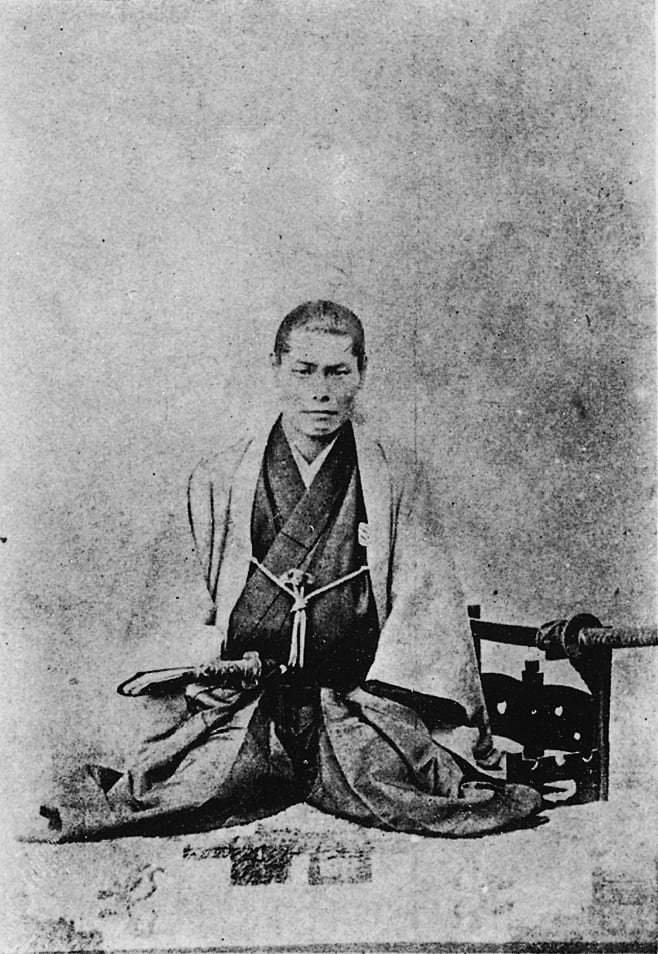
By the middle of the nineteenth century the school's main line in Edo was centred on the Shieikan, the dōjō of the third head, Kondō Shūsuke. Shūsuke adopted a gifted young man from a Tama farming family who took the name Kondō Isami and became, in time, the fourth head of the school. The Shieikan gathered around it a group of dedicated and mostly humble swordsmen, among them Hijikata Toshizō and the prodigy Okita Sōji, and it was this community, bound by the school as much as by birth, that history would remember.
The Shinsengumi
In 1863 Kondō Isami and a number of his Shieikan companions travelled to Kyōto and there formed the core of the Shinsengumi, a special police force raised to keep order in the capital on behalf of the shogunate. For a few years they were among the most feared swordsmen in Japan, and the school they had trained in, Tennen Rishin-ryū, was the art that several of their leaders actually practised. This is the part of the school's history that is most fully documented, precisely because the Shinsengumi were so closely watched and so much written about. It is also the part most heavily overlaid with later drama, in novels, films and television, and the careful reader should separate the well-recorded outline from the romance built upon it.
After the fall
The Shinsengumi chose the losing side. With the fall of the shogunate Kondō Isami was captured and executed in 1868, and Okita Sōji died of illness in the same year; the corps was destroyed in the wars of the Restoration. The school itself, however, did not die with its most famous members. It survived in its old heartland in the Tama region, carried on by lines that had never gone to Kyōto, and it is from these that the tradition continues.
The style today
Tennen Rishin-ryū is preserved today by several lines and preservation societies, mainly in the western suburbs of Tōkyō that were once the Tama farmlands, where it is demonstrated at shrine festivals and at events commemorating the Shinsengumi. What survives is the older, broader school, the country art of the thick wooden sword, rather than the brief and bloody police work that made its name. It is an unusual case of a tradition whose fame and whose substance point in slightly different directions, and it repays being known for both.