Hōzōin-ryū (宝蔵院流) is the most famous of the classical Japanese schools of the spear, and one of the few founded not by a soldier but by a monk. It grew up in the sixteenth century at the Hōzōin, a sub-temple of the great Kōfuku-ji in Nara, and it is known above all for its distinctive weapon, a spear with a cross-shaped head that can thrust, cut, hook and parry.
The spear of the temple
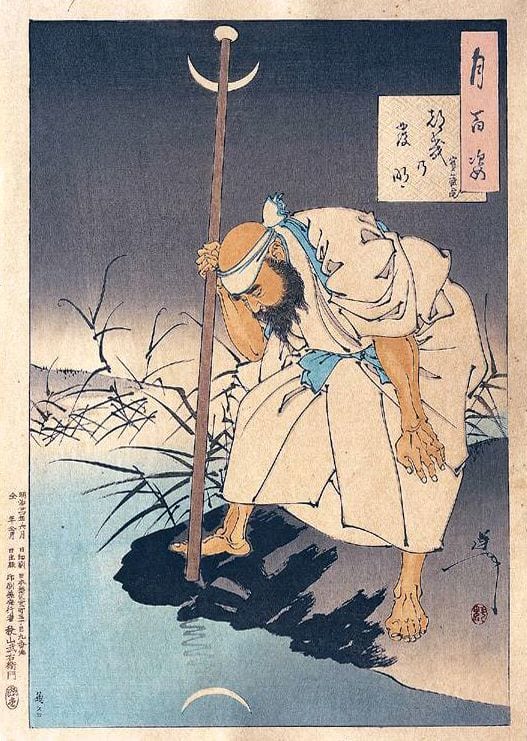
The founder was Hōzōin In'ei (1521–1607), a monk and abbot of the Hōzōin in Nara. The warrior-monks of the old temples were a real feature of medieval Japan, and In'ei was among the most accomplished of them as a martial artist. He is credited with developing the cross-shaped spear, the jūmonji-yari or sickle-spear, whose side blades turned a simple thrusting weapon into something far more versatile. The school's own tradition tells that the idea came to him as he watched the crescent moon reflected on the surface of the Sarusawa pond below the temple, an image so closely tied to the school that a famous later woodblock print shows him exactly so.
A single weapon made to do many things at once: a spear that attacks and defends in every direction in the hands of one who has mastered it.
In'ei and the swordsmen of his age
In'ei lived at a moment when Nara was an unusually rich centre of martial study. When the great swordsman Kamiizumi Nobutsuna, founder of the Shinkage-ryū, came to the region, In'ei studied with him, as did Yagyū Munetoshi, who would carry the sword tradition into the Yagyū line. That the spear monk and the founder of the Yagyū school sat under the same teacher is well attested, and it places Hōzōin-ryū firmly within the documented history of its time. The school is also bound up, in the popular imagination, with Miyamoto Musashi, who is shown in fiction crossing weapons with the Hōzōin monks; but that connection belongs to the novels rather than to the record.
The cross-spear
What sets the school apart is the weapon itself. The cross-spear carries, below its central point, a pair of curved side blades set crosswise, and the art is built around using all of them: thrusting with the point, cutting and hooking with the cross-blades, trapping and deflecting an opponent's weapon, and pulling a horseman or a swordsman off balance. The result is a spear method of unusual richness, in which the same weapon can attack and defend in many directions, and which demands great control to use well.
Branches and the Takada line
After In'ei the school divided into several branches, as successful traditions usually did. The line that came to dominate, and which survives most strongly today, is the Takada-ha, named for Takada Matabei Yoshitsugu, a gifted exponent through whom the art spread to a number of domains across the country. The transmission of the Takada line in places such as the Aizu domain is documented in some detail, and it is largely through this branch that Hōzōin-ryū has reached the present.
The school today
Hōzōin-ryū Takada-ha is preserved today by a line based in Nara, close to where In'ei first taught, where it is studied and demonstrated as a living spear tradition. It is a rare survival: a complete classical method for a weapon that has long since left the battlefield, kept alive in the city of its birth. What endures is the genuine art of the cross-spear, distinct from the layer of legend that the school's age and its literary fame have wrapped around it.