Shindō Munen-ryū (神道無念流), the "divine way of no-thought", is a school of Japanese swordsmanship founded in the eighteenth century and remembered above all for the sheer power of its swordsmen. Through the Renpeikan, the great Edo dōjō of Saitō Yakurō, it trained many of the men who fought in the upheavals that ended the Tokugawa order. Its name points at a contemplative ideal, yet its reputation rested on vigour: when the swordsmen of late Edo ranked the city's leading schools, the Renpeikan was the one they credited with force.
The founder and the Izuna legend
The school is attributed to Fukui Hyōemon Yoshihira (福井兵右衛門嘉平, 1700–1782), a swordsman from Shimotsuke province (modern Tochigi). He is recorded as having trained in Shin Shinkage Ichiden-ryū under Nonaka Gonnai and as having received full transmission while still relatively young, after which he travelled the country to test himself. The tradition then turns devotional: Fukui is said to have secluded himself at the Izuna Gongen shrine for fifty days and, on the final night, to have reached a sudden enlightenment that he shaped into a new curriculum. That part of the story is best treated as religious legend rather than record, but the name he chose, joining the idea of a divine way (shindō) to the Zen-flavoured notion of no-thought (munen), has stayed with the school ever since. Fukui settled in Edo and opened a dōjō in the Yotsuya district.
Shindō munen, a 'divine way of no-thought': a contemplative ideal carried by famously forceful, decisive swordsmanship.
From the Gekikenkan to the Renpeikan
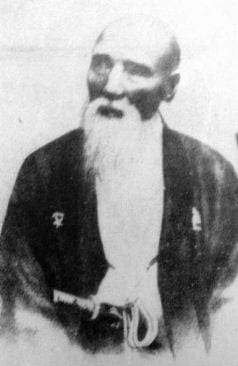
The line that carried Fukui's school to fame is well recorded. He was succeeded by Togasaki Kumatarō Teruyoshi (戸ヶ崎熊太郎暉芳), and the headmastership passed in turn to Okada Jūmatsu Yoshitoshi (岡田十松義利), who taught at a busy Edo dōjō called the Gekikenkan (撃剣館). Among Okada's students was Saitō Yakurō Yoshimichi (斎藤弥九郎善道, 1798–1871), a farmer's son from Echizen who had come to Edo with little and risen through sheer ability. It was Saitō who, in the 1820s, founded the dōjō that would make Shindō Munen-ryū a household name among swordsmen: the Renpeikan (練兵館).
Power at the Renpeikan
By the closing decades of the Tokugawa period the Renpeikan was counted as one of the three great dōjō of Edo, beside Chiba Shūsaku's Genbukan, the home of Hokushin Ittō-ryū, and Momonoi Shunzō's Shigakukan. A saying of the time distributed their virtues neatly: dignity at the Momonoi school, technique at the Chiba school, and power at the Saitō school. That verdict captures what set Shindō Munen-ryū apart. Where other traditions prized refinement, the Renpeikan was known for producing strong, aggressive swordsmen, and Saitō himself was nicknamed for his strength. The school flourished in the politically charged final years of the shogunate, and its hall drew students who would become major figures of the Bakumatsu, among them the Chōshū activist Katsura Kogorō, later known as Kido Takayoshi, who served as a senior student of the Renpeikan.
Technique and training
Shindō Munen-ryū is a comprehensive sword school, with paired kata practised using the wooden sword alongside an iai curriculum for drawing the blade. Its character, though, was shaped as much by how it trained as by the forms it preserved. Like several leading Edo schools of its day, it embraced free sparring with the bamboo shinai and protective bōgu armour, the vigorous contest practice known as gekiken, which let students strike one another at full force. This full-contact training suited a school that valued decisive, powerful cutting over intricate technique, and it is one reason the Renpeikan turned out swordsmen with such a hard, practical reputation.
Into the modern age
The Meiji Restoration of 1868 and the later ban on wearing swords stripped the sword schools of their purpose and their patrons, and many branches of Shindō Munen-ryū closed. The school owes much of its survival to Negishi Shingorō (根岸信五郎, 1844–1913), the last headmaster trained in the Edo line, who opened a dōjō called the Yushinkan (有信館) and taught swordsmanship to the new Tokyo police. It was at the Yushinkan that Nakayama Hakudō (中山博道, 1872–1958), one of the towering figures of twentieth-century kendō and iaidō, studied Shindō Munen-ryū and carried part of its method into the modern budō world. The school survives today as a living koryū through a small number of lines, including one recognised by the Nihon Kobudō Kyōkai, kept up by practitioners who still train the powerful swordsmanship that made the Renpeikan famous.