I have never had much patience for the souvenir-shop version of Bushidō (武士道), pronounced “boo-shee-doh,” usually translated as “the way of the warrior.” You know the one. A stern samurai silhouette against a red sun, a quote about honour that sounds suspiciously like it was written by a motivational speaker in a hotel conference room, and somewhere in the distance the word “discipline” being abused until it begs for death. I understand the appeal. It is clean. It is sharp. It looks good on a black T-shirt. But history is rarely that polite. History arrives with muddy boots, contradictory sources, awkward dates, regional differences, later propaganda, and some poor scholar in a library quietly ruining everyone’s favourite fantasy. Personally, I find that far more interesting. So when I speak about Bushidō, I do not want to worship a myth. I want to look at the thing itself, or at least as close as I can get to it through Japanese sources, and ask what it actually was, when people actually used the word, and why the modern image of it often tells us more about later Japan than about medieval warriors themselves. I am leaning here on Japanese-language historical material: reference entries such as Kotobank’s treatment of 武士道, Bushidō, “the way of the warrior”; Japanese academic papers by scholars such as Taniguchi Shinko (谷口眞子) on Hagakure (『葉隠』), pronounced “Hah-gah-koo-reh,” often translated as “Hidden by the Leaves”; Maeda Tsutomu (前田勉) and others on Yamaga Sokō (山鹿素行) and shidō (士道), “the way of the gentleman-warrior” or “the way of the samurai as a moral social role”; research on kindai Bushidō (近代武士道, “modern Bushidō”) through J-STAGE; digital records from the National Diet Library (国立国会図書館, Kokuritsu Kokkai Toshokan) and the National Archives of Japan (国立公文書館, Kokuritsu Kōbunshokan); and primary or near-primary texts such as Goseibai Shikimoku (『御成敗式目』), the Kamakura legal code often rendered as “Formulary of Adjudications”; Buke Shohatto (『武家諸法度』), the “Laws for the Military Houses”; Kōyō Gunkan (『甲陽軍鑑』), a military chronicle associated with the Takeda tradition; Yamaga Gorui (『山鹿語類』), the collected teachings of Yamaga Sokō; Budō Shoshinshū (『武道初心集』), “The Beginner’s Collection on the Martial Way”; Hagakure Kikigaki (『葉隠聞書』), the recorded sayings behind Hagakure; and Nitobe Inazō’s Bushidō (新渡戸稲造『武士道』). I am saying that plainly because I am not interested in the vague “ancient wisdom says…” fog machine. Ancient wisdom says many things, usually after someone modern has helpfully rewritten it.
The first thing I have to admit is also the first thing that makes people uncomfortable: Bushidō was not an eternal, perfectly formed samurai constitution descending from the heavens sometime in the Heian period with a tasteful cloud effect and a soundtrack of flutes. I know that is disappointing. My condolences to the merchandise industry. The Japanese historical sources make something much less romantic and much more useful clear: before “武士道,” Bushidō, becomes visible as a clear term, warriors used other language. They spoke of things like kyūba no michi (弓馬の道), “the way of the bow and horse”; yumiya no michi (弓矢の道), “the way of the bow and arrow”; and tsuwamono no michi or hei no michi (兵の道), “the way of arms” or “the way of the warrior.” That matters. Words matter. If I call something Bushidō too early, I smuggle a later idea into an older world and then congratulate myself for discovering what I planted there. That is not history. That is gardening with a sword.
When I look at the Heian and early Kamakura background, I do not see a single sacred code called Bushidō. I see the gradual formation of warrior groups, armed specialists, households, military service, local power, land rights, violence, loyalty, ambition, and reputation. I see people learning how to survive in a society where force and legitimacy were constantly negotiating with each other, often with less tea ceremony and more blood than the tourist brochure would prefer. The older Japanese terms point toward practical warrior norms rather than abstract moral philosophy. Riding, archery, service, courage, family reputation, readiness to die if necessary, shame, reward, obedience, calculation. That mixture is already complicated. It does not need a gold frame.
By the Kamakura period, I start to see something more formal. Not Bushidō as a universal moral slogan, but warrior society organising itself through law and custom. Goseibai Shikimoku (『御成敗式目』), issued in 1232 under the Kamakura bakufu (the Kamakura military government), is crucial here. I do not read it as “the Bushidō code,” because that would be lazy, but I do read it as evidence that warrior rule was developing its own legal and moral order. It deals with rights, disputes, inheritance, punishment, procedure, the very unsexy machinery of power. And honestly, that machinery matters more than any poster quote. A society reveals itself not only in its poems about death, but in how it handles property disputes, betrayal, succession, and who gets punished when everyone claims to be honourable. Honour is lovely until there is land involved. Then suddenly everyone becomes a legal philosopher.
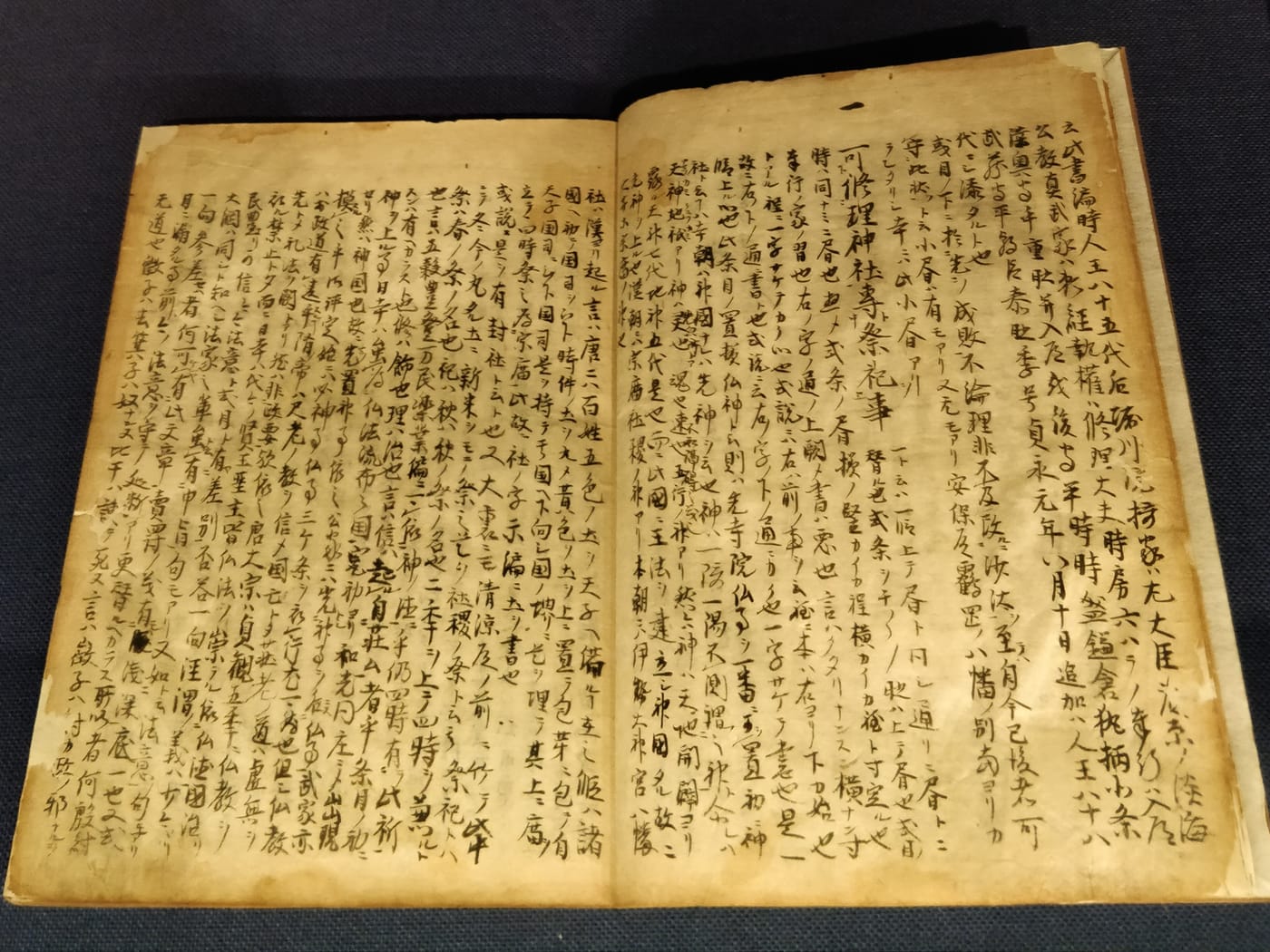
House instructions from the medieval warrior elite, such as the teachings associated with Hōjō Shigetoki (北条重時) also show something important. The warrior ideal was not just about glorious death in battle. It was about discipline inside the household, behaviour, restraint, hierarchy, everyday conduct. That is one of the quiet facts that cuts through the fantasy. The warrior was not expected to live every moment like a tragic hero standing under cherry blossoms waiting to be decapitated poetically. He had to manage a house, serve a lord, control himself, observe rank, avoid disgrace, and function inside a social order. That may sound less cinematic. It is also more historically believable.
Then there is the Muromachi and Sengoku world, where regional warrior houses produced their own house codes and instructions. I find this part especially useful because it breaks the illusion of a single national samurai morality. Different houses, different domains, different political situations, different pressures. Texts associated with Imagawa Ryōshun (今川了俊); Asakura Toshikage (朝倉敏景); Hōjō Sōun (北条早雲); and others show a world of practical ethics: loyalty, military readiness, frugality, administration, suspicion of arrogance, rules for retainers, and a constant awareness that a badly governed house could collapse. This is not soft-focus spirituality. This is survival literature. The Sengoku period (戦国時代), the “Warring States period”, did not reward men for having attractive values printed in calligraphy. It rewarded organisation, discipline, violence, timing, and not being stupid at scale, which, regrettably, remains a rare virtue in politics.
The term 武士道, Bushidō, becomes especially important in connection with Kōyō Gunkan (『甲陽軍鑑』). Japanese research often treats this text as one of the earliest major sources where the word appears visibly and repeatedly. It is connected with the Takeda tradition, with the memory of Takeda Shingen (武田信玄) and his house, and with early Edo military thought looking back on the Sengoku world. But I have to be careful here too. Kōyō Gunkan is not a clean window through which I can simply watch the sixteenth century unfold. Its redaction history is complicated, its reliability has been debated, and Japanese scholars have long discussed its errors and later formation. Still, it matters enormously because it shows how warrior conduct was being remembered, shaped, and named. When it speaks of 武士道, Bushidō, the flavour is still martial. It is close to battlefield service, bravery, fighting performance, what some sources discuss through the language of yaribataraki (槍働き), literally “spear-work,” meaning active battlefield performance, actually doing the work of war, not merely posing beside a sword like an aristocratic coat rack.
This is where I think the modern cliché begins to wobble. If early Bushidō language is tied to battle, service, courage and reputation, then it is not yet the same as the later Edo moralised Bushidō, and it is certainly not the same as the Meiji national morality that eventually gets sold to the world. The word travels. Its meaning changes. That is not a betrayal of tradition; that is what traditions do when human beings get their hands on them. They adapt, mutate, get polished, weaponised, sentimentalised, and occasionally dragged into school textbooks by people who look as if they have never lost an argument because they have never had one.
The Edo period changes everything. The Tokugawa peace is the great awkward fact in the story of Bushidō. What does a warrior class do when there is no large-scale war for generations? It cannot spend two and a half centuries standing heroically in a field waiting for someone to invade. So the samurai had to become something else while still pretending, in some sense, to remain warriors. They became administrators, officials, moral exemplars, domain servants, bureaucrats with swords, and sometimes men trapped between inherited status and actual social function. I find that tension fascinating. It is easy to romanticise the warrior when he is on horseback. It is harder, and much more revealing, to study him when he is doing paperwork.
The opening formula of Buke Shohatto (『武家諸法度』), the Tokugawa “Laws for the Military Houses”, with its famous emphasis on bunbu kyūba no michi (文武弓馬之道), “the way of letters, arms, bow, and horse”, says a great deal. Bun (文), letters, learning, culture, and bu (武), arms, martial force, belong together. Learning and martial discipline. The Tokugawa order did not imagine the samurai merely as a thug with good manners and a sharp object, which, to be fair, would still be an improvement over some modern public figures. The samurai was supposed to cultivate literacy, self-command, etiquette, order, and service. This is one of the reasons Edo Bushidō cannot be reduced to “death.” It was also about life under discipline, daily, repetitive, status-conscious, often suffocating discipline. Death may be dramatic, but daily restraint is where character either forms or quietly goes mouldy.
This is where Yamaga Sokō (山鹿素行) becomes impossible to ignore. His idea of shidō (士道), the way of the shi, meaning the gentleman-warrior or samurai as a moral social figure, discussed in Japanese scholarship by figures such as Maeda Tsutomu (前田勉) and Taniguchi Shinko (谷口眞子), is not simply battlefield ethics. It is a theory of the samurai’s social role. The warrior, or shi (士), has a shokubun (職分), a social function, duty, or proper role, a reason for existing inside the social order. In a peaceful age, that mattered desperately. If farmers farm, artisans make, merchants trade, what exactly does a samurai do when he is not fighting? Sokō’s answer is moral and political. The samurai must govern himself and others. He must be a model. He must embody order. Whether every samurai managed that is another question entirely. I have met enough human beings to know that moral theories often look best before they are asked to survive contact with breakfast.
Still, this Edo transformation is historically central. Bushidō becomes less a raw battlefield habit and more a status ethic. It absorbs Confucian vocabulary. It becomes concerned with hierarchy, duty, education, loyalty, restraint, and the proper conduct of a ruling class. I do not say this to make it sound gentle. A moral code attached to hierarchy is never innocent. It can produce self-mastery and responsibility, yes. It can also produce obedience, rigidity, and beautifully dressed cruelty. That is why I do not want to kneel before Bushidō as if it were pure wisdom. I want to examine it the way I would examine a blade: admire the workmanship, respect the danger, and avoid cutting myself on someone else’s romanticism.
Then comes Kashōki (『可笑記』), a seventeenth-century text often mentioned in discussions of Edo moral Bushidō. What interests me is that its picture of warrior conduct includes honesty, avoiding flattery, not being greedy, not boasting, not being rude, maintaining human relations, showing compassion, keeping giri (義理), duty, obligation, or social-moral responsibility. It even complicates the idea that simply being willing to die makes one a good samurai. That is deliciously inconvenient for the death cult version of Bushidō. Apparently, being an honourable person required more than shouting about death and frightening the neighbours. One had to avoid lying, greed, arrogance and bad manners. Imagine that. A warrior ethic with social intelligence. The internet would never recover.
Of course, I cannot talk about Bushidō without talking about Hagakure (『葉隠』), “Hidden by the Leaves”, because the moment the word appears, someone usually leaps out of a hedge whispering, “Bushidō to iu wa shinu koto to mitsuketari” (「武士道というは死ぬことと見つけたり」), usually rendered as “I have found that Bushidō is to die.” I understand why the line became famous. It is brutal, memorable, almost theatrically final. “I have found that Bushidō is to die.” There it is, sharp as a snapped bone. But if I treat that sentence as the whole of Bushidō, I commit a historical crime with excellent branding. Japanese research, including Taniguchi Shinko’s work on the reception and reinterpretation of Hagakure, makes the context clear. Hagakure Kikigaki (『葉隠聞書』), the recorded sayings behind Hagakure, was connected to the Saga/Nabeshima domain. It was based on the words of Yamamoto Tsunetomo (山本常朝) and written down by Tashiro Tsuramoto (田代陣基) around 1710 to 1716. It circulated in manuscript form for a long time. It was not originally the universal handbook of every samurai in Japan. Its broad modern fame came much later, especially through printed editions and twentieth-century reinterpretation.
That one fact alone should make us pause. The book now treated by many outsiders as the beating heart of all samurai morality was, historically, regional, domain-specific, and later elevated into something far larger. I am not dismissing it. I respect Hagakure deeply as a source. But I refuse to let it bully every other source out of the room. Its obsession with death has to be read in the context of a peaceful Edo domain, of a retainer class struggling with service, memory, loyalty, frustration, and a world in which old forms of ultimate devotion like junshi (殉死), following one’s lord in death, had been prohibited. The famous death sentence is not just a battlefield command. It is an existential discipline, a way of resolving hesitation, a psychological extremity born in peace as much as war. That is darker, stranger, and more human than the usual “samurai were fearless” nonsense. Fearless people are usually either lying, dead, or selling something.
I read Hagakure as a text of tension. It is not simply saying “go die” like an inefficient manager with a sword. It is asking what absolute loyalty means when the world no longer offers the old heroic stage. What does a retainer do with devotion when the age of constant battle has passed? What happens to martial identity in a bureaucratic peace? How does one preserve intensity when one’s actual life may be full of waiting, service, etiquette and domain politics? There is something almost claustrophobic in that. The call to death becomes a way of refusing mediocrity, but also a symptom of a class trapped inside its own ideal. I find that both powerful and troubling. Which is usually a sign that I am near something real.
Daidōji Yūzan’s (大道寺友山) Budō Shoshinshū (『武道初心集』), “The Beginner’s Collection on the Martial Way”, gives me another angle. It is an Edo-period educational text for warriors, often dated around the early eighteenth century, and it concerns daily conduct more than theatrical martyrdom. It is about how a warrior should live, behave, prepare, discipline himself, and avoid disgrace. Again, the historical Bushidō world becomes broader than death. It includes habit. It includes manners. It includes the boring little choices that no one writes poems about because they do not involve arterial spray. And yet those choices form the actual spine of a social ethic. Anyone can praise honour in a crisis. The question is whether one can pay attention, keep one’s word, restrain one’s ego, and not become a pompous little disaster when given rank. The past, I suspect, had as much trouble with this as the present. Humans do like to disappoint elegantly.
Regional differences also matter. I cannot say “the samurai believed” as if Aizu (会津); Satsuma (薩摩); Saga (佐賀); Mito (水戸); Edo (江戸); and every other domain all shared a single brain. Saga’s Hagakure reflects Nabeshima domain culture. Aizu had its own educational ethos through institutions and texts such as Nisshinkan (日新館), the Aizu domain school, and Nisshinkan Dōjikun (日新館童子訓), teachings for children in that educational world, shaping children and retainers through loyalty, learning and discipline. Satsuma’s gōjū kyōiku (郷中教育), local group education, cultivated a more collective, physical, practical warrior ethos. Mito’s Kōdōkan (弘道館) world tied moral cultivation to political and loyalist thought. These are not decorative differences. They change the tone of Bushidō completely. One domain’s ideal retainer is not automatically another domain’s ideal retainer. To flatten all of this into “the samurai code” is not only historically wrong; it is rude to the dead, and the dead have had enough trouble.
Then Meiji arrives and smashes the material foundation of the samurai class. Hanseki hōkan (版籍奉還), the return of land and population registers to the emperor; haihan chiken (廃藩置県), the abolition of domains and creation of prefectures; shimin byōdō (四民平等), equality of the four status groups in the new order; chōheirei (徴兵令), the conscription ordinance; chitsuroku shobun (秩禄処分), the commutation and abolition of hereditary stipends; sanpatsu dattōrei (散髪脱刀令), the order allowing haircutting and voluntary abandonment of swords; haitōrei (廃刀令), the sword prohibition order. These are not tiny administrative details. They are the dismantling of a world. The sword loses its status as the visible privilege of a class. The domain system collapses. Stipends are commuted. Conscription creates a national army that does not depend on hereditary warriors. The samurai as a legal class disappears, and this is where the irony becomes almost indecent: Bushidō becomes louder as the samurai class becomes less real. The body dies, the ghost becomes famous. Very Japanese, very modern, and very convenient for people who need a past to discipline the present.
In Meiji, Bushidō is reborn as national morality. This is not invention from nothing, and I dislike that simplification too. There were real older warrior norms, real texts, real ethical traditions, real memories. But Meiji thinkers selected, rearranged, translated and elevated them. Scholars in Japanese research on kindai Bushidō (近代武士道), modern Bushidō, point to figures such as Shigeno Yasutsugu (重野安繹); Matsumoto Aijū (松本愛重); Naitō Chisō (内藤耻叟); Inoue Tetsujirō (井上哲次郎); and of course Nitobe Inazō (新渡戸稲造). The word begins to serve new needs. Japan is building a modern state, facing Western imperial power, redefining education, military service, moral identity, and international self-presentation. Bushidō becomes useful. Perhaps too useful. Whenever an old virtue suddenly becomes extremely useful to a modern state, I instinctively check where the exits are.
Nitobe Inazō’s Bushidō (新渡戸稲造『武士道』) is the great international turning point. He wrote it in English, published it at the end of the nineteenth century, and explained Japanese moral culture to Western readers. It is elegant, influential, and historically dangerous if handled carelessly. I do not treat Nitobe as a medieval source because he is not one. I treat him as a Meiji intellectual translating Japan for the world, comparing Bushidō to Western moral and religious frameworks, and shaping the global image that many people still carry today. That image is not useless. It tells us a great deal about Meiji Japan, about international anxiety, about identity, about how a nation presents its soul when the world is staring at it with measuring instruments and colonial appetite. But it does not give me direct access to Kamakura battlefields or Sengoku retainers. If I use Nitobe to explain the entire samurai past, I might as well use a Victorian postcard to reconstruct the Roman Empire. Charming, but perhaps not ideal.
Inoue Tetsujirō (井上哲次郎) takes Bushidō in a different direction, binding it more explicitly to national morality. Japanese studies show how he connected Bushidō with Japanese ethical spirit, elevated Yamaga Sokō, and treated warrior morality as a foundation for modern civic and national conduct. This is where Bushidō becomes less the ethic of a class and more the supposed moral bloodstream of a people. That move is powerful. It is also politically loaded. A class ethic transformed into national character can inspire responsibility, courage and sacrifice. It can also become a tool for obedience, exclusion, and state worship. I am not saying every modern use of Bushidō is sinister. I am saying history has a habit of putting sharp ideas into official uniforms, and once that happens, one should pay attention.
By the Taishō and Shōwa periods, the militarisation of Bushidō becomes harder to ignore. Military education, the language of Yamato-damashii (大和魂), “Japanese spirit”; the willingness to abandon life for gi (義), righteousness or moral duty; imperial rescripts; later texts such as Senjinkun (戦陣訓), the “Field Service Code”; and wartime compilations like Bushidō Zensho (『武士道全書』), the “Complete Collection of Bushidō”, show a canon being assembled under pressure. The wartime version of Bushidō did not simply preserve the past. It selected the past, disciplined it, and made it march. That is not the same thing. When Bushidō Zensho opens with imperial and military material alongside older warrior texts, I see the structure of memory being reorganised for war. The medieval retainer, the Edo moralist, the Meiji nationalist and the modern soldier are made to stand in one line and salute. History is rarely so obedient unless someone has been shouting at it.
This is why I resist the lazy modern praise of Bushidō as pure honour. Honour is never pure. It is always attached to a society, a hierarchy, a body, a law, a memory, a fear. For a Kamakura warrior, honour might involve land, service and reputation. For a Sengoku retainer, it might involve battlefield achievement and survival under a lord whose fortunes could collapse by Tuesday. For an Edo samurai, it might mean disciplined conduct within a peaceful bureaucracy, Confucian duty, household order, and the painful maintenance of status. For Meiji intellectuals, it might become Japan’s moral explanation to the world. For Shōwa militarists, it might become a vocabulary of sacrifice. Same word, changing world. If I ignore that, I am not respecting Bushidō. I am embalming it.
And yet I do not want to throw it away either. That would be too easy, and frankly a little smug. There is something in the historical Bushidō traditions that still bites. Not the cartoon version. Not the “real men feel nothing” nonsense, which usually produces men who feel everything and understand none of it. I mean the harder questions. What do I owe to those I serve? What does courage mean when no one is applauding? How do I live under discipline without becoming a servant of cruelty? Can loyalty survive moral judgment, or does it demand the death of conscience? When is self-sacrifice noble, and when is it just a beautiful word for being used? What is the difference between resolve and fanaticism? Between honour and vanity? Between restraint and repression? Between duty and fear wearing formal clothes?
Those questions are why I keep returning to the Japanese sources. Goseibai Shikimoku (『御成敗式目』) reminds me that warrior society was legal and practical, not merely poetic. Medieval house codes remind me that self-control began at home, in the daily discipline of behaviour. Kōyō Gunkan (『甲陽軍鑑』) reminds me that the language of 武士道, Bushidō, emerged in relation to battle memory and martial service, but also that memory itself must be interrogated. Yamaga Sokō’s Yamaga Gorui (山鹿素行『山鹿語類』) and the scholarship on shidō (士道) remind me that the Edo samurai had to justify his existence in peace, which is a rather cruel assignment for a hereditary warrior. Budō Shoshinshū (『武道初心集』) reminds me that ordinary conduct mattered. Hagakure Kikigaki (『葉隠聞書』) reminds me that death, loyalty and service could become absolute ideas inside a domain-specific emotional world. Nitobe’s Bushidō (新渡戸稲造『武士道』) reminds me that modern Japan translated Bushidō for outsiders, and in doing so changed the thing being translated. Inoue Tetsujirō and later military sources remind me that moral traditions can be conscripted. They do not always volunteer.
So when someone says “Bushidō means honour,” I want to ask, “Which century?” When someone says “Bushidō means loyalty,” I want to ask, “To whom, under what law, and at what cost?” When someone says “Bushidō means death,” I want to ask whether they have read Hagakure in context or merely met one sentence in a dark alley and decided to marry it. When someone says “Bushidō is the soul of Japan,” I want to ask whether they mean Nitobe’s Meiji-era international argument, Edo status ethics, medieval warrior custom, wartime ideology, or a gym poster next to the protein powder. These distinctions are not pedantic. They are the difference between thought and theatre.
I also think Bushidō became powerful precisely because it was never one simple thing. If it had been a neat legal code, fixed and limited, it might have stayed in archives. Instead it was flexible. It could mean battlefield courage, household discipline, lord-retainer devotion, Confucian role ethics, national character, military sacrifice, personal self-mastery. That flexibility made it rich. It also made it easy to abuse. A word that can carry courage can also carry coercion. A tradition that can teach restraint can also teach silence before injustice. A code that praises loyalty can make betrayal shameful, but it can also make moral refusal almost impossible. That is the blade again. Beautiful. Useful. Dangerous. Not something to wave around after two inspirational podcasts and half a whisky.
My own view is that Bushidō becomes most meaningful when I stop asking it to be pure. I do not need it to be ancient in the fake sense. I do not need every samurai from the Heian period onward to have believed the same thing. I do not need a single code carved into stone. The real history is stronger than the myth because it shows human beings adapting ideals to changing conditions. Warriors became rulers. Fighters became administrators. Regional house ethics became printed moral instruction. Domain texts became national symbols. A Meiji book written in English became the world’s doorway into an idea that was already layered, contested and unstable. That is not weakness. That is history breathing.
And yes, I know some people prefer the clean myth. I can almost hear them sighing into their replica swords. But I think the mess is the point. The mess is where the truth lives. Bushidō was never only about noble death. It was also about law, land, class, bureaucracy, education, masculinity, memory, propaganda, grief, pride, restraint, fear, and the desperate human desire to make violence look meaningful. That last part matters. Warrior cultures everywhere have to solve the same terrible problem: how to make killing, dying, serving and obeying into something morally bearable. Bushidō was one Japanese answer, or rather several Japanese answers across several centuries. Some were admirable. Some were frightening. Some were both, which is usually how serious things behave.
If I take anything from Bushidō now, I take it with suspicion and respect together. I admire courage, but I do not worship death. I respect loyalty, but not when it demands blindness. I value discipline, but not the kind that turns a person into furniture for authority. I understand honour, but I know how easily honour becomes vanity with a family crest. I like restraint, but not emotional cowardice dressed as dignity. I believe in service, but I reserve the right to ask whether the lord deserves serving. That may be rebellious, but frankly any code worth studying should be strong enough to survive a few impolite questions.
So I will not bow to the cardboard Bushidō of slogans. I will bow, perhaps, to the archive: to the old legal codes, the house rules, the military chronicles, the Edo treatises, the Saga manuscripts, the Meiji translations, the Japanese scholars who patiently separate source from legend while everyone else is busy polishing the myth. I will bow to complexity. Not too deeply, mind you. One mustn’t encourage it. But enough to acknowledge that the real Bushidō is not a museum sword under perfect light. It is a layered historical argument, forged and reforged by warriors, bureaucrats, scholars, nationalists, soldiers, translators and readers. If that makes it less simple, good. Simple things are often dead things. Bushidō, inconveniently, is still alive enough to argue with us. And I would rather argue with the living truth than salute a beautiful lie.
For readers who want to know exactly which Japanese sources I am leaning on, I would name them openly rather than hide them behind the usual mist of “tradition.” I am drawing from Kotobank’s Japanese reference entry on Bushidō (武士道); the National Diet Library (国立国会図書館) records for texts such as Nitobe Inazō’s Bushidō (新渡戸稲造『武士道』) and Budō Shoshinshū (『武道初心集』); the National Archives of Japan (国立公文書館) materials on Goseibai Shikimoku (『御成敗式目』) and Buke Shohatto (『武家諸法度』); Saga Prefectural Library manuscript records for Hagakure Kikigaki (『葉隠聞書』); Japanese academic work by Taniguchi Shinko (谷口眞子) on the later reading and reinterpretation of Hagakure; Maeda Tsutomu (前田勉) on Yamaga Sokō’s shidōron (山鹿素行の士道論), meaning his theory of samurai moral role; J-STAGE studies on kindai Bushidō (近代武士道) and the modern transformation of warrior ethics; and Japanese studies of Inoue Tetsujirō (井上哲次郎) and wartime compilations such as Bushidō Zensho (『武士道全書』). I am not pretending those sources all say the same thing. That would defeat the point. I am saying they let me follow the historical trail from older warrior languages like kyūba no michi (弓馬の道) through medieval law, regional house discipline, Edo moral theory, Hagakure’s domain-specific intensity, Meiji national reinterpretation, and finally the modern world’s rather dramatic habit of turning Bushidō into whatever it needs at the time. History, bless it, refuses to behave like a slogan.