I keep seeing the same romantic little bedtime story about “Japanese warfare” being all noble duels, clean blades, poetry in the moonlight, and two men politely agreeing to die for art. And I get it. It’s comforting. It’s cinematic. It’s merch-friendly. But it’s also… not how war works. Not in Japan. Not anywhere. And the older I get, the more allergic I become to the glossy, exported version of history that was sanded down until it could be sold to tourists and Facebook pages that think “bushidō” is a personality type.
If you want the real spine of Japanese warfare (pre-modern, historical, not WWII) you have to start by swallowing one hard truth: Japanese warfare was never obsessed with “fairness.” It was obsessed with control. With preventing chaos. With ending things before they became unmanageable. The battlefield wasn’t a stage. It was an accounting problem with blood on it. The moment you understand that, everything that follows starts to make brutal sense.
Early Japan didn’t magically wake up as “samurai Japan.” That image is late. Before the famous warrior class became the brand, there were courts trying to govern a difficult landscape, borrowing military ideas from the continent, experimenting with conscription, struggling to project power into provinces that didn’t particularly care about imperial elegance. People love to pretend Japan was always some isolated universe with its own pure martial destiny. No. Japan watched, borrowed, adapted, discarded. That’s what serious cultures do when they want to survive.
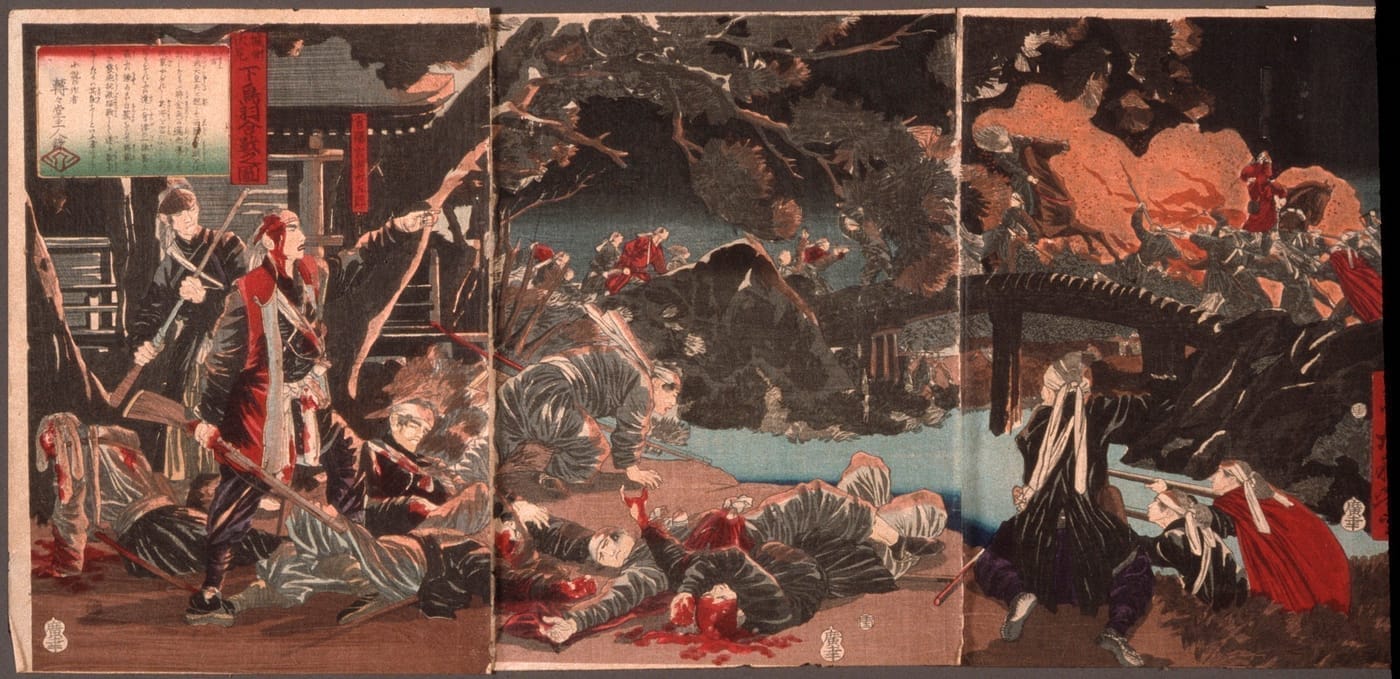
Then the center weakened and the provinces grew teeth. The warrior wasn’t born out of honour; he was born out of necessity. Land needed protecting, rivals needed discouraging, rebellions needed crushing, roads needed controlling. And when your government can’t do that with bureaucracy, it does it with men who can ride, shoot, and kill. That is basically the origin story of the samurai, less “noble calling,” more “local enforcement with a bow.”
By the time we reach the late Heian world and the big clan wars, we start getting the famous war tales, full of heroic names and dramatic challenges. People read those and assume that’s how it happened. But war tales are literature. They’re identity-making. They are not CCTV footage. The reality underneath was messier: raids, ambushes, sudden attacks, opportunism, betrayal when it served survival. Not because the warriors were uniquely immoral, because war punishes idealism. You can love honour all you want; arrows don’t care.
Then comes the Kamakura period and Japan gets slapped in the face by a foreign reality check: the Mongol invasions. And this is where the myth really starts trembling, because the invaders didn’t play the Japanese script. They came in disciplined formations, using tactics that weren’t built around individual posturing. They advanced like a machine. There’s something almost darkly funny about the way some Japanese accounts describe the shock, warriors expecting a ritual challenge, and instead getting massed attack, noise, bombs, and relentless forward motion. It’s the moment you realise that “honour culture” collapses fast when someone else refuses to perform it.
Japan survives that invasion partly through preparation, partly through fighting, and yes, partly through weather. But what it also learns is this: if you want to defend a society, you need coordination, logistics, walls, planning. Not just brave men. Bravery is common. Organisation is rare.
And then, because history has a sense of humour, Japan spends centuries tearing itself apart anyway.
The Muromachi era sliding into Sengoku is where warfare stops being a knightly hobby and becomes a full-body industry. And this is the part people either don’t know or don’t want to know because it wrecks the fantasy. You don’t get “heroic single combat” when you have tens of thousands of men on a field, when you have supply trains, when you have ashigaru drilled to move as units, when you have commanders who win by starvation rather than swordsmanship.
This is where the ashigaru matter. I’m always watching people worship the “samurai” while ignoring the mass of men who actually made the wars possible. Ashigaru are the uncomfortable truth in armour: warfare wasn’t just elites on horseback, it was bodies. Labour. Feet. Discipline. Spears in a wall. Men who were not born into poetry and privilege, but who learned quickly because the alternative was dying even faster.
And then firearms enter the chat and the romantic story practically bursts into flames.
The gun didn’t “end the samurai.” That’s another lazy slogan. What it did was force Japanese warfare to reveal its real priority: efficiency. The matchlock wasn’t elegant. It wasn’t spiritual. It was loud, smoky, temperamental in rain, and brutally democratic. It didn’t care if you were a famous line of ancestral warriors or a farmer handed a weapon and told to aim. It changed armour. It changed formations. It changed morale. It changed castles. And it proved, again, that the core of warfare is not aesthetics. It’s outcomes.
The famous battles people quote, like Nagashino, are not interesting because “guns beat swords.” They’re interesting because they show planning beating ego. Barriers. Terrain. Timing. Rotating fire. The kind of boring, methodical discipline that gets written out of legends because it doesn’t sparkle. But it wins. And victory is the only glitter war recognises.
Now, let’s talk castles, because the castle is another place where the fairytale version dies. Japanese castles aren’t just pretty landmarks for tourists to buy keychains. They’re machines. They’re landscape weapons. They’re built to exhaust you physically and mentally. Narrow approaches, twisting routes, multiple gates, angles that expose you, spaces designed to funnel you into death. A proper castle isn’t a “last stand” backdrop. It’s a message to anyone thinking of rebellion: you will pay for every metre. And you might not even reach the wall.
And if you want to understand the genius, and cruelty, of Japanese warfare, you look at siege strategy. Because siege warfare is where honour goes to die. You don’t need grand duels to break a domain. You cut off food. You take peripheral forts. You isolate supply routes. You apply pressure until surrender looks like mercy. That’s how the big unifiers operated: Nobunaga, Hideyoshi, Ieyasu. Not as romantic heroes, but as men who understood that war is a system, and systems can be strangled.
Hideyoshi in particular understood something that modern people still don’t: psychological warfare isn’t about being theatrical. It’s about being inevitable. The “overnight fortress” stories, whether you take every detail literally or not, capture the point: create a situation where the enemy feels smaller than your momentum. Make resistance feel pointless. That is warfare. Not sword twirls. Not speeches. The feeling of being trapped by someone else’s ability to plan.
And then, after all that blood, Japan does something that looks almost unbelievable: it stops. Tokugawa peace locks the country down, starves the daimyō of the freedom to play warlord, turns the warrior class into administrators, and forces violence to become regulated, ritualised, controlled. This is where the emotional irony kicks in: bushidō becomes loudest when the battlefield goes quiet.
That’s the part I always want to scream at people who treat bushidō as if it fell from heaven in the 1100s, fully formed, like a sacred instruction manual. No. The “way of the warrior” is not a timeless single code. It is an evolving story the warrior class told about itself, especially when it needed a reason to exist without war. Edo era bushidō is a moral framework as much as a martial one, shaped by Confucian order, social discipline, and the need to make samurai useful in a society that no longer required them to kill daily. It doesn’t make it fake. It makes it human. Ideals always harden in peacetime because in wartime they get tested and snapped.
So when someone tells you Japanese warfare was “honourable,” I always want to ask: which century are you talking about, and whose honour? The lord who demanded loyalty? The retainer who wanted land and status? The ashigaru who wanted to eat? The peasant whose field got burned to deny supplies? War doesn’t distribute virtue evenly. It distributes consequences.
And this is why I keep coming back to Japan as a warfare study, because it’s one of the clearest mirrors for how societies mythologise violence after they survive it. Japan didn’t uniquely invent honour, or uniquely invent brutality. What it did (brilliantly, terrifyingly) was build warfare around structure. Around obedience. Around the management of fear. Around the containment of chaos. And when it finally achieved stability, it wrote the story backward until the violence looked cleaner than it ever was.
That’s not me “hating” on Japan. It’s me respecting it enough to refuse the cartoon version.
Because if you strip away the cosplay and the modern propaganda, Japanese warfare is not a fairy tale about noble swordsmen. It’s a long, shifting argument about power: who holds it, how they keep it, how they break others, how they feed armies, how they turn landscapes into weapons, how they force order in a country where order was never guaranteed.
History is not a comfort blanket. It’s a blade that shows you what humans are capable of when they’re organised, threatened, ambitious, terrified… and very, very clever.