There’s something cruelly poetic about the way Japan approaches death. Not death itself - death is usually messy, loud, humiliating, inconvenient, and very rarely cinematic unless someone in the background is playing shamisen music for dramatic effect - but the moment just before it. That suspended breath. That final tightening of thought. The strange calm that sometimes arrives when a human being realizes the road has finally ended and there are only seconds left to decide what kind of ghost they intend to become. The tradition is called jisei no ku - the “death poem,” though even that translation feels too tidy for what it really is. Samurai wrote them. Monks wrote them. Emperors too, because apparently even absolute rulers eventually discover mortality has terrible customer service. A few lines. A final verse. A measured resignation from the world before silence closes its fist around the throat.
But I think people misunderstand these poems when they reduce them to aesthetic relics framed behind museum glass beside some politely tragic cherry blossoms. They were never just about beauty. Beauty was almost incidental. The real core of a jisei was control. Precision. Defiance. The ability to stand on the threshold of annihilation and still say: no, this part belongs to me. These words are mine. If I vanish, I decide the final shape of my own voice.
That idea runs deep through Japanese thought - impermanence, awareness, the Buddhist understanding that everything dissolves eventually whether we approve of it or not. It demands presence. Brutal presence, actually. You cannot write a true death poem while bargaining with reality. You cannot do it while pretending tomorrow is guaranteed. To write one properly means looking directly into the dark without flinching, without theatre, without comforting little lies about destiny or fairness or cosmic reward systems. And frankly, most people cannot do that. Most people can barely answer emails without emotional collapse. Facing death honestly is another category entirely.
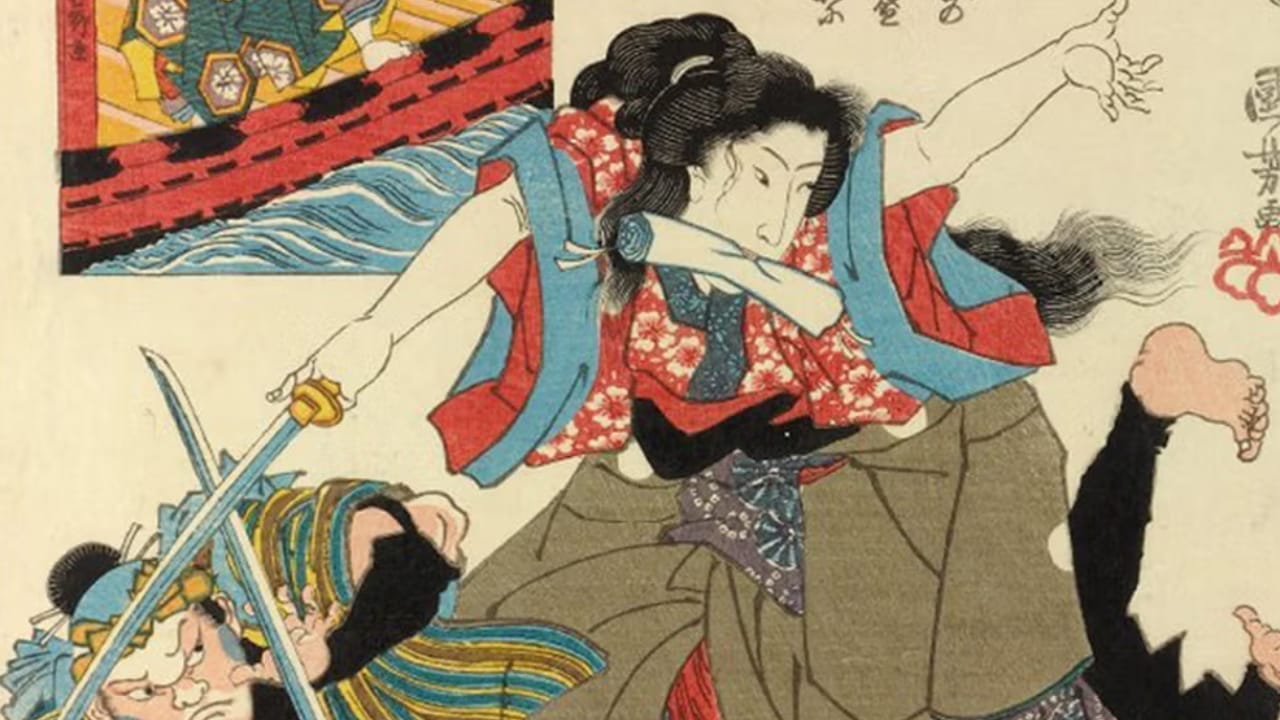
Which is precisely why Nakano Takeko fascinates me so much. Not simply because she fought. History is full of fighters. Men especially seem endlessly enthusiastic about documenting every occasion on which they hit each other with sticks. No, what grips me is the fact she wrote a death poem despite existing in a system that was never truly designed to acknowledge her existence in the first place. That changes everything.
She was not officially recognized as a soldier. Her unit existed in that uncomfortable grey zone history loves creating around women who become inconveniently competent during wartime. Useful when desperate circumstances arise. Forgettable the moment the smoke clears. There would be no formal military recognition waiting for her. No grand institutional mourning. No secure place in the records. If she died, the machine would continue forward exactly as before. Dirt. Blood. Silence. Administrative indifference wearing ceremonial clothing.
Unless she left something behind first.
And she did.
One poem.
Not for decoration. Not for literary applause. Certainly not for the comfort of future academics carefully adjusting their glasses while discussing “female martial symbolism” over green tea and conference funding. She wrote it because she understood exactly what history does to people like her when nobody nails their voice down before the erasure begins.
And what she left behind is extraordinary precisely because it refuses softness.
Her jisei lacks the gentle surrender people expect from death poetry. No drifting blossoms. No elegant moon imagery floating across still water while someone expires beautifully in poetic moonlight. Real death is usually less cooperative than that anyway. Takeko’s poem is sharp. Direct. Controlled. It sounds like someone tightening their grip on a weapon rather than releasing it. Which makes perfect sense considering she literally tied the poem to her naginata before entering battle. Honestly, if that image alone does not hit someone directly in the spine, I do not know what to tell them.
This was never meant to fit comfortably into the polished canon of samurai poetry. It was written to survive. To testify. To leave a scar.
That matters.
Because poems like this are dangerous to systems built on selective memory. This is not the kind of verse institutions enjoy displaying too prominently. It does not flatter power. It does not reassure anyone. It refuses obedience in the most controlled and disciplined way imaginable. And every part of it - the phrasing, the structure, the choice of words - pushes back against the silence waiting to swallow her.
So I cannot approach this poem like a detached scholar pretending emotional neutrality while dissecting historical tissue samples. That feels dishonest. I approach it the way one approaches a weapon unearthed from a battlefield. Carefully. Respectfully. Aware it still cuts.
And it begins like this.
She did not write it for applause. She did not write it to become inspirational wall art shared by people named Karen beside sunrise yoga photos. She wrote it because death was approaching and she intended her words to strike harder than the bullet that eventually killed her.
もののふの 猛き心にくらぶれば 数にも入らぬ 我が身ながらも
Mononofu no Takeki kokoro ni kurabureba Kazu nimo iranu Wagami nagaramo
That is the real poem. Not a romanticized reconstruction. Not a theatrical adaptation invented later by people addicted to historical perfume and dramatic violin music. Those are her actual words. And once you stop filtering them through generations of overly polite translation, they become almost frightening in their clarity.
Most standard translations render it something like:
“When compared to the ranks of warriors’ stalwart hearts, I cannot enter into their number, despite this body of mine.”
And honestly? I hate that translation.
Not because it is technically inaccurate in every sense, but because it reshapes her voice into something smaller. Softer. More apologetic. It drapes silk over steel. It turns a blade into an apology note. Suddenly she sounds timid. Regretful. Like someone sadly acknowledging exclusion instead of someone staring directly at exclusion and walking forward anyway.
That difference matters enormously.
Take the opening phrase: mononofu no.
People casually translate mononofu as “warrior,” but that strips away the weight embedded inside the word. This is not generic battlefield terminology. It evokes the mythic samurai class itself - hereditary warriors, male legacy, banners, hierarchy, bloodline, official recognition. It is loaded with centuries of masculine military identity. Takeko chooses that word deliberately. She invokes the established warrior order directly before positioning herself against it.
That alone is already provocative.
Then comes takeki kokoro ni kurabureba.
“When compared to their fierce hearts.”
Fierce. Not noble. Not honourable. Fierce. The word takeki carries heat. Violence. Intensity. It evokes the kind of spirit capable of running directly into gunfire without hesitation. And notice what she does not do here. She never explicitly says she lacks such a heart. She simply creates the comparison. Here are the officially recognized warriors with their fierce hearts. And here am I.
Then the line that detonates the entire poem:
Kazu nimo iranu.
“I am not even counted among them.”
Not “I wish to join them.” Not “I fail to qualify.” Simply this devastating recognition: I am not included in the number.
That line is merciless because it is factually true.
She and the women fighting beside her were not formally acknowledged military personnel. They existed outside the official count. Outside institutional legitimacy. Outside the neat administrative framework history prefers. If she died, no proper tally would fully account for her. No clean military record would comfortably contain her sacrifice. She understood this perfectly.
And yet she went anyway.
That is where the final phrase strikes hardest:
Wagami nagaramo.
“And yet this body of mine…”
The phrasing is astonishingly restrained. No dramatic explanation. No self-pity. No gendered pleading. She does not even explicitly mention being female. She simply refers to this body - mine. The body not recognized. The body excluded from the count. The body history does not know where to file properly.
And still it moves forward.
When stripped of ornamental translation, the meaning becomes brutally simple:
“When I compare myself to the fierce hearts of warriors, I know I am not counted among them. And yet this body still goes.”
That is not surrender.
That is confrontation.
What devastates me most is not what she says, but what she refuses to say. She never asks permission. Never begs acceptance. Never requests validation from the system excluding her. She acknowledges the exclusion with perfect clarity and then proceeds toward death regardless. Calmly. Deliberately. Like someone adjusting their grip before impact.
There is nothing modest about that.
And frankly, I think generations of translators panicked slightly when faced with the full force of it. So they softened her. Made her sound tragic rather than dangerous. They translated her through pity because they were uncomfortable translating her through defiance. They wanted her to sound wistful instead of tactical. Like she longed to belong among the warriors rather than recognizing she already stood among them regardless of bureaucratic recognition.
But this poem does not say, “Please let me in.”
It says, “Whether you count me or not, I am already here.”
That changes everything.
She tied those words to her weapon and entered battle fully aware history might attempt to erase her afterward. So she ensured her voice would become harder to erase than her body. Every syllable feels engineered for survival. No wasted ornament. No sentimental decoration. Just pressure. Precision. Intent.
And somehow people still misread it.
They interpret it through shame. Through femininity. Through this exhausting tendency to force powerful women into narratives of graceful suffering because apparently history becomes nervous whenever women sound too sharp while holding weapons. They want her brave but not disruptive. Poetic but not dangerous. Admirable but still digestible.
But Takeko is not digestible.
Her poem is cold steel wrapped in disciplined language.
And I understand that instinctively. Personally. Probably too personally, if I am honest. Because I know exactly what it feels like to stand in places where your existence itself seems to irritate the structure around you. To not be formally welcomed. To not fit the expected category. To hear your name omitted, dismissed, questioned, reduced - and still continue forward anyway because stopping would feel spiritually dishonest.
That is why this poem feels so modern despite belonging to another century.
People assume exclusion always arrives dramatically. Sometimes it does. But more often it arrives quietly. In omissions. In not being counted. In being treated as adjacent rather than central. Supplemental rather than legitimate. Decorative rather than dangerous. And over time that invisibility becomes its own form of violence.
Takeko understood that violence intimately.
So she answered it with control.
She chose not to scream. Not to plead. Not to perform tragedy for future audiences hungry for noble suffering. She simply documented reality with terrifying precision: you do not count me, and yet I still advance toward you.
That line is explosive once you truly absorb it.
Not soft. Not elegant. Explosive.
A perfectly measured middle finger delivered in classical poetic rhythm. Which, honestly, is perhaps one of the most Japanese forms of rebellion imaginable. Quiet enough to appear disciplined. Sharp enough to leave permanent damage.
And I think that is why the poem still breathes centuries later.
Because this is not merely about historical remembrance. It is about consequence. About what happens when someone the system refuses to fully acknowledge continues moving forward anyway until reality itself is forced to adapt around them.
You carry a poem like this differently after understanding it properly.
You carry it when your name gets skipped. When someone tells you to wait your turn. When institutions quietly imply you are adjacent rather than essential. When you are informed - politely, of course, because systems adore polite cruelty - that you do not quite fit the category required for recognition.
And then you answer anyway by continuing.
That is the real heartbeat of her jisei.
Not “remember me.”
Never that.
It is closer to: “You may refuse to count me, but you will still face the consequences of my existence.”
That is a completely different kind of power.
I have seen people talk about strength as though it only becomes real once externally validated. As though legitimacy arrives through acceptance. But the strength embedded in Takeko’s poem operates differently. It does not wait for permission. It sharpens in exclusion. It becomes more dangerous precisely because it is denied comfortable recognition.
She did not need the system to certify her before entering battle.
She entered anyway.
And centuries later we are still repeating her words while the institutions that overlooked her crumble quietly into dust around them.
There is something deeply satisfying about that, I admit. Perhaps a little wickedly satisfying. History occasionally develops a sense of humour after all. Dry, patient, slightly vindictive humour. My favourite kind.
Because in the end, her voice survived precisely because she understood she might not.
That awareness shaped every line.
And when I read her poem, I do not simply admire her. I hear her. I hear someone standing at the edge of erasure and responding with movement instead of surrender. Someone recognizing the count excludes her and deciding the count no longer matters.
I understand that instinct.
Deeply.
No matter how many doors remain closed. No matter how often categories fail to include me properly. No matter how many times someone somewhere insists I should stay smaller, quieter, easier to classify, easier to dismiss -
I still come.
And so does her voice.