Higo Ko-ryū (肥後古流) is a classical Japanese tradition of the naginata (薙刀), the long polearm with a curved blade, kept alive in the old Higo domain (肥後), the country of present-day Kumamoto on the southern island of Kyūshū. Its name means simply the old school of Higo, and it is counted among the classical naginata lines that survive into the present chiefly through demonstration rather than as large teaching organisations. Of the surviving naginata traditions it is one of the hardest to document in English, and much of what follows is set down plainly as tradition rather than as established fact. The name is shared, confusingly, with a Kumamoto tea-ceremony tradition; this article concerns the naginata school alone.
The naginata and the Higo domain
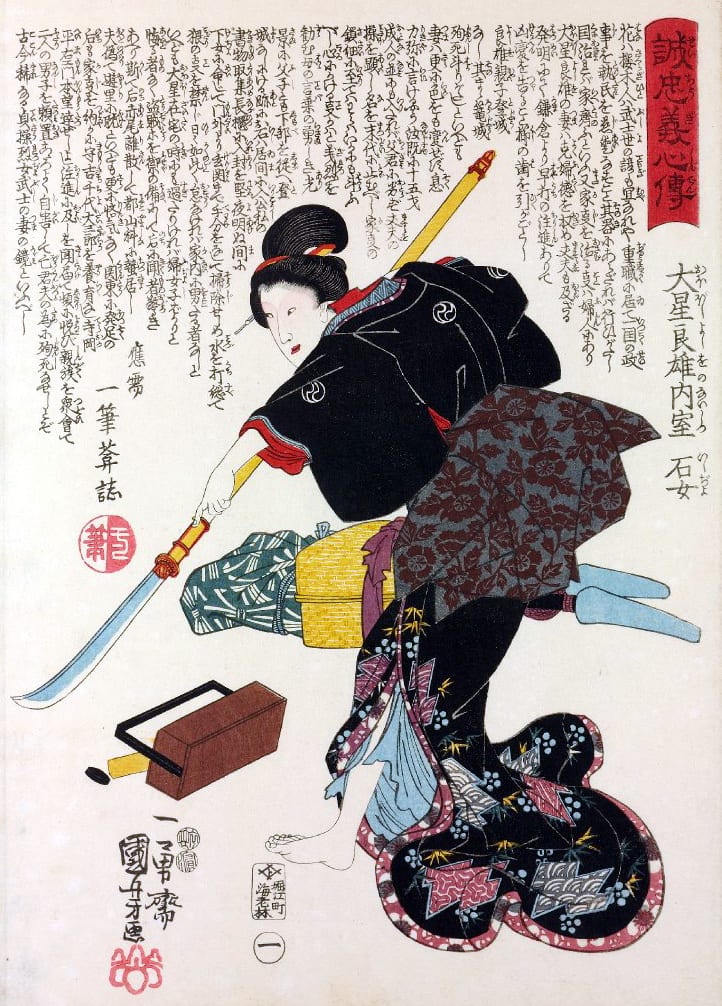
The naginata is one of the oldest of the Japanese long weapons: a curved blade mounted on a long wooden shaft, swung in wide arcs and used to cut, sweep and thrust at a distance the sword cannot reach. In the medieval wars it was a weapon of foot soldiers and of the warrior-monks, and the literary tradition, above all the Tale of the Heike, fixed it in the imagination through the figure of Tomoe Gozen, the woman warrior said to have fought with one; that famous image belongs to legend and literature rather than to documented record. Higo, the domain ruled from Kumamoto castle by the Hosokawa house after 1632, was a serious centre of martial study, and several classical arts took root there, the best known being the two-sword swordsmanship that Miyamoto Musashi taught in his last years. A naginata tradition under the name Higo Ko-ryū is recorded among the martial lines of this region, though the precise circumstances of its founding are not clearly preserved in the sources available outside Japan.
The whole advantage of a long weapon is its length; the forms exist to teach how to keep an opponent at the end of it.
A school of uncertain origins
The honest difficulty with Higo Ko-ryū is that its earliest history is thin. The standard Japanese reference to the koryū, the Bugei Ryūha Daijiten, records the school as a naginata line of the Higo country, but a securely dated founder and an unbroken early succession are not something the accessible record will supply. Where a school's own tradition offers a founding story, it deserves to be set down as tradition and no more, because outside the line there is little against which to test it. This is the ordinary condition of the smaller regional koryū, whose first generations usually stand half in shadow, and it is more honest to say so than to dress a thin record in false certainty. What can be said with more confidence is modest but real: that a naginata tradition bearing this name was carried within the Higo domain, and that it has been handed down far enough to take its place among the classical naginata schools recognised today.
The naginata as a women's art
The naginata's later history is bound up with women, and that shift is well documented even where the particular schools are not. As the long peace of the Edo period wore on and the weapon faded from the battlefield, the naginata came to be associated above all with the women of the samurai households, who were expected to be able to defend the home with it, so that a naginata often formed part of a daughter's dowry. After the Meiji Restoration the art was carried further into the world of women through the schools, where naginata practice was taught to girls as physical education well into the twentieth century. Like the other surviving naginata lines, Higo Ko-ryū is today transmitted largely, though not only, by women, and its public appearances sit within a naginata community that is overwhelmingly female. The image many people carry of the naginata as a woman's weapon is, in this later period, close to the truth.
What the school preserves
What a classical naginata school transmits is a set of paired forms, kata, in which two practitioners take fixed roles and work through prearranged exchanges. The naginata is handled with both hands well apart on the shaft, and the art turns on the reach and the sweep of the long weapon: wide cuts at the head, the shins and the body, thrusts driven from distance, and the spinning of the shaft to bring either the blade or its butt-end into play. Footwork and the management of distance matter more here than in many sword schools, because the whole advantage of the weapon is its length, and a forms practice exists to teach how to keep an opponent at the end of it. The detailed curriculum of Higo Ko-ryū is not well described in English, and it would be wrong to claim a precise knowledge of its kata; what can be said is that it preserves its own forms within this shared family of naginata technique.
In the modern naginata world
The naginata survived the upheavals of the twentieth century in two related forms. From the classical schools, above all Tendō-ryū and Jikishinkage-ryū, came the material from which a standardised modern naginata was built, governed since 1955 by the All Japan Naginata Federation (全日本なぎなた連盟, Zen Nihon Naginata Renmei). Alongside this competitive and educational naginata the older koryū continued, and they appear at demonstrations where the classical forms are shown rather than scored. Higo Ko-ryū is named among the classical naginata lines that take part in this demonstration culture, which is the main way an outsider is likely to encounter it. Its present-day organisation, its current teachers and the size of its following are not, however, clearly documented in sources reachable in English, and it would be dishonest to state them with confidence.
What can honestly be said
Higo Ko-ryū is best described modestly: a naginata tradition of the Higo country, of uncertain and lightly documented origin, surviving into the present among the classical schools that keep the old forms of the weapon alive. Its deeper history rests largely on tradition and on its appearance in the standard reference works, and the reliable detail thins quickly the further back one looks. That is not a reason to ignore the school, but it is a reason to write about it carefully. The honest account is of a regional naginata line that has endured, whose forms are still shown, and whose full story is better preserved in Kumamoto than in anything yet available to a reader working in English.