Kashima-Shintō-ryū (鹿島新當流) is a classical school of Japanese swordsmanship founded in the sixteenth century by Tsukahara Bokuden (塚原卜伝, 1489–1571), one of the most celebrated swordsmen of his age. It grew out of the ancient martial tradition of the Kashima Shrine in Hitachi province, and it is still transmitted today in Kashima, close to where it began. Much of what is told of Bokuden is later legend, but he was a genuine historical figure, and the school that carries his teaching has an unusually long and continuous home.
Tsukahara Bokuden
Bokuden was born into the Yoshikawa family, hereditary priests of the Kashima Shrine, and was adopted into the Tsukahara family, from whom he took his name. He lived through the wars of the Sengoku period and built a reputation as a swordsman of the first rank, undertaking the long training journeys, the musha shugyō, by which warriors of the time tested and refined their skill. Tradition credits him with surviving many duels and battles and with teaching swordsmanship at the highest level, including, it is said, the thirteenth Ashikaga shōgun, Yoshiteru. The detail of these accounts comes largely from later writings rather than from contemporaneous record, and the more dramatic claims, the exact tally of duels won and men killed, the boast that he was never cut in a duel, are best read as the heroic biography of a famous man rather than as documented fact. What can be said with confidence is that a swordsman of this name lived, was respected in his own time, and left a tradition behind him.
Mutekatsu, winning without fighting: the highest skill is the victory that needs no cut.
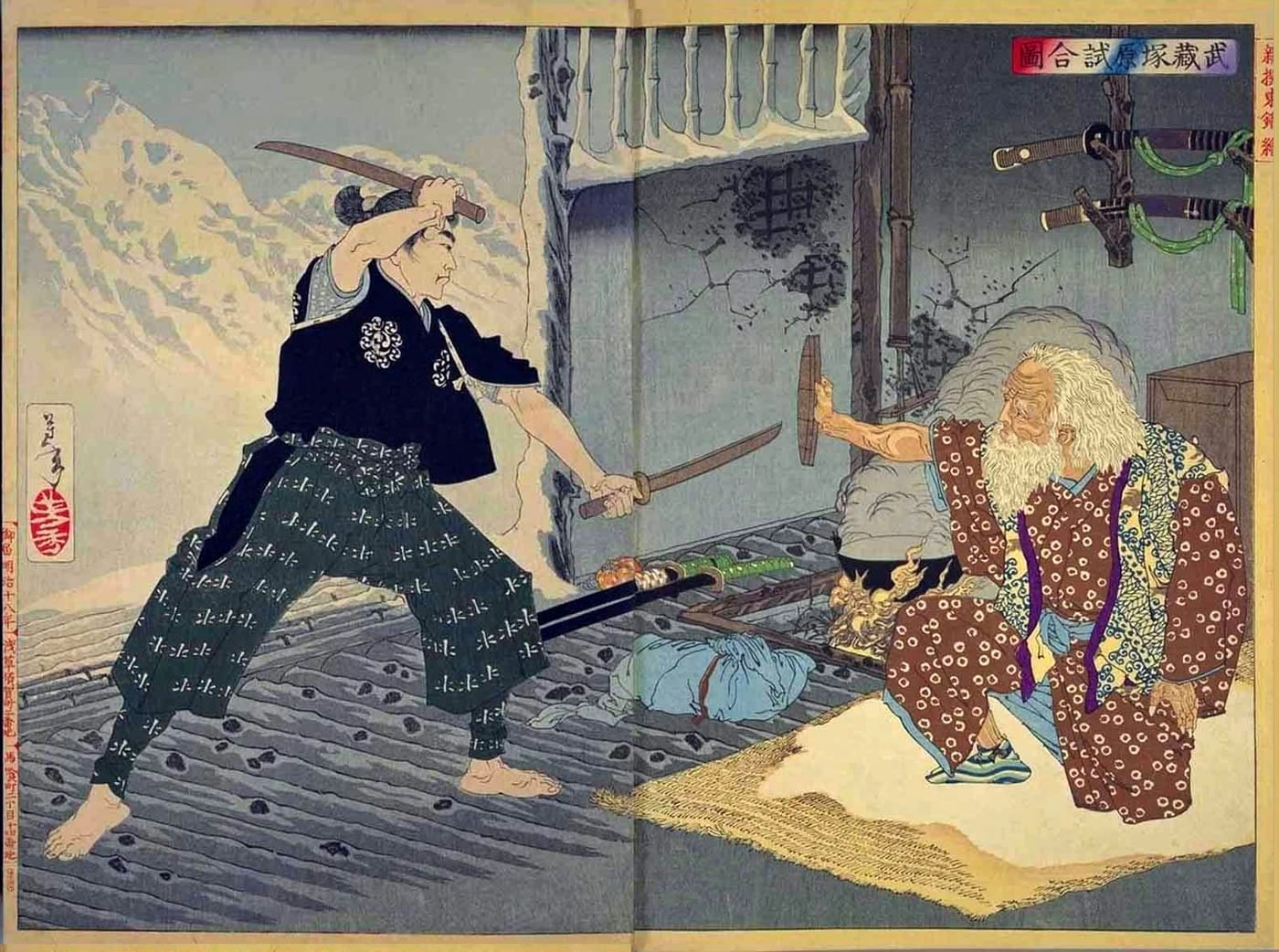
The Kashima tradition
The roots of the school lie in the sword tradition associated with the Kashima Shrine, one of the oldest centres of martial practice in Japan, often referred to as the Kashima-no-tachi. Bokuden learned this tradition through his family, and the accounts also connect him to the Katori sword tradition transmitted at the nearby Katori Shrine, the source of Tenshin Shōden Katori Shintō-ryū. From these older methods he shaped his own system, which he called Shintō-ryū (新當流), written with characters distinct from the Katori school of the same spoken name. Because of this shared root, Kashima-Shintō-ryū stands beside the other Kashima schools, such as Kashima-Shin-ryū, as one branch of a single regional martial culture rather than an isolated invention.
The hitotsu no tachi
At the heart of the school is a teaching known as the hitotsu no tachi (一の太刀), the "one stroke" or "single sword", a decisive cutting technique that Bokuden is said to have arrived at after a period of seclusion and prayer at the Kashima Shrine. In the tradition it represents the essence of the whole art reduced to a single perfected action, and it was transmitted only to a small number of senior students. The surrounding curriculum is built from paired sword forms practised with the wooden sword, emphasising timing, distance and the composure to act decisively at the right moment. As with much in any koryū, the inner content of the hitotsu no tachi is held closely, and outside accounts of it are necessarily incomplete.
The "no-sword" story
The most famous story attached to Bokuden is the anecdote of the "no-sword" school, the mutekatsu-ryū (無手勝流), the art of winning without fighting. In the tale, a boastful young swordsman challenges Bokuden aboard a ferry on a lake and demands to know his style; Bokuden replies that his is the school that wins without drawing the sword. He proposes they settle the matter on a small island, and as the younger man leaps ashore Bokuden pushes the boat back out with an oar, leaving his challenger stranded and remarking that this is what it means to win without fighting. The story is recorded in later collections rather than in contemporaneous documents, and versions of it are told of other swordsmen as well, so it is best treated as a famous anecdote that captures an idea, the preference for victory without bloodshed, rather than as a verified event.
The school today
Kashima-Shintō-ryū is still practised in Kashima, where it has been carried as a hereditary tradition by the Yoshikawa family, the line into which Bokuden himself was born. It remains a small classical school rather than a large modern organisation, transmitted through direct instruction and demonstrated at the Kashima Shrine and at gatherings of the old martial traditions. For a school founded nearly five centuries ago around the teaching of a single famous swordsman, its survival in the very place where it began is remarkable, and it allows the historical Bokuden to be remembered alongside, but apart from, the legends that have gathered around his name.