Daitō-ryū Aiki-jūjutsu (大東流合気柔術) is a Japanese grappling tradition built around joint locks, immobilising pins, throws and the disputed principle of aiki, the art of neutralising an attacker by blending with their balance and intent rather than meeting force with force. Its documented history begins with Takeda Sōkaku (1859–1943), an itinerant swordsman from the Aizu region who taught the art across Japan from the 1890s until his death. The school claims a far older descent, traced through the Takeda clan of Kai province and the in-castle traditions of the Aizu domain back to the eleventh-century warrior Minamoto no Yoshimitsu, but that earlier lineage is a traditional account rather than a documented one. Daitō-ryū matters above all because one of Takeda's students, Ueshiba Morihei, drew on it to create aikidō, which carried its ideas around the world.
The name and its claimed antiquity
The school's name is usually traced to Minamoto no Yoshimitsu (1045–1127), a Heian-period warrior said as a child to have lived at a residence called the Daitō mansion. From him the art is claimed to have passed within the Takeda clan of Kai province and, after the fall of Takeda Shingen, into the service of the Aizu domain in what is now Fukushima Prefecture. There it is said to have become oshikiuchi (御式内), a body of in-castle methods of etiquette and self-defence kept as a domain secret. No contemporaneous document confirms this descent. The historian and editor Stanley Pranin, who spent decades interviewing the school's senior teachers, concluded that the verifiable history of Daitō-ryū begins with Takeda Sōkaku, and that the longer genealogy is best read as the tradition's account of itself rather than as established fact.
Neutralising an attack by blending with the opponent's balance and intent rather than opposing force with force.
Takeda Sōkaku
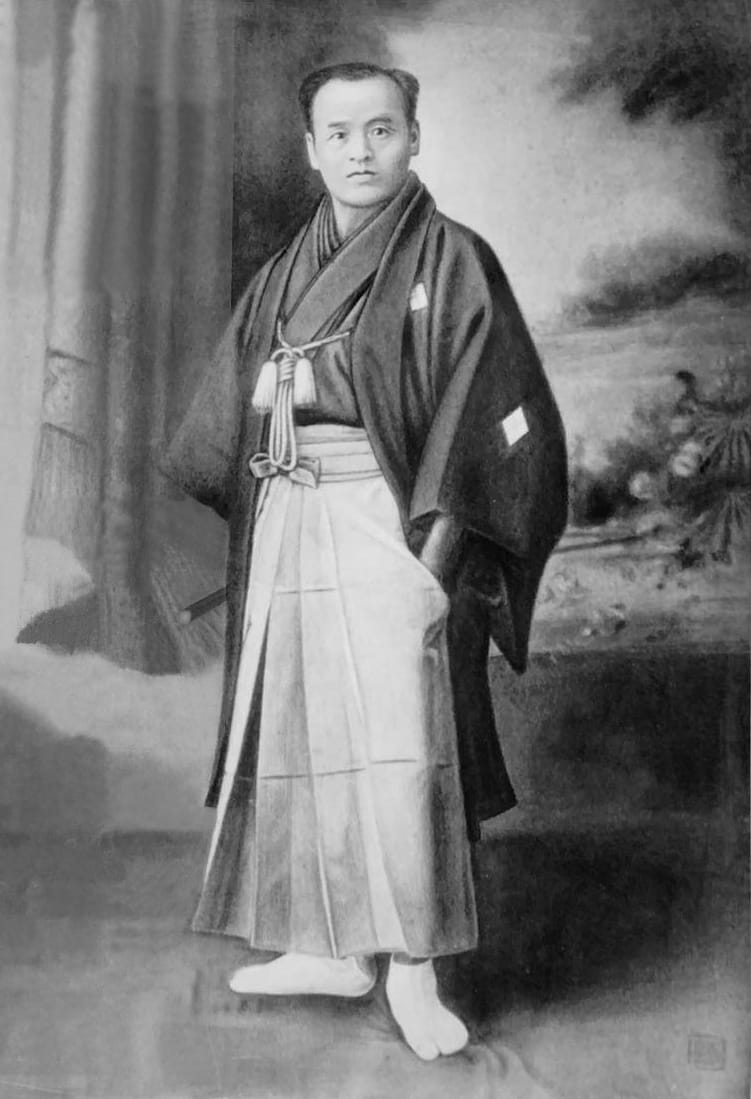
Takeda Sōkaku was born in 1859 in the village of Aizu-Bange, in the Aizu region of Mutsu province (now Fukushima Prefecture), into a family of the warrior class. He was a small man, well under five feet, and as a boy he absorbed sumō, spearwork and swordsmanship from his father and from the dōjō around him. He became a serious swordsman, training in the Ono-ha Ittō-ryū and travelling the country in the old manner of the warrior pilgrimage, testing himself in matches at a time when the sword was rapidly losing its place in Japanese life. Tradition holds that the principles of aiki reached him through Saigō Tanomo, a former senior retainer of Aizu who had become a Shintō priest, although this transmission is debated and cannot be firmly documented. From around 1898 Takeda taught openly, moving constantly, charging fees for each technique and recording his many thousands of students in enrolment ledgers he kept throughout his life. He spent his later years largely in Hokkaidō and died in 1943 while on a teaching journey.
Branches and the line to aikidō
Takeda named his son Takeda Tokimune (1916–1993) as his successor. Tokimune founded the Daitōkan dōjō in Abashiri, in Hokkaidō, organised the core curriculum into a graded set of techniques and renamed his line Daitō-ryū Aiki-budō; after his death the senior instructor Kondō Katsuyuki carried a major branch forward through the Shinbukan. Other students founded enduring lines of their own. Sagawa Yukiyoshi developed a celebrated and closely studied approach to aiki; Horikawa Kōdō taught a small-circle internal method that passed into the Kōdōkai; and Hisa Takuma, who learned first from Ueshiba and then directly from Takeda, preserved an unusually complete photographic record of the techniques and founded the Takumakai. The most consequential student was Ueshiba Morihei, who trained under Takeda in the 1910s and 1920s and later built from that foundation an independent art, aikidō, which spread Daitō-ryū's central ideas far beyond Japan.
Technique
Daitō-ryū is a comprehensive grappling system rather than a striking art. Its catalogue covers seated, standing and rear-attack forms and includes joint locks, immobilising pins, throws, takedowns, defences against weapons and methods against more than one opponent. The school presents its curriculum through a series of transmission scrolls of rising rank, from an initial catalogue of around a hundred and eighteen techniques up to the inner teachings, and gives the total number of techniques as several thousand, a figure best read as the tradition's own count rather than an independent tally. Above ordinary joint technique the school sets aiki-jūjutsu, and above that aiki-no-jutsu, said to be the purest expression of the principle. A characteristic training exercise, aiki-age, has a seated student neutralise a strong two-handed grip not by muscular strength but by a coordinated use of structure, breath and timing that breaks the partner's balance.
The idea of aiki
Aiki is the concept on which the school's reputation rests, and it has no single agreed definition. In older martial usage the word could describe a clash of two wills, a condition to be avoided; Daitō-ryū inverts this, treating aiki as the act of harmonising instantly with an opponent's force and intention so that the attack is unbalanced at the moment it is launched. Teachers within the tradition have described it variously as the uniting of one's energy with the opponent's, as the instantaneous breaking of balance on contact, and as a way of drawing off an attacker's power so that their own strength topples them. Takeda himself left no systematic written explanation, and the differences between the surviving lines are real, so the honest position is that aiki names a family of closely related skills rather than one fixed doctrine. The art is a secular fighting method; the overtly spiritual reading of aiki belongs mainly to aikidō and the religious life of its founder, not to Daitō-ryū itself.