Kendō (剣道), the "way of the sword", is the modern Japanese martial way of fencing with the shinai (竹刀), a sword of bound bamboo staves, while wearing the protective armour called bōgu (防具). It is not a single old school but a modern synthesis: a sporting and educational discipline drawn from the kenjutsu of the Edo period and standardised in the twentieth century by national federations. Two opponents score by striking defined targets with correct form, spirit and follow-through, so that the cut, the body and the will arrive as one.
From kenjutsu to fencing practice
Kendō descends from the sword schools of the samurai, but no single school can claim to be its parent. Its decisive ancestor is less a lineage than a method: free sparring with a bamboo sword and protective armour. Through the eighteenth century several schools developed padded fencing gear, the men (面, helmet and face guard), kote (小手, gauntlets), dō (胴, breastplate) and tare (垂, waist guard), together with the split-bamboo shinai, so that students could strike at full force without maiming one another. The growth of this equipment is associated above all with the Jikishinkage-ryū, where Naganuma Kunisato is credited with the early armour, and with the Nakanishi line of Ittō-ryū under Nakanishi Chūzō, whose dōjō spread armoured shinai practice widely in Edo. Out of it came matches between schools (taryū-jiai) and a shared way of fencing that crossed the boundaries of the individual ryū.
To discipline the human character through the application of the principles of the sword.
The Meiji crisis and revival
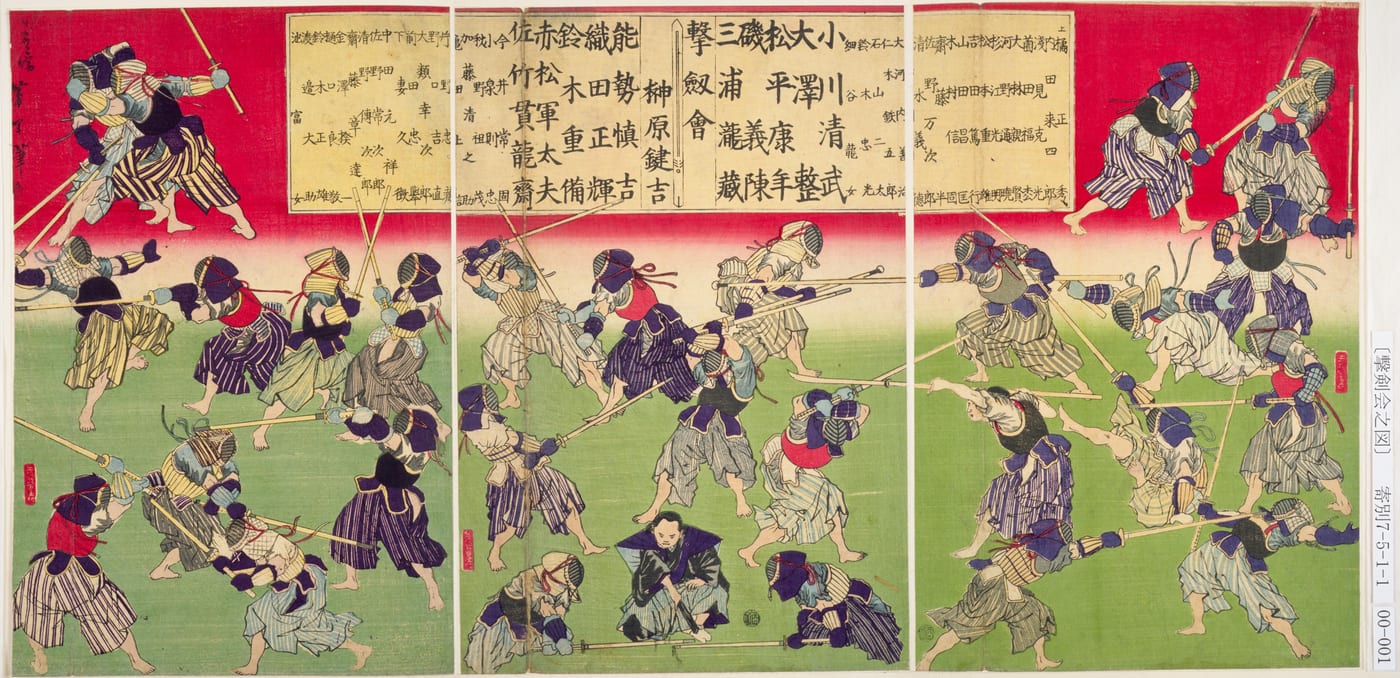
The end of the samurai class nearly killed Japanese swordsmanship. The government's ban on the wearing of swords in 1876 removed both the sword's everyday role and the livelihood of fencing teachers. To survive, swordsmen such as Sakakibara Kenkichi staged gekiken kōgyō, public fencing exhibitions, from 1873, turning their art into paid spectacle. Interest revived after the Satsuma Rebellion of 1877, when sword-trained police proved their worth, and the new Tōkyō police took up swordsmanship as part of their training. From these threads fencing recovered as a civic and educational pursuit rather than a warrior's skill.
Codification and the federations
The body that turned this surviving practice into a single named way was the Dai Nippon Butokukai (大日本武徳会), founded in Kyōto in 1895 to promote and organise the martial arts. It drew the schools together, awarded teaching titles, and oversaw a standard set of paired forms, the Dai Nippon Teikoku Kendō Kata, compiled in 1912 and still practised as the Nihon Kendō Kata. The word kendō, the "way" of the sword rather than its "technique" (kenjutsu), came into general official use across this period, and fencing entered the school curriculum. After the Second World War the occupation authorities banned kendō and dissolved the Butokukai in 1946 because of its wartime militarist associations; the art returned cautiously, first as a sportified "bamboo-sword competition" (shinai kyōgi), and was reorganised under the All Japan Kendo Federation (Zen Nihon Kendō Renmei, 全日本剣道連盟) in 1952, the body that governs it in Japan today. The International Kendo Federation followed in 1970, and the World Kendo Championships have been held since that year.
Technique and the valid strike
Kendō is contested between two armoured opponents holding the shinai in both hands. Points are scored only on four targets: men (the head), kote (the wrist or forearm), dō (the side of the torso) and tsuki (a thrust to the throat). A strike counts not merely because it lands but because it is delivered well. The federation requires ki-ken-tai-no-ichi, the union of spirit, sword and body, so that a valid cut joins the correct part of the shinai (the monouchi), an upright committed posture, a sharp shout that names the target (kiai), and zanshin, the alert follow-through that shows readiness after the blow. This is why two blows that look identical may be judged differently, and why kendō is often described as a contest of decisiveness as much as of speed.
Ranks and present-day practice
Practitioners advance through kyū and dan grades and, beyond them, the teaching titles renshi, kyōshi and hanshi, awarded for skill and character together. Training combines kihon (basics), kata and jigeiko (free sparring), with formal matches (shiai) judged by three referees. Today kendō is practised in Japanese schools, universities, workplaces and police forces, and by a growing international community under national federations affiliated to the International Kendo Federation. The All Japan Kendo Federation's 1975 statement, "The Concept of Kendō", defines its purpose as disciplining the human character through the application of the principles of the sword, a deliberately modern, educational aim that sits honestly beside the art's origins in the fighting methods of the samurai.
A modern way
It is worth being plain about what kendō is. It is a modern budō, a "way" settled by committees and federations within living memory, not an unbroken transmission from one founder or one school. Its forms, its scoring and its equipment are twentieth-century arrangements. Yet its roots in Edo-period kenjutsu are real, and the koryū sword schools from which it draws, several of which survive in their own right, are still transmitted separately under their own headmasters. Kendō is best understood as the common modern descendant of that older world: a national, and now international, way of the sword that kept the practice of Japanese fencing alive once the sword itself had left daily life.