Sekiguchi-ryū (関口流), known more fully as Sekiguchi Shinshin-ryū (関口新心流), is one of the early traditions of Japanese jūjutsu. It was founded in the first half of the seventeenth century by Sekiguchi Ujimune, far better known by his art name Sekiguchi Jūshin, and it grew up under the patronage of the Kishū branch of the Tokugawa house at Wakayama. Beside its grappling the school preserves a tradition of iai, the drawing and cutting of the sword, and it is remembered above all for a reputation, more tradition than documented fact, for having refined ukemi, the breakfall that lets a thrown body meet the ground without injury.
The founder
The school is attributed to Sekiguchi Yarokuemon Ujimune, who is usually called Sekiguchi Jūshin after the art name he took. Tradition spreads his life across the late sixteenth and the seventeenth centuries, with the dates c. 1598–1670 often given, although they are not securely fixed and the personal record is thin. The Sekiguchi were a warrior family, and the school's own accounts connect them to service under the Imagawa and then the Tokugawa. Jūshin himself is remembered as a retainer who entered the service of the Kishū Tokugawa, one of the three senior branches of the ruling house. What can be said with more confidence than any single biographical detail is that a man of this name shaped a system of yawara, the older word for jūjutsu, that carried his family name and outlived him by many generations.
Yawara, the yielding art: to control an opponent with the hands as readily as with the blade, and to meet the ground unhurt.
A school of yawara and the sword
Sekiguchi-ryū is at heart a school of unarmed and lightly armed close combat. Its curriculum works through the methods of jūjutsu: throwing, joint locks, pinning, and the strikes and seizures of a grappling exchange, much of it studied as paired forms against an opponent who is also reaching for a short blade. Alongside this the school preserves iai, also called battōjutsu, the art of drawing the sword straight into a cut. The full Sekiguchi Shinshin-ryū therefore belongs among the comprehensive Edo traditions that taught both empty-handed grappling and the sword, rather than confining themselves to a single weapon. The name Shinshin-ryū (新心流), the "new heart" school, is the founder's own designation for the system he settled out of what he had learned.
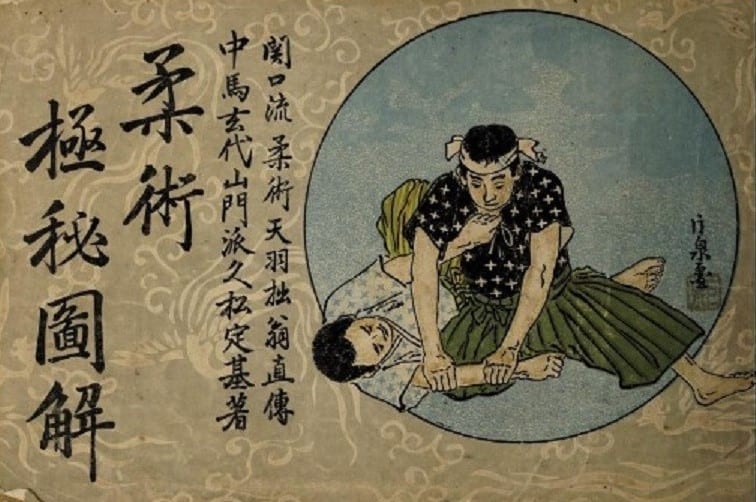
The ukemi tradition
The claim most often attached to Sekiguchi-ryū is that its founder developed, or greatly refined, ukemi, the breakfall by which a thrown person spreads the shock of landing and rises unhurt. A well-known story tells that Jūshin watched a cat thrown into the air twist in the fall and land softly on its feet, and took from it the principle of falling safely. It is a good story and a fitting emphasis for a grappling school, but it is best read as tradition rather than as established history: the tale has the shape of the founding anecdotes common to the koryū, and the wider history of breakfalling cannot honestly be credited to one man. What is fair to say is that the school is associated, in its own teaching and in later memory, with careful attention to safe falling, and that this emphasis sits naturally with a curriculum built on throws.
Kishū patronage and the spread of the line
Sekiguchi-ryū owed much of its long survival to domain patronage. Established under the Kishū Tokugawa at Wakayama, it became one of the martial traditions taught within that domain, and the founder's sons and their pupils carried it outward. From the Wakayama root the school spread to other domains across the country, so that by the later Edo period Sekiguchi jūjutsu and its iai were practised in several regional lines rather than as one centrally governed school. This pattern, a named tradition surviving as a family of branches under different domains, is typical of the older jūjutsu, and it means the history of the school is better pictured as a spreading tree than as a single inherited headship.
The school today
Sekiguchi-ryū has come down to the present, though as regional traditions rather than one unbroken national line. Branches carrying the Sekiguchi name are still transmitted in Japan, preserving the jūjutsu forms and, in some lines, the iai. As with many koryū, the documented record is firmer for the Edo-period domain lines than for the founder's own generation, and honest practice keeps the well-attested transmission clearly apart from the founding anecdotes. What endures is a tradition that taught a warrior to control an opponent with his hands as readily as with a blade, and that is remembered, rightly or not, for teaching him first how to fall.