Miyamoto Musashi's early two-sword school
Enmei-ryū (円明流) is a school of Japanese swordsmanship attributed to Miyamoto Musashi (c. 1583–1645) as his first independent system, formed before the two-sword tradition later known as Niten Ichi-ryū (二天一流). The name is commonly read Enmyō-ryū in Japanese dictionary entries, though Enmei-ryū is the reading used by the modern traditions. Broader than the better-known later school, the early corpus also included the throwing of the short sword and dagger.
The Heidōkyō and the question of authorship
The central early document is the Heidōkyō (『兵道鏡』), "Mirror of the Way of War", whose surviving versions contain twenty-eight articles on the mind, gaze, posture, grip, footwork, distance, timing, initiative and methods of combat, with a supplementary recension dated 1607. The scholar Uozumi Takashi has argued that Musashi wrote it in his twenties, building on the Tōri-ryū two-sword and jitte methods inherited from his adoptive father Miyamoto Muni. The attribution is not settled: no autograph manuscript survives, the copies carry names that differ from Musashi's securely attested signature, and one major Japanese dictionary places the school's establishment in the Kan'ei era, between 1624 and 1644, rather than around 1605. The founding is therefore best described as probable rather than certain.
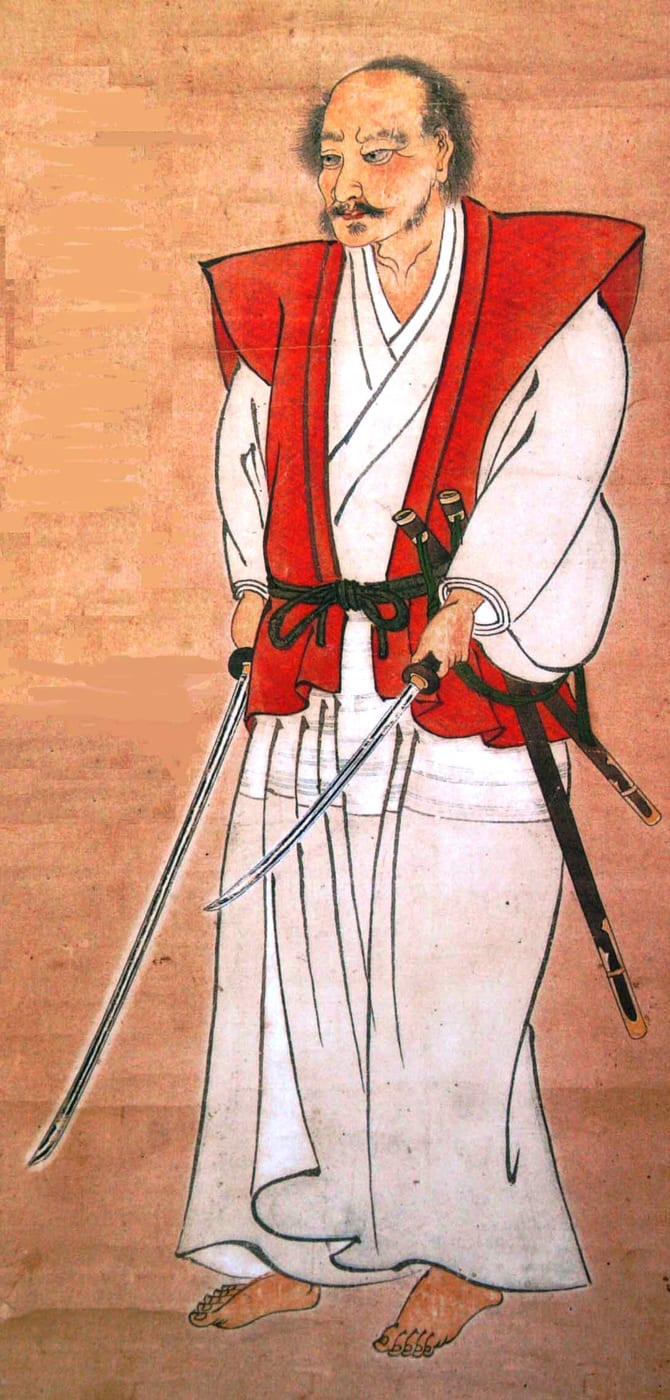
A calm mind, broad perception, adaptability and direct commitment: the first shape of the two-sword idea that Musashi would later refine.
Transmission through the domains
Enmei-ryū was carried through the Edo period in several domains, among them Owari, Okazaki and Tatsuno, where it was handed down as a distinct line of Musashi's teaching. In Owari, the Aichi Prefectural Archives record that the documents of Tōkōin temple in Nagoya include a joint register of disciples prepared in 1744 for the hundredth anniversary of Musashi's death, establishing an organised community there identifying its inheritance with Musashi by the mid-eighteenth century. Tatsuno tradition holds that Musashi taught at Enkōji temple and licensed Tada Hansaburō, a transmission the city itself presents as handed-down account rather than contemporary documentation. A separately transmitted school of similar name, the Musashi Enmei-ryū (武蔵円明流) of the Tottori domain, is documented through the Kawake family's genealogies, oaths and licences preserved by the Tottori Prefectural Museum; though both descend from Musashi's name they should not be treated as one school.
Legacy in the Musashi tradition
No prominent independent Enmei-ryū line survives today, but the branch is not wholly extinct: its Owari two-sword material is preserved within Owari Kan-ryū, whose Shunpukan tradition transmits Enmei paired two-sword kata practised with fukuro-shinai, alongside modern organisations in the Musashi Enmei-ryū line. Musashi's two-sword swordsmanship otherwise lives on chiefly through Hyōhō Niten Ichi-ryū, the school with which his name is now most closely associated in Japan.