Kenyu-ryu Karate-do is a Japanese style of karate that occupies a transitional position between Okinawan tradition and modern mainland Japanese karate. According to official Japanese material, it was founded in 1939 by Tomoyori Takamasa, the name is also read as Tomoyori Ryusho, as the Japanese sources are inconsistent about certain details. The style is distinctive for openly combining Shuri-te and Naha-te influenced kata within a single framework, and for developing within the broader transformation of karate as it moved into mainland Japanese organisational and educational structures.
Founder and Disputed Timeline
The early history of Kenyu-ryu contains several unresolved details. Some official material places Tomoyori's birth year as 1905, while other material suggests 1907. The years connected to his training under Chōjun Miyagi shift slightly depending on the Japanese source consulted, and the timeline regarding his connection to Kenwa Mabuni also changes subtly between documents. Such inconsistencies are common in Okinawan and Japanese karate history, which is characterised by oral transmission, postwar reconstruction, fragmented records, local politics, and later organisational mythmaking. Historical inconsistency does not in itself indicate fabrication.
History is not one story, the mess between lineages is where the real knowledge lives.
Organisational History
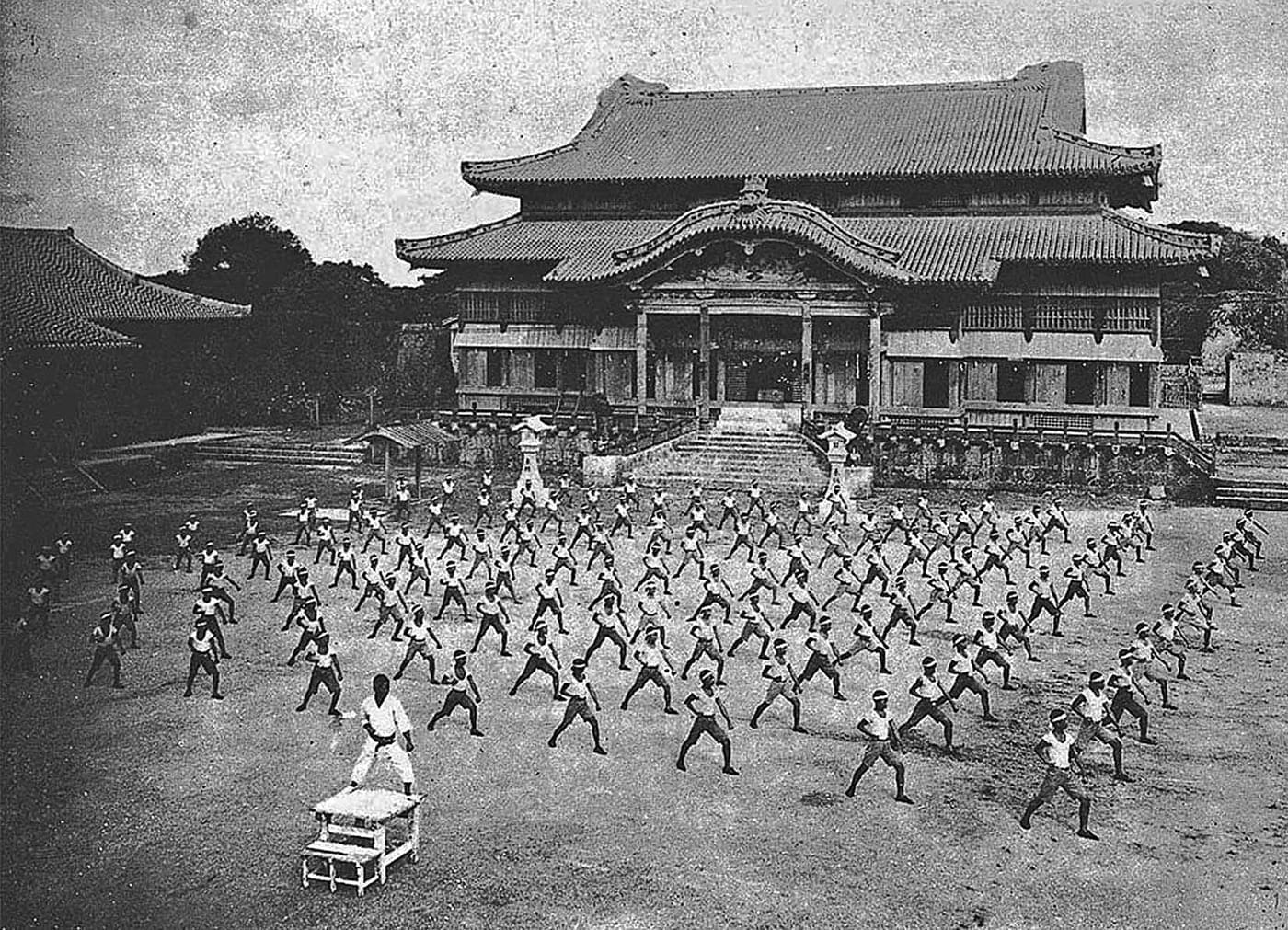
Despite the uncertainties in its early lineage, Kenyu-ryu shows clear organisational continuity. Japanese sources confirm nationwide branches, annual tournaments, grading systems, and a headquarters in Osaka, along with long-term continuity and multi-generational leadership succession. The style marked its 80th anniversary in 2019 and its 85th anniversary in 2024. Records include official tournament regulations, grading requirements, branch structures, instructor seminars, kumite training materials, and connections to Japanese university karate circles.
The style developed in Osaka rather than remaining purely Okinawan, which is significant because mainland Japan transformed karate considerably during the twentieth century as the art entered university systems, organisational structures, grading bureaucracy, and national federations. Kenyu-ryu reflects that transition: neither fully old Okinawan village transmission nor fully modern sports karate, but something between the two.
Curriculum and Techniques
Kenyu-ryu presents a dual framework that combines Shuri-te influenced kata with Naha-te influenced kata. Forms associated with the Shuri-te lineages (such as Passai, Matsumura Passai, Tomari Passai, Kusanku, Chinto, and Gojushiho) exist alongside deeply Naha-te rooted forms such as Sanchin, Tensho, Seienchin, and Seisan. This combination produces a technical dialogue within the style between sharp linear mechanics and circular body control, explosive transitions and rooted breathing, and fast directional movement and compression and tension work.
The grading material reflects this balance. Lower dan ranks involve kata and kumite together, while higher levels introduce structured application work. Advanced grading requirements emphasise "oji-waza," or response techniques, indicating that the style treats kata as something that should eventually become interactive and applied rather than purely aesthetic. Kata study remains central, but practical training clearly exists alongside it: official seminar documentation from 2023 included footwork drills, distance management, jab-reverse combinations, counter timing, ura mawashi geri variations, lower body conditioning, structured sparring progression, and competitive training methodology.
Philosophy
The public messaging of Kenyu-ryu is comparatively unmystical, emphasising discipline, manners, self-control, unity, cooperation, character development, consistency, and education. The phrase "Isshu Hitotsu" appears repeatedly in connection with the third-generation leadership under Tomoyori Aiko, pointing toward the idea of unity, many people moving toward one purpose together. In the Japanese material this concept is tied to the organisational survival of the style, with leadership describing periods where instructors and members gathered collectively around the hombu structure to preserve continuity, technical cohesion, and teaching standards. The branch dojo descriptions repeatedly emphasise etiquette, cooperation, self-discipline, courage, kindness, perseverance, and sincerity, reflecting an educational model that frames karate as a means of shaping behaviour, community, and mental structure rather than simply developing combative efficiency.
Historical Assessment
Although Kenyu-ryu has connections to the Shitō-ryū lineage through Kenwa Mabuni, it presents the Shuri-te and Naha-te framework more explicitly than many systems, with the duality visible directly within its grading structures. Some lineage descriptions connected to earlier Okinawan figures become historically difficult if interpreted literally, and certain timelines do not fully align, which underscores the value of separating organisational history from mythology. Based on the Japanese material, Kenyu-ryu appears historically legitimate as a functioning karate organisation with deep roots and coherent structure, while still containing unresolved questions around parts of its early lineage narrative.