Shitō-ryū is a style of karate formalised in early twentieth-century Japan by Kenwa Mabuni. It is notable for combining two major Okinawan lineages, the Shuri-te traditions of Ankō Itosu and the Naha-te traditions of Kanryō Higaonna, and for preserving an unusually large catalogue of kata rather than narrowing its curriculum to a single interpretation.
Kenwa Mabuni and His Training
Kenwa Mabuni was born in 1889 in Shuri, Okinawa, at a time when karate was not yet a sport or a categorised budō system but a scattered body of teachings and personal transmissions passed through small circles of students. Mabuni did not invent karate; his contribution was to preserve it as old teachers and their knowledge were beginning to disappear.
Honouring dual lineage through technical synthesis rather than choosing one tradition over another.
His early training came from Ankō Itosu, a figure of great influence on modern karate who systematised training, introduced karate into Okinawan schools, and wrote the 1908 letter often called the Ten Precepts of Karate. In these precepts Itosu observed that karate had different roots and branches and was never a single unified system, an idea Mabuni absorbed deeply. From Itosu, Mabuni learned what later generations called the Shuri-te traditions, including kata such as Naihanchi and the Pinan series, characterised by structured forms, precise movement lines, and compact, efficient techniques.
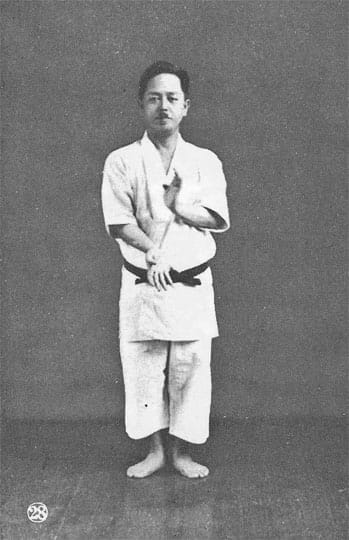
Mabuni then became a student of Kanryō Higaonna, whose teachings represented a different current of Okinawan fighting culture. Where Itosu's methods emphasised linear precision and explosive timing, Higaonna's emphasised rooted breathing, body conditioning, and the internal mechanics found in forms such as Sanchin. Rather than choosing a single teacher, Mabuni studied both, an unusual decision for the period that became the foundation of his style. His position as a police officer in Okinawa gave him unusual freedom to travel the island and seek out instructors; beyond Itosu and Higaonna he is recorded as having studied with other masters such as Aragaki Seishō and as having drawn on Tomari-te and white-crane–influenced lines, a breadth of contact that later defined his approach.
Origin of the Name
The name Shitō-ryū is a tribute to Mabuni's two principal teachers, combining "Shi" from Itosu and "Tō" from Higaonna. It reflects the intention that the style should not be a narrow school but a broad repository of Okinawan martial knowledge drawn from two different streams.
A Library of Kata
Mabuni travelled across Okinawa searching for teachers, kata, and fragments of old training knowledge, gathering material from Shuri and Naha traditions as well as Tomari lineages and independent masters with their own interpretations of older Chinese-influenced forms. While other karate styles eventually narrowed their curricula, Shitō-ryū preserved an enormous catalogue of kata, a feature so pronounced that practitioners sometimes compare the style to a library. Where some traditions settled on a dozen or so core forms, Shitō-ryū is commonly said to retain on the order of fifty kata or more, one of the largest repertoires among the major styles.
Mabuni also wrote extensively. One notable work from this era is his 1934 study Kōbō Jizai Karate Kenpō Jūhachi no Kenkyū, a detailed examination of eighteen karate techniques and principles. The book contains references to the Bubishi, a Chinese martial text that circulated among Okinawan masters. Often romanticised as a secret manual, the Bubishi is in fact a compilation of Chinese martial theory, medical notes, and fighting principles used as a reference. Mabuni's inclusion of it indicates that he viewed karate not as a static Okinawan invention but as part of a larger East Asian martial ecosystem.
Move to Japan and Formalisation
Like many Okinawan masters of his generation, Mabuni moved to mainland Japan, where karate evolved into a modern martial art. Universities formed clubs, budō organisations began categorising styles, and demonstrations appeared in cities such as Osaka and Tokyo. Mabuni established his dōjō in Osaka and taught students from across Japan. To survive within the Japanese budō system, karate had to organise itself, with styles requiring names, associations requiring structure, and titles requiring registration. Shitō-ryū emerged in this environment during the early 1930s, not as a sudden invention but as the formal recognition of Mabuni's teaching method.
Method and Legacy
Mabuni's method required students to train kata from multiple Okinawan traditions, studying both the Shuri-derived forms from Itosu and the Naha-derived forms from Higaonna rather than choosing one lineage and discarding the rest. Historians have interpreted this as philosophical, pragmatic, or both; by the 1930s, as old teachers in Okinawa were dying and pieces of karate history were vanishing, Mabuni preserved many branches of karate rather than only one.
After the Second World War, when budō restrictions imposed under the Allied occupation were lifted, karate expanded rapidly across Japan and the world, and Shitō-ryū took part in that expansion. Mabuni died in 1952, and, like the other large karate styles, Shitō-ryū afterwards continued through several parallel organisations rather than under a single head: among them the Mabuni family line carried by his sons Kenei and Kenzō, the Shitō-kai within the national federation, and the Itosu-kai, alongside related branches such as Shūkōkai. These are best understood as parallel lines of one inherited framework rather than as an original and its imitations. Associations formed, international branches appeared, and by the 1960s competition, global teaching networks, and standardised grading systems reshaped the practice. Beneath these modern structures, Shitō-ryū continued to embody Mabuni's original idea of a style that tried to remember the whole of karate rather than reduce it to a single interpretation, reflecting the reality that karate grew from overlapping teachers, borrowed ideas, Chinese influence, Okinawan adaptation, and Japanese institutionalisation.