Shintō Musō-ryū (神道夢想流), usually known for its jōjutsu, is the foremost classical school of the jō, a plain wooden staff about four feet long. Where most weapon arts of Japan grew up around the sword or the spear, this one is built around a short stick, and it is studied above all as a way of defeating a swordsman. Its founding is tied, in legend, to the most famous swordsman of all.
The founder and the duel with Musashi
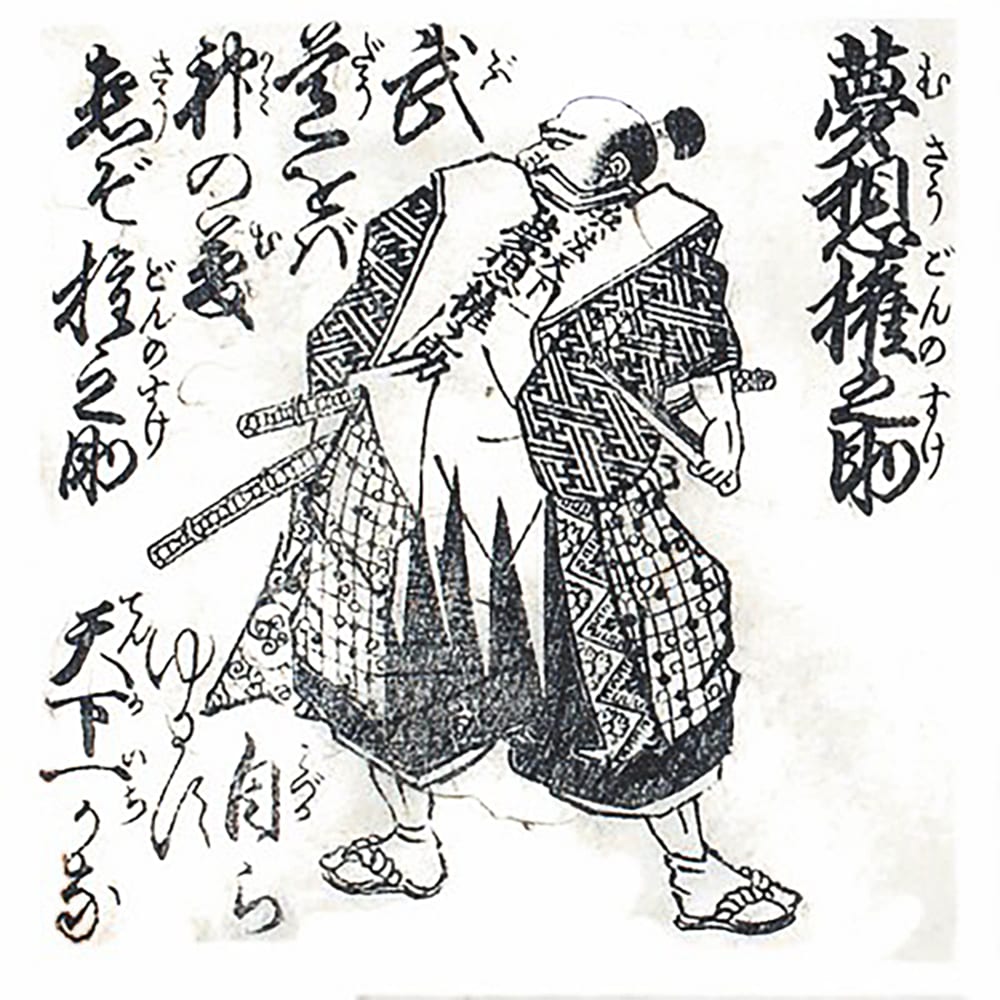
The school is attributed to Musō Gonnosuke Katsuyoshi, a warrior of the early seventeenth century. The traditional account, which cannot be confirmed from independent records, holds that Gonnosuke was an accomplished martial artist who challenged Miyamoto Musashi and was defeated, caught helpless by Musashi's two-sword cross-block. He is said to have withdrawn to Mount Hōman in Chikuzen, in the north of Kyūshū, where after a period of austerity at the Kamado Shrine he received in a dream the insight that gave the school its name, and devised the jō: a staff a little longer and thinner than the bō, which could be used at a reach the sword could not easily answer. Tradition adds that he then met Musashi again and won, making him the one man said to have defeated Musashi. None of this is documented outside the school's own tradition, and the rematch in particular should be read as legend rather than history.
The humblest weapon, a plain stick, mastered well enough to control and defeat the sword without taking life.
The jō and its method
What is not in doubt is the cleverness of the weapon. The jō is held and shifted so that either end may strike, and in trained hands it borrows the actions of several weapons at once: it can thrust like a spear, strike like a sword, and sweep or hook like a naginata, switching between them faster than an opponent can read. The whole curriculum is practised in paired forms against a partner wielding a sword, so that the school is in essence a long study of how a staff can control and defeat a blade. Distance, timing and the constant changing of ends are its central concerns.
Preservation in the Kuroda domain
Shintō Musō-ryū owes its survival to the Kuroda clan, lords of the Fukuoka domain in Chikuzen, who took the art into their service and preserved it as a domain tradition for more than two centuries. Kept largely within the domain and transmitted with some secrecy, it gathered to itself a group of associated arts that were taught alongside the jō, among them short-sword, truncheon, chained-sickle and rope-tying techniques. This bundle of weapons, carried together within one school, is part of what makes Shintō Musō-ryū unusual among surviving koryū.
From domain secret to police and the world
The art might have remained a local tradition had it not been carried to Tōkyō in the twentieth century by Shimizu Takaji (1896–1978), who had learned it in the Fukuoka line. Shimizu taught the jō to the Japanese police, and the stick techniques used by the police to this day descend from his teaching; he also opened the school to the wider public and to foreign students, so that Shintō Musō-ryū became one of the most widely practised of all the classical weapon arts. Through students of his generation it spread well beyond Japan.
The school today
Shintō Musō-ryū is practised today in Japan and across the world, in several lines that trace back through the twentieth-century teachers to the Fukuoka tradition. The associated arts are still transmitted with it in varying degrees. For a school founded, by its own account, in a dream and a defeat, it has proved remarkably durable, and it remains the standard by which the jō is judged.