Tenshin Shōden Katori Shintō-ryū (天真正伝香取神道流) is one of the oldest surviving martial traditions in Japan. A classical school usually dated to around 1447, it is connected to the great shrine Katori Jingū and encompasses sword, spear, naginata, staff, strategy, and ritual. Its name (roughly "the heavenly, true, correct transmission of the Katori Shintō school") is itself a declaration of origin, authority, and spiritual legitimacy.
The date of around 1447 places the school's founding in the late Muromachi period, an age before the long stability of Tokugawa rule. It was a martial world shaped by instability, regional power, inheritance disputes, political violence, and religious authority, in which skill could be a condition of survival rather than a pastime.
Among the oldest surviving sword schools, the shrine is not decoration; it is the transmission itself.
Founding
The founder is given by tradition as Iizasa Chōisai Ienao (飯篠長威斎家直), traditionally said to have lived from 1387 to 1488, a span of more than a century if accepted as transmitted. He is described as coming from the region of Shimōsa, in what is now Chiba, and as having undertaken severe ascetic practice at Katori Jingū, the shrine associated with the deity Futsunushi-no-Ōkami (経津主大神). The tradition recounts a thousand days of austerity, purification, training, and devotion, after which he is said to have received a divine book of military strategy (兵法神書) from the deity.
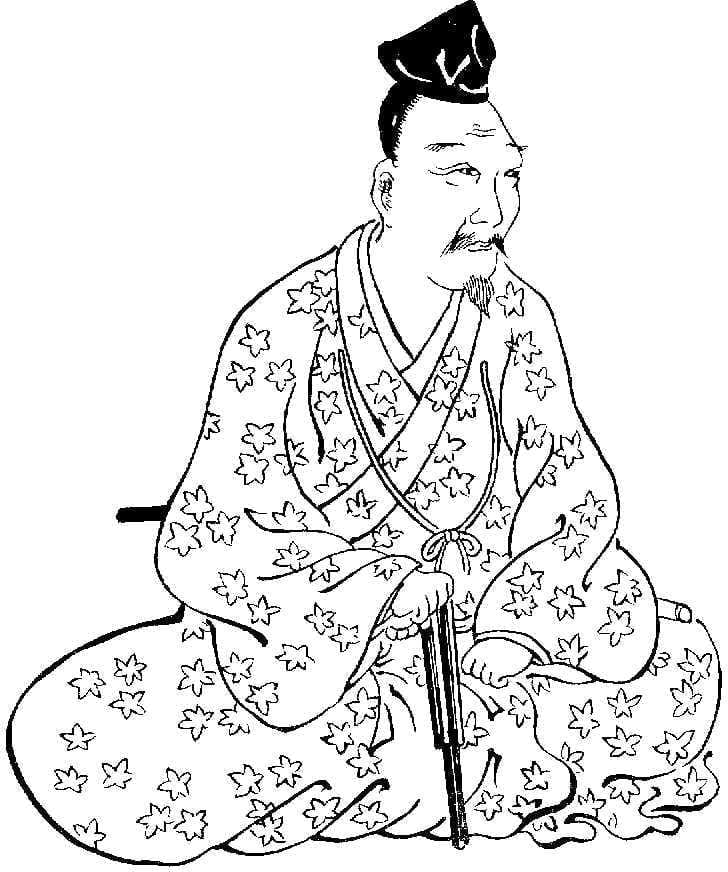
Such accounts mix archive, legend, lineage memory, and religious framing, and the historical method that distinguishes among them remains important. Beyond the question of literal verification, the divine-transmission story illustrates how the school understood itself: not merely as a collection of techniques but as a transmission, something received, guarded, embodied, and passed on.
Curriculum
The school is described as a comprehensive martial system (総合武術). While the sword is central, the curriculum also includes sword methods (太刀術), drawing methods (居合術), batto (抜刀術), staff (棒術), spear (槍術), naginata (薙刀術), short sword (小太刀), two-sword methods (二刀), throwing blades (手裏剣術), and grappling (柔術). Beyond weapons, it encompasses military knowledge such as methods of command and tactics (軍配法), fortification (築城法), and the cosmological and directional knowledge (陰陽気学) belonging to the older intellectual world of strategy and timing.
Training is kata-based. In the school's paired forms, the practitioners take defined roles often described through terms such as uke and kiri-komi, receiver and attacker, though the relationship is more subtle than those simple translations suggest. The beginner curriculum already shows structure and depth: omote no tachi, omote iai, tachiai batto, omote bo, omote naginata, and chudan bo. Omote, the outer or surface level, is foundational rather than easy; later come ura forms, the hidden or inner methods, along with additional weapons and principles. Knowledge is given in stages, with deeper layers opening as the student progresses.
Transmission and Oath
The school marks levels of attainment through the traditional ranks of mokuroku (catalogue), menkyo (licence), and kaiden (full transmission), which denote a student's relationship to knowledge, responsibility, and trust rather than functioning as modern grades. Entry into the school is traditionally associated with the keppan (血判誓約), a blood oath. Beneath its dramatic reputation, the oath binds the student to secrecy, discipline, restraint, respect for the deity and ancestors of the tradition, and the refusal to misuse what is taught; the blood marks the seriousness of crossing a threshold.
Techniques and Characteristics
The forms are often described as long, dynamic, and designed around armoured combat. Armour changes posture, mobility, targeting, distance, and timing, and against an armoured opponent the vulnerable points become specific: the throat, the gaps near the armpit, the wrists, the inner arms, and the hips. Katori methods preserve this logic of pressure into weakness, structure against structure, and timing against intent rather than theatrical slashing. The breadth of weapons (staff, spear, naginata, short sword, two swords, throwing blades, grappling, and tactical knowledge) reflects a world in which adaptability mattered more than aesthetic preference. The naginata in particular, later associated in complex ways with women's martial training and the image of the onna-bugeisha, belongs in these older systems firmly to practical combat, giving reach, cutting, controlling distance, and threatening mounted and armoured opponents.
Philosophy
Several concepts central to the tradition extend beyond combat. Maai (間合い), distance, is the space in which one can strike or be struck, a matter of timing, reach, and opportunity. Zanshin (残心), translated as remaining mind or lingering awareness, is the mind that does not collapse after a strike but continues to watch, holding the possibility that a situation is not over because one movement has ended.
A principle often associated with the tradition is expressed as 「兵法は平法なり」, the art of war is the law of peace. Rather than a soft pacifism, this holds that true strategy aims at peace because violence is destructive and morally heavy, and that the highest victory may be the conflict prevented. This emphasis pairs capacity with restraint: the choice not to act carelessly made by someone who has trained toward decisive action.
The spiritual dimension is rooted in a Shintō atmosphere, with shrine devotion, reverence for Futsunushi-no-Ōkami, and ritual practice. Bowing, purification, etiquette, and respect for the dojo space frame the practice and place martial knowledge within an order larger than the individual.
Lineage and Legacy
Katori Shintō-ryū predates many of the modern frameworks through which martial arts are now understood. It belongs to the koryū world, the old schools, in which transmission, lineage, and embodied preservation are central. The art survived through the Edo period, the transformation of warfare, modernisation, and the decline of the warrior class, and in 1960 it was recognised as an intangible cultural asset of Chiba Prefecture, a recognition coming after Meiji modernisation, imperial militarisation, defeat in 1945, occupation, and post-war reconstruction. The designation reflects a shift in how martial knowledge is understood: not only as a fighting method but as cultural memory.
The Iizasa line claims succession from the founder across twenty-one generations down to the present, through the main line, branch lines, and the school's modern international spread. Such preservation is understood as active labour, choosing what must remain unchanged, what may be clarified, and what must never be carelessly exposed. Documentation of the school is supported by official dojo material, Japanese cultural heritage sources, Nihon Kobudō Kyōkai references, Budōkan publications, and works connected to teachers such as Ōtake Risuke. Reference works on the classical schools, such as the Bugei Ryūha Daijiten (武芸流派大事典), record Katori Shintō-ryū among the oldest documented ryūha and trace its principal teaching lines; alongside the Iizasa headmaster's family the art is carried by senior licensed lines that present themselves as keepers of the same kata rather than as rival schools.