Uechi-ryū is a style of karate founded by Uechi Kanbun (1877–1948), an Okinawan who learned a Chinese martial system in Fuzhou, China, and later transmitted it in Okinawa and mainland Japan. Rather than a mystical tradition of hidden mountain secrets, its documented history (drawn from Okinawan association records, dojo chronicles, and local historical documents) is a human story of migration, war, and cultural exchange.
Founder and Origins in China
Uechi Kanbun was born in 1877 in Motobu on Okinawa, at a time when the island was adjusting to its incorporation into the Japanese state following the abolition of the Ryūkyū Kingdom. In 1897 Japan introduced modern military service, and Kanbun, reluctant to serve, travelled to Fuzhou in Fujian Province, China, in order to avoid conscription and to find work. In Fuzhou (then a busy port city of merchants, sailors, labourers, and martial arts teachers) he encountered a Chinese master named Zhou Zihe, written in Japanese records as Shū Shi Wa. Zhou taught a system called Pangai-noon, a name meaning roughly "half-hard, half-soft," and this concept became the foundation of Uechi-ryū.
Returning to Chinese roots while surviving Okinawan soil, a style that refuses to be fully classified.
Fuzhou and the surrounding Fujian region were a heartland of southern Chinese boxing, and Pangai-noon shares the broad character of southern systems often described through animal imagery such as the tiger, dragon, and crane. Exactly how Zhou's method related to any named Fujian school is not documented with certainty, and Uechi-ryū tradition is careful to record what was transmitted rather than to claim a precise Chinese pedigree.
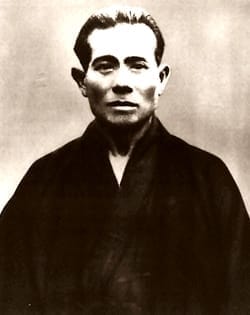
Kanbun trained under Zhou for more than a decade, thirteen years according to most Japanese accounts, long enough to absorb both the techniques and the underlying philosophy of the system. The training centred on three forms: Sanchin, Seisan, and Sanseiryu. This compact curriculum reflects the practice of older systems, which demanded that practitioners extract everything from a few highly demanding patterns rather than accumulating many. Sanchin in particular is known for its severity: outwardly simple, with slow stepping, tight fists, and controlled breathing, it relies on intense internal tension throughout the body and became the central pillar of the entire training method.
Return to Okinawa and Withdrawal from Teaching
Around 1909 an incident permanently altered Kanbun's life. One of his students became involved in a violent conflict, most sources mention a dispute over water rights, which ended with a man dead. Whether Pangai-noon techniques were used directly is unclear, as the records are vague, but the outcome led Kanbun to blame himself for teaching something that could be used to kill, and he closed his school. He returned to Okinawa and for years refused to teach, becoming a farmer and living quietly and privately. Had history taken a different turn, the art might have disappeared at this point.
Revival in Japan
In 1924 Kanbun moved to Wakayama in mainland Japan to work in the textile industry. Okinawan migrant communities had formed there, and some, on discovering his background, persuaded him, reluctantly, to teach again. In 1926 he opened a small training hall referred to in Japanese sources as the Pangai-noon Karate Kenkyujo, essentially a research institute, reflecting a small circle devoted to preserving the system rather than a commercial dojo.
Kanbun's son, Kanei Uechi, born in 1911, became the next key figure. After inheriting the system following Kanbun's death in 1948, he chose to adapt the art to make it easier to teach and to provide structured progression for students. Where Kanbun had transmitted only the three core kata, Kanei and senior students added five bridging forms (Kanshiwa, Kanshu, Seichin, Seiryu, and Kanchin) so that the modern curriculum of eight kata now carries a beginner gradually toward the severe demands of the original three. The art, taught at the small research hall, was renamed Uechi-ryū in the founder's honour, sources commonly place the change around 1940, and by the 1950s the name was firmly established, after the family that carried it forward.
Techniques and Characteristics
Training methods evolved over time while retaining their severity. Okinawan dojo descriptions from the mid-twentieth century mention kote kitae, forearm conditioning in which partners repeatedly strike their arms together to strengthen the bones, along with exercises using wooden poles and heavy body-impact training. The style spread gradually across Okinawa and then internationally after the 1960s, when American servicemen stationed on the island encountered it and brought it overseas, leading to Uechi-ryū schools in the United States, Europe, and beyond.
The character of the style remains direct, hard, and largely undecorated, closely reflecting its Chinese origins. While many karate systems became sport-oriented or aesthetically polished, Uechi-ryū retained a raw quality: compact techniques, narrow stance work, and strikes that use the knuckles, fingertips, or open hands in ways closer to Chinese boxing than to mainstream Japanese karate.
The physical demands of these methods have even drawn academic notice. A 2001 study in a Japanese university bulletin examined the physiological effects of Uechi-ryū's Sanchin breathing on the body, an unusual case of a traditional kata being measured in the language of sports science rather than described only in the language of tradition.
Legacy
Uechi-ryū illustrates that the categories of Japanese karate, Okinawan karate, and Chinese kung fu are not neatly separate. A Ryūkyūan man travelled to China to avoid military service, trained under a Chinese teacher, returned to Okinawa, later taught migrant workers in mainland Japan, and produced a karate style now practised worldwide. Its three original kata continue to be trained internationally, an outcome for a style that at one point had nearly faded into a farmer's quiet life on Okinawa.
Uechi-ryū also figures in how Okinawa documents its own martial heritage. As part of a prefectural project to record the island's major karate traditions, the Okinawan government published a dedicated Uechi-ryū study in 2018, placing it alongside Gōjū-ryū and the Shuri–Tomari lines among the styles formally treated as Okinawan cultural property. Writers have likewise read the art through the lens of postwar Okinawan identity: a 1988 essay discussed Uechi-ryū under the heading of "karate for peace," reflecting a wider tendency on the island to present its fighting arts as disciplines of self-cultivation rather than aggression.
The history above is drawn from Japanese and Okinawan documentation, including the archives of the Uechi-ryū Karatedō Rengōkai, the Okinawa Dentō Karate-dō Shinkōkai, Ryūsei-kai Uechi-ryū Karate-dō, the Uechi-ryū Karate-dō Shubukan, and records connected to the Motobu Town Board of Education, alongside Okinawan karate association archives and dojo historical records documenting traditional training practices and the evolution of the kata curriculum.