Gōjū-ryū is a major style of traditional Okinawan karate whose development is rooted in Naha-te, the martial tradition associated with the port city of Naha. Its history is shaped by exchange between Okinawa and China, by later systematisation, and by postwar institutionalisation. Rather than emerging complete from a single moment, the style developed through travel, adaptation, and reform across several generations.
Origins in Naha-te
Naha-te grew in an environment shaped by contact between Okinawa and China, particularly through Naha as a port. The central early figure in this tradition was Higaonna Kanryō, born in 1853 in Naha. He travelled to Fujian in China, trained there, and returned to Okinawa around the late 1870s. This broad outline is well established, though the finer details remain less certain: exactly whom he trained under, which streams of Chinese boxing influenced him most directly, how much derived from White Crane, how much from other southern Chinese systems, and how much he retained unchanged versus adapted are all difficult to determine with certainty.
Go is hard, Jū is soft. Power and yielding are not opposites.
Sources describe Higaonna as having created the basis of Naha-te by connecting what he learned in Fujian with the older Naha traditions already present in Okinawa. His art was regarded as refined, sophisticated, and technically rich, and his students referred to it as Naha-te. The roots of Gōjū-ryū are therefore bound specifically to this Naha tradition and the Chinese contact embedded within it.
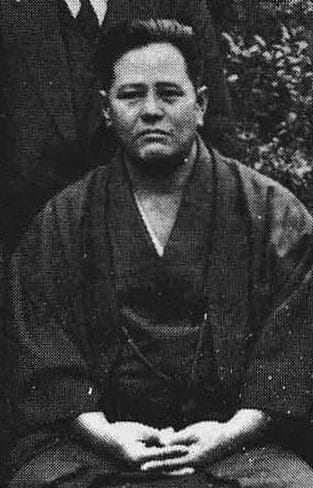
By 1905 Higaonna was teaching in a school setting, a historically significant development because the entry of a martial tradition into organised education tends to systematise its methods and structure its transmission. When he died in 1915 he left a significant body of students, but no neat, uncontested line of succession.
Founding and Naming
Among Higaonna's students, the most important for the later identity of Gōjū-ryū was Miyagi Chōjun, born in 1888. Miyagi organised and systematised the kata, brought the art into a more modern budō structure, and gave it a name. The precise date of the naming is not entirely free of dispute.
The commonly repeated account places the naming around 1930, tied to a demonstration at the Meiji Shrine in Tokyo. According to this account, one of Miyagi's students was asked what style he practised and could not answer because the style had not yet been formally named; Miyagi then chose the name Gōjū-ryū, drawing on the concept of hardness and softness, go and ju, from classical phrasing associated with the Bubishi tradition. Some sources indicate that while the naming may have emerged around 1930, the first official usage is better attested in 1935. The two dates appear in serious treatments for slightly different reasons, and the historical record does not resolve the matter into a single tidy point.
Either way, Miyagi's contribution was decisive. He took Higaonna's Naha-te inheritance and transformed it into something more deliberately organised and publicly defined, structuring the kata and training according to principles that made the style recognisable in a modern form. This formative period has itself become a subject of academic study: an article in a Japanese budō-studies journal examined Miyagi's activity in the Taishō and early Shōwa years, reflecting how the early history of Gōjū-ryū is now treated as a documented historical question rather than only an in-house tradition.
Techniques and Characteristics
Two kata stand at the centre of the style's identity: Sanchin and Tenshō. Sanchin represents a core logic of body structure, breathing, stance, control, tension, rootedness, and internal discipline that defines the style at a deep level. Tenshō expresses the softer, more flowing side, circular motion, continuity, and softness without weakness. Together they embody the principle of hardness and softness contained in the name itself, combining hard structure with soft motion, force with yielding, and rooted tension with circular flow.
There is evidence that Miyagi modified Sanchin, possibly to make it more suitable for school instruction. Such adaptation reflects the broader reality that systems survive through transmission, and transmission involves decisions and change. Gōjū-ryū is also notable for how clearly it carries traces of Chinese influence compared with some other Okinawan traditions; research notes that it preserves elements linked to White Crane-derived principles that are less central in other Okinawan styles. The style is best understood as something distinct that emerged through fusion, shaped first in Okinawa and then further developed by Miyagi.
Postwar Institutionalisation
After the Second World War, the style entered a phase of formalisation. Miyagi himself died in 1953 without clearly designating a single successor, and the senior students who had trained closely with him each carried the art forward in their own dōjō rather than under one recognised head. In 1956, leading masters in Okinawa, including students from Miyagi's circle such as Yagi Meitoku, helped form the Okinawa Karate-dō Renmei, which later became the All-Okinawa Karate-dō Renmei. The postwar period made preservation and formalisation especially visible, as the style became part of organisations, federations, grading systems, and public demonstrations, along with the accompanying politics of lineage and legitimacy.
Gōjū-ryū was also institutionalised on the Japanese mainland, where groups such as the Gōjūkai shaped its development in different directions. The postwar story is one of multiple branches and line systems with distinct emphases. The Okinawan lines more closely tied to Miyagi's tradition preserve one texture; Meibukan, associated with Yagi Meitoku, introduced its own flavour and additional kata; and Japanese branches such as Gōjūkai took the style into somewhat different territory, often with more sport-oriented tendencies and different pedagogical habits.
Lineage and Variation
Rather than a single frozen original from which other versions are corruptions, the history reflects a core inherited framework that branched into lineages with variation. Okinawan Gōjū often retains a stronger emphasis on closer distance, gripping, practical self-defence orientation, and an older training flavour, while some Japanese branches developed with more emphasis on public instruction, competition environments, and standardised forms. These differences show how a martial tradition evolves under different historical pressures while retaining shared roots.
Legacy
By the later twentieth century, Gōjū-ryū had become recognised as one of the major pillars of traditional Okinawan karate. The 1987 memorial stone for Higaonna and Miyagi in Naha reflects how the lineage came to be treated not simply as a local training method but as part of Okinawa's cultural heritage. Such public memorialisation preserves memory while also shaping how later generations frame their history.
The overall story of Gōjū-ryū is one of a martial tradition shaped by travel and exchange, by teachers learning abroad and bringing ideas home, by students organising what they inherited into clearer and more structured form, and by institutions that later worked to preserve it. It combines hardness and softness not only in technique but in its history: firm enough to keep its identity, yet flexible enough to survive the changing world around it.