Wing Chun is a southern Chinese martial art known for its close-range efficiency, short structure, direct attacks, and centerline theory. Its history is fragmented and stands between folklore and documented record: the traditional origin legend cannot be verified, while the earliest figures who can be placed in a documented context appear only in the nineteenth century.
The Traditional Legend
The best-known origin story begins with the Shaolin nun Ng Mui and a young woman named Yim Wing Chun. According to this narrative, the southern Shaolin temple was destroyed during the Qing dynasty, forcing several masters into hiding. One of them, Ng Mui, is said to have created a new combat system after observing a fight between a crane and a snake, and then taught it to Yim Wing Chun, who used it to defeat a local bully attempting to force her into marriage. She later passed the system to her husband, and the art took her name.
Efficiency over strength, the science of angles and pressure rather than power.
This account is historically unverifiable. Researchers examining written records from the Qing period, including official documents, martial manuals, and local gazetteers, have found no mention of Ng Mui, Yim Wing Chun, or a Shaolin-derived system called Wing Chun, and the origin story appears only in much later oral traditions. This does not automatically make it false, but it places it in the category of legendary transmission rather than documented history.
Documented Origins
The earliest figure who can be placed in a documented historical context is Leung Jan, born in 1826 in Foshan, Guangdong province, who appears in local records and historical accounts. A pharmacist by profession, he became widely respected for his fighting ability and was locally referred to as the "King of Boxing of Foshan." Leung Jan did not claim to have invented Wing Chun; he learned it from earlier teachers associated with travelling Cantonese opera performers.
This connection is historically significant, because the opera troupes were linked with secret societies. Southern China during the late Qing dynasty contained underground anti-Qing networks such as the Hung Mun, and opera boats travelling the rivers of Guangdong provided cover for communication, recruitment, and martial training. Within these "Red Boat" opera communities, fighting methods developed that emphasised close-range efficiency rather than large theatrical movements, which helps explain Wing Chun's technical character of short structure, direct attacks, and centerline theory suited to cramped environments.
Transmission to Ip Man
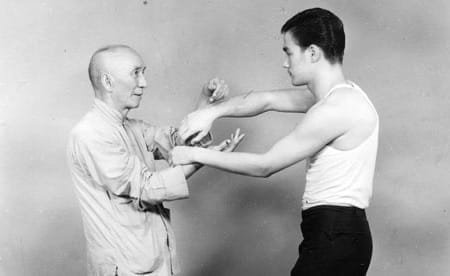
Leung Jan passed the system to several students, including Chan Wah Shun, through whom the art reached Ip Man. Born in Foshan in 1893, Ip Man began studying Wing Chun as a teenager under Chan Wah Shun and later continued with other teachers connected to Leung Jan's lineage. When the Communist government took power in 1949 after the Chinese Civil War, many people left southern China for Hong Kong, Ip Man among them, and there he began teaching Wing Chun publicly. This decision transformed the art's reach, spreading what had been a relatively obscure regional system rapidly through Hong Kong's martial arts culture. Among his students was Bruce Lee, who trained Wing Chun for a relatively short time before developing his own ideas, but whose global fame brought unprecedented attention to the system and helped it spread internationally.
Branches and Naming
The Ip Man lineage became globally dominant, but it was never the only Wing Chun tradition. Other branches existed in Guangdong, including systems associated with Yuen Kay Shan and Sum Nung, alongside traditions in Fujian province known as Yongchun boxing. The name itself is a source of confusion, appearing as Wing Chun, Yong Chun, and Ving Tsun, with different characters, similar pronunciations, and overlapping histories. Some researchers believe the Guangdong system may have evolved from earlier Fujian styles related to White Crane boxing, while others argue the opposite, and some suggest the name "Wing Chun" was adopted later as a symbolic reference rather than the name of a literal founder.
Historical Interpretation
Modern Chinese academic studies suggest the system likely emerged during the late Qing period as a practical combat method connected with social conflict, secret societies, and regional militias. This interpretation fits the turbulent conditions of nineteenth-century southern China, marked by banditry, rebellion, and political upheaval, in which communities needed practical close-quarters self-defence. Legends are recognised as serving a cultural purpose by giving identity to a tradition and inspiring practitioners, but history and legend are distinct. Beyond its disputed origins, Wing Chun's technical principles, particularly its economy of motion and control of the centerline, have influenced wider discussions of efficiency in combat, including the thinking of Bruce Lee.