White Crane is a Chinese martial art associated with Fujian Province, traditionally attributed to a founder named Fang Qiniang. Its documented history is layered and at times inconsistent, drawn from Fujian sources, Okinawan records, family genealogies and fragmentary technical texts. The system is characterised by precision striking, short-range power, adaptability and efficiency, and it later became an influence on the early development of karate in Okinawa.
The Founder Legend
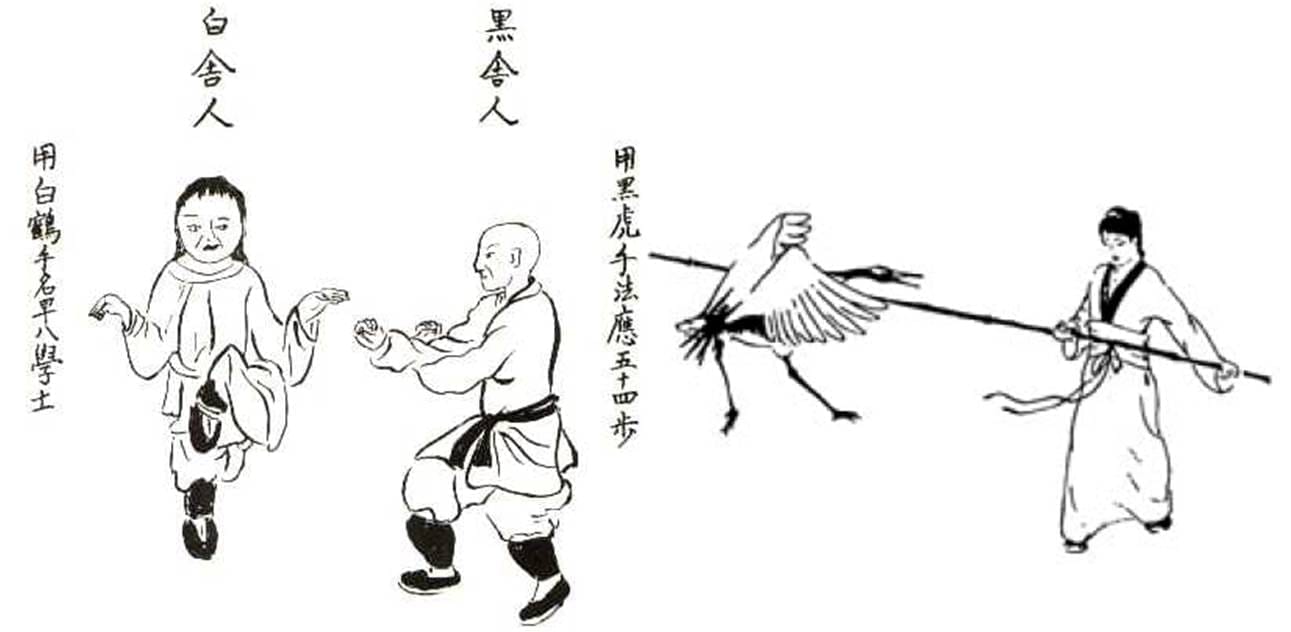
The traditional account centres on Fang Qiniang, said to have developed the system after observing a crane, transitioning from reliance on force to precision. There is no contemporary record of her from the 17th century; the surviving material comes much later, in the form of local Fujian gazetteers, family genealogies, and oral traditions written down generations after the events they describe. This does not establish that the account is false, but it indicates that the story had already been shaped before it reached written form.
The crane does not fight force with force, it finds the space force cannot follow.
Despite the lack of contemporary documentation, the core elements recur with notable consistency across different sources. Fujian texts, especially those tied to Yongchun County, repeatedly return to the same narrative structure: a woman, a Shaolin background through her father, a moment of observation involving a crane, and a transition from force to precision. This pattern appears across sources that were not necessarily attempting to agree with one another, which places the founder tradition somewhere between outright acceptance and dismissal.
Development and Transmission
The Yongchun Gazette from the early 20th century, one of the most cited local sources, mentions not only Fang Qiniang but also her students, twenty-eight of them, among whom figures such as Zheng Li emerge as having done much of the structural work of shaping the system into something teachable. Read without the legendary layer, the evidence suggests less a single creator than a network of practitioners refining the system over time, testing what worked and discarding what did not.
The system emerged in a specific environment: Fujian during the Qing period, a region marked by trade, instability, migration and violence. Its emphasis on precision striking, throat attacks and short-range power is consistent with conditions of tight space and fast, costly encounters.
Techniques and Characteristics
White Crane is often described as a "soft" or "internal" style, but Fujian sources describe not gentleness so much as adaptability: the ability to avoid meeting force head-on, to redirect, to collapse structure, and to strike where resistance is weakest. This is better understood as efficiency than as softness.
The technical literature survives in fragments of manuals and references to texts such as the Bai He Quan Jia Zheng Fa, with discussions of breathing, structure and alignment. Recurring ideas include centreline control, coordinated breath, and the interplay between tension and release. Even when wrapped in philosophical language, these concepts point consistently back to practical application.
Influence on Okinawan Karate
The trail of White Crane leads from Fujian to Okinawa, where it became part of the early development of karate. Kanryo Higaonna traveled to Fuzhou in the late 19th century, studied there, and brought back not a copy or exact transmission but an influence and framework. Later, Miyagi Chōjun formalised what became Gōjū-ryū, and its "hard-soft" concept echoes principles already present in Fujian White Crane writings. Compared with the founder legend, this transmission is supported more solidly by Okinawan records, training histories and evidence of cross-cultural exchange, messy but traceable. In this sense, the origin of White Crane is largely legend while its later transmission is documented history.
Disputed Connections
White Crane is frequently linked to other systems, most notably Wing Chun, with claims of shared lineage or a common ancestor. There are similarities, including centreline theory, close-range engagement and an emphasis on efficiency over force, but similarity does not establish lineage, and hard documentation directly linking the systems is thin. The connection therefore remains unproven.
Legacy
White Crane is best understood not as a single fixed system but as a cluster of related practices that developed in a specific region, influenced one another, spread, adapted and at times contradicted themselves. Its survival reflects functional value rather than a perfect or unified origin story. Stripped of legend and conflicting sources, what remains is a system that prioritises timing, precision, structure and efficiency, does not rely on size or brute strength, and has influenced other arts across regions and generations.