Hōki-ryū (伯耆流) is one of the older traditions of iai, the art of drawing the sword and cutting in a single motion. It is attributed to Katayama Hisayasu, a swordsman of the late sixteenth and early seventeenth centuries who is remembered above all by his court title, Hōki-no-kami, from which the school takes its name. Hōki-ryū belongs to the first generation of named iai schools, and tradition counts it among the lines that look back to the semi-legendary Hayashizaki Jinsuke, the figure to whom the founding of iai is usually ascribed.
The art of iai
Iai (居合), sometimes called iaijutsu, is the discipline of meeting a sudden attack by drawing the sword and cutting in one continuous movement, rather than fighting with a blade already in hand. Its forms typically begin from rest, seated or standing, and pass through a small sequence: the draw and first cut, a finishing stroke, the symbolic clearing of blood from the blade, and the careful return of the sword to its scabbard. Because the decisive moment is the instant the blade leaves the saya, iai places its whole weight on readiness, distance and composure, on resolving a confrontation before it can develop into a prolonged exchange. Hōki-ryū is one of several schools that shaped this art in the early Edo period.
Resolving a confrontation in the instant the sword leaves the scabbard, with the mind settled before the blade moves.
Katayama Hisayasu
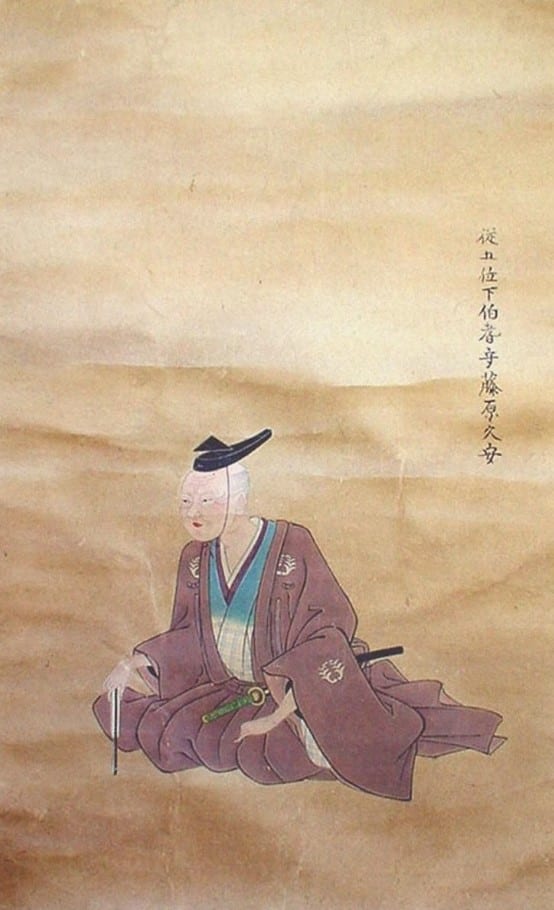
The founder, Katayama Hisayasu (片山久安, c. 1575–1650), is a better-recorded figure than the founders of many koryū, though parts of his story remain a matter of tradition. He is said to have studied the sword and the drawing arts in his youth and to have refined his iai through a period of religious austerity, an element common to the founding accounts of this period and best treated as tradition rather than record. The most frequently repeated story holds that he demonstrated his iai before the imperial court in the Keichō era, around 1610, and was rewarded with the honorary title Hōki-no-kami and a junior court rank. Whatever the exact circumstances, the title is historical, and it is the reason the school carries the name it does.
A name from a court title
The name Hōki-ryū is easily misread. Hōki-no-kami means, literally, "Governor of Hōki", Hōki being an old province in what is now Tottori Prefecture, but the title was an honorary court rank rather than a statement that Katayama governed or even came from that province. The school is named for its founder's title, not for a place of origin, and it should not be assumed that Hōki-ryū began in Hōki. This kind of honorary provincial title was a common mark of distinction for accomplished men of the period, and several martial figures are known chiefly by such names.
Lineage and the Hayashizaki question
Where exactly Katayama's iai came from is not settled. Tradition groups Hōki-ryū with the broad family of schools descended from Hayashizaki Jinsuke Shigenobu, the sixteenth-century and largely legendary master regarded as the originator of iai. Some accounts have Katayama learning within that tradition; others present his art as a parallel development drawn from his own training and lineage. The honest position is that Hōki-ryū stands among the earliest iai schools and shares the broad Hayashizaki framing, but that a direct, documented line of teaching from Hayashizaki to Katayama is not firmly established. From Katayama the school was carried into the Edo period and transmitted in several domains of western Japan, including the Iwakuni domain in Suō (now Yamaguchi), where a portrait of the founder is still preserved, and in the Kii (Kishū) region, among the warrior houses that maintained it.
The method
In technique Hōki-ryū is a focused iai tradition built from solo forms practised against imagined opponents, with attention to the clean draw, the committed first cut and the controlled resheathing. As with other classical iai, the curriculum trains a small number of movements to a high standard, so that the draw and cut become one decisive action and the practitioner is settled and balanced before the blade ever moves. The emphasis falls on precision, timing and the disciplined economy of the drawing arts rather than on a large catalogue of separate techniques.
The school today
Hōki-ryū survives as a living tradition, though a far smaller one than the widely studied iai schools such as Musō Shinden-ryū and Musō Jikiden Eishin-ryū. It continues in Japan through a limited number of lines descended from its Edo-period transmission, taught both within and outside the modern iaidō federations. For a school founded four centuries ago around a single, demanding skill, that quiet continuity is itself a notable achievement, and Hōki-ryū remains of interest as one of the oldest named expressions of the art of drawing the sword.