Kashima-Shinden Jikishinkage-ryū (鹿島神傳直心影流) is one of the oldest surviving traditions of Japanese swordsmanship. Its name announces a descent from the martial culture of the Kashima Shrine, and its long history through the Edo period made it one of the most important ancestors of modern kendō. It is remembered above all for the demanding Hōjō no kata, its four foundational forms, and for the early adoption of protective armour and the bamboo shinai, which let swordsmen strike one another at full force without crippling injury.
Roots in the Kashima tradition
The "Kashima-Shinden" in the school's name, meaning "transmitted from the Kashima deity", places its origins in the swordsmanship associated with the great shrine of Kashima in what is now Ibaraki, one of the oldest centres of the martial arts in Japan. The tradition traces its earliest descent through the medieval Kashima and Kage-ryū lines, and like nearly all koryū it carries a founding story that reaches back into a partly legendary past. The Kashima setting genuinely is ancient, and the older sword traditions it grew from are real; but the detailed lineage that connects the medieval shrine to the school as it later took shape is, in its earliest stretches, a matter of tradition rather than independent record, and a careful account keeps the two apart.
The slow, demanding foundational forms shape the swordsman before they teach technique; what is formed slowly is trusted to hold under speed.
The naming of the school
The art now known as Jikishinkage-ryū passed through several earlier names as it descended through its first generations, among them forms of Kage-ryū and Shinkage-ryū. The system in its mature form was settled by the Yamada line, and in particular by Yamada Heizaemon Mitsunori, known as Ippūsai, who is generally credited with fixing the curriculum and the name Jikishinkage-ryū around the turn of the eighteenth century. From this point the history of the school is documented in much greater detail, and its later heads are well attested figures rather than names in a traditional genealogy.
The Hōjō no kata
At the centre of the tradition stands the Hōjō no kata (法定), a set of four paired forms associated with the four seasons. They are practised slowly and with deep, audible breathing, the cuts large and fully committed, so that the forms train the body and the spirit at least as much as they teach a sequence of techniques. The Hōjō is understood as the foundation on which everything else is built, and a student may work at it for years before it is considered sound. Its severity is deliberate: the school holds that the qualities formed in this slow, demanding practice are what carry over into faster work.
Armour, the shinai, and the road to kendō
The feature for which Jikishinkage-ryū matters most to the wider history of swordsmanship is its early embrace of full-contact practice. Naganuma Shirōzaemon Kunisato (1688–1767), a holder of the school in the early eighteenth century, is widely credited with developing the protective equipment, the helmet (men), the gauntlets (kote) and the padded fencing armour, that made it possible to strike a partner with a bamboo shinai at full speed without serious harm. Together with the Nakanishi branch of Ittō-ryū, which took up similar methods, this kind of armoured sparring spread widely over the following century and became one of the direct foundations of modern kendō.
Sakakibara Kenkichi and the gekiken shows
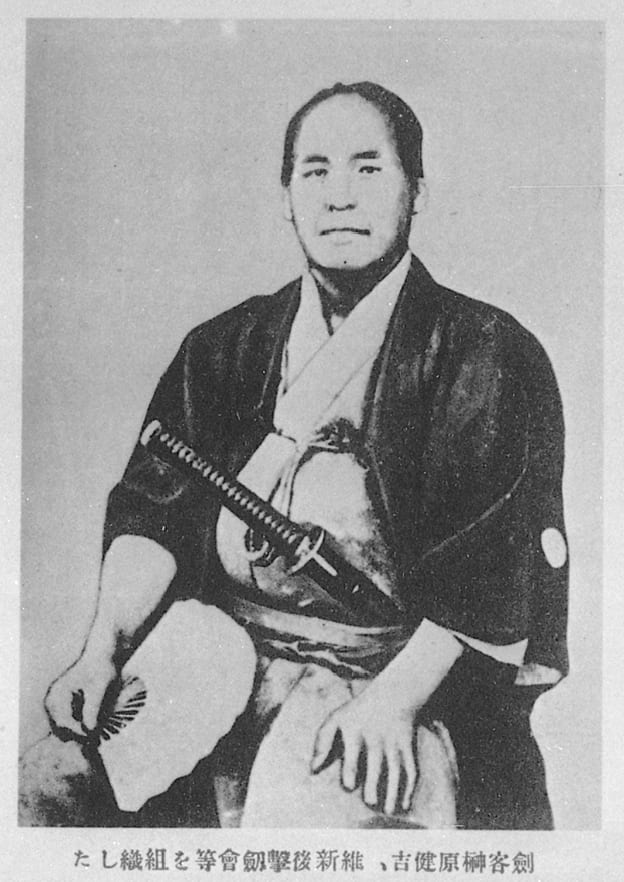
The best-known figure in the school's later history is Sakakibara Kenkichi (1830–1894), a head of Jikishinkage-ryū and an instructor at the Kōbusho, the shogunate's military academy in its final years. After the Meiji Restoration of 1868 swordsmanship lost its place and its patrons, and many swordsmen were left without a living. In 1873 Sakakibara organised the gekiken kōgyō (撃剣興行), public exhibitions of fencing staged before paying audiences in the manner of a sumo tournament. They were criticised by some as turning a martial art into a spectacle, but they gave swordsmen an income and kept the art before the public through its leanest years. Sakakibara is also remembered for a celebrated feat of test-cutting, the kabutowari, when he cut into an iron helmet in a demonstration before the Meiji Emperor.
The school today
Jikishinkage-ryū survives as a living classical school, transmitted through several lines in Japan and, through their students, abroad. These lines preserve the Hōjō no kata and the paired sword forms, and continue to treat the slow foundational practice as the heart of the art. A related naginata tradition, Jikishinkage-ryū naginatajutsu, descends from the same name but is a separate line with its own history. For all the antiquity claimed in its name, the school's clearest importance is as one of the bridges between the old sword schools and the kendō practised today.