Musō Shinden-ryū (夢想神伝流) is one of the two most widely practised schools of iai, the art of drawing the sword. It is a relatively modern school, shaped and named in the early twentieth century by Nakayama Hakudō, but it carries forward a tradition of sword-drawing that reaches back, by its own lineage, to the sixteenth century.
The art of iai
Iai, or iaijutsu, is the art of responding to a sudden attack by drawing the sword and cutting in a single motion, rather than fighting with a blade already drawn. Its forms characteristically begin from a position of rest, seated or standing, and resolve a confrontation in a few movements: the draw and first cut, a finishing cut, the symbolic shaking of blood from the blade, and the return of the sword to its scabbard. The tradition of iai is traced to Hayashizaki Jinsuke Shigenobu, a swordsman of the sixteenth century whose life is largely legendary and who is regarded as the founder of the art. From his line descended the later schools, among them the Eishin-ryū tradition, out of which Musō Shinden-ryū was eventually drawn.
Readiness in stillness: resolving a confrontation in the instant the sword leaves the scabbard, with the mind settled before the blade moves.
Nakayama Hakudō and the making of the school
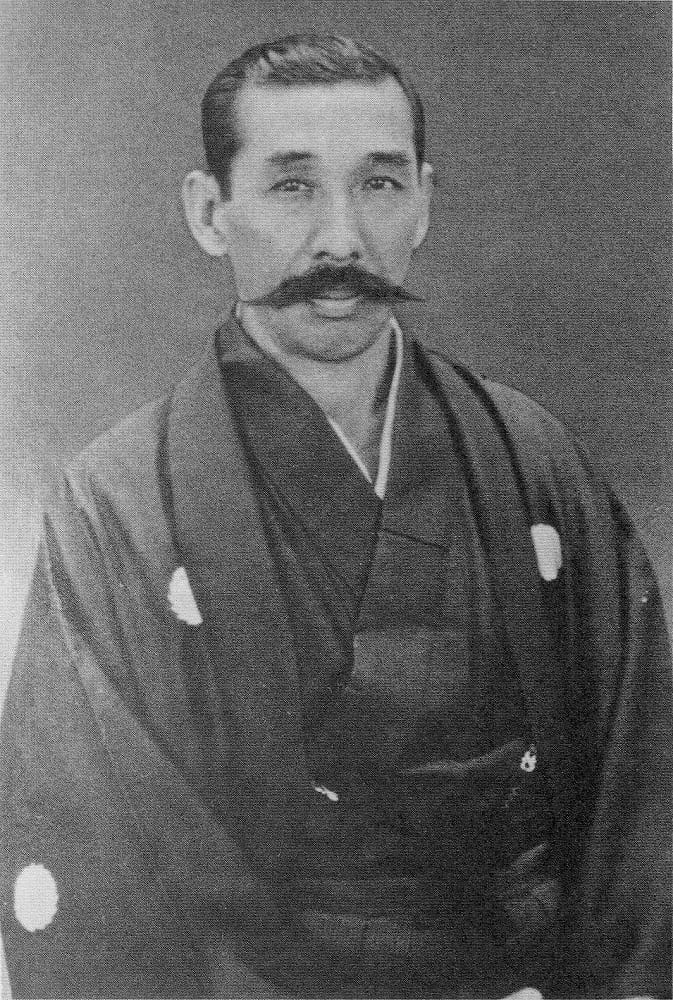
The school as it now exists is the work of Nakayama Hakudō (1872–1958), one of the most important figures in modern Japanese martial arts. A master of kendō, iai and the jō, he learned the Shimomura branch of the Eishin-ryū iai tradition and, in the early twentieth century, organised what he had received into a coherent school that he called Musō Shinden-ryū. Nakayama did much to establish iai as a recognised modern discipline, and the word iaidō, the "way" of iai, came into common use through the generation of teachers he led. Musō Shinden-ryū is therefore best understood as an early twentieth-century formalisation of an older line rather than as an ancient school in its own right, a distinction the tradition itself is generally clear about.
The forms and the method
The curriculum is built from sets of solo forms practised against imagined opponents. The first group is performed from a formal seated posture and teaches the basic shape of every technique: the simultaneous draw and cut, the finishing stroke, the cleaning of the blade and the careful resheathing. Later groups are performed from a raised-knee posture and from standing, and bring in turning, multiple opponents and more varied openings. Throughout, the emphasis falls on precision and composure rather than on speed for its own sake, on doing a small number of movements exactly, with the whole body settled behind the blade.
A modern school with old roots
Musō Shinden-ryū is today, with its sister tradition Musō Jikiden Eishin-ryū, one of the two iai schools most widely studied in Japan and abroad. The two descend from the same Eishin-ryū root and remain closely related, differing in details of posture and emphasis rather than in fundamentals. Through the federations that took up iaidō in the twentieth century, and through the many students of Nakayama's line, Musō Shinden-ryū has spread well beyond its origins, so that the drawing of the sword first taught, in legend, by Hayashizaki is now practised on every continent.