Kitō-ryū is one of the older and more influential of the classical Japanese schools of jūjutsu, the art of unarmed grappling. Its name, which can be read as "rise and fall", points to its central idea: that a fight turns on the moments when balance is gained and lost, and that a smaller person can throw a larger one by working with those moments rather than against them. Though the school is now rare in its own right, it has shaped modern budō more deeply than almost any other, for it was one of the two schools from which Kanō Jigorō built Judo.
Rising and falling
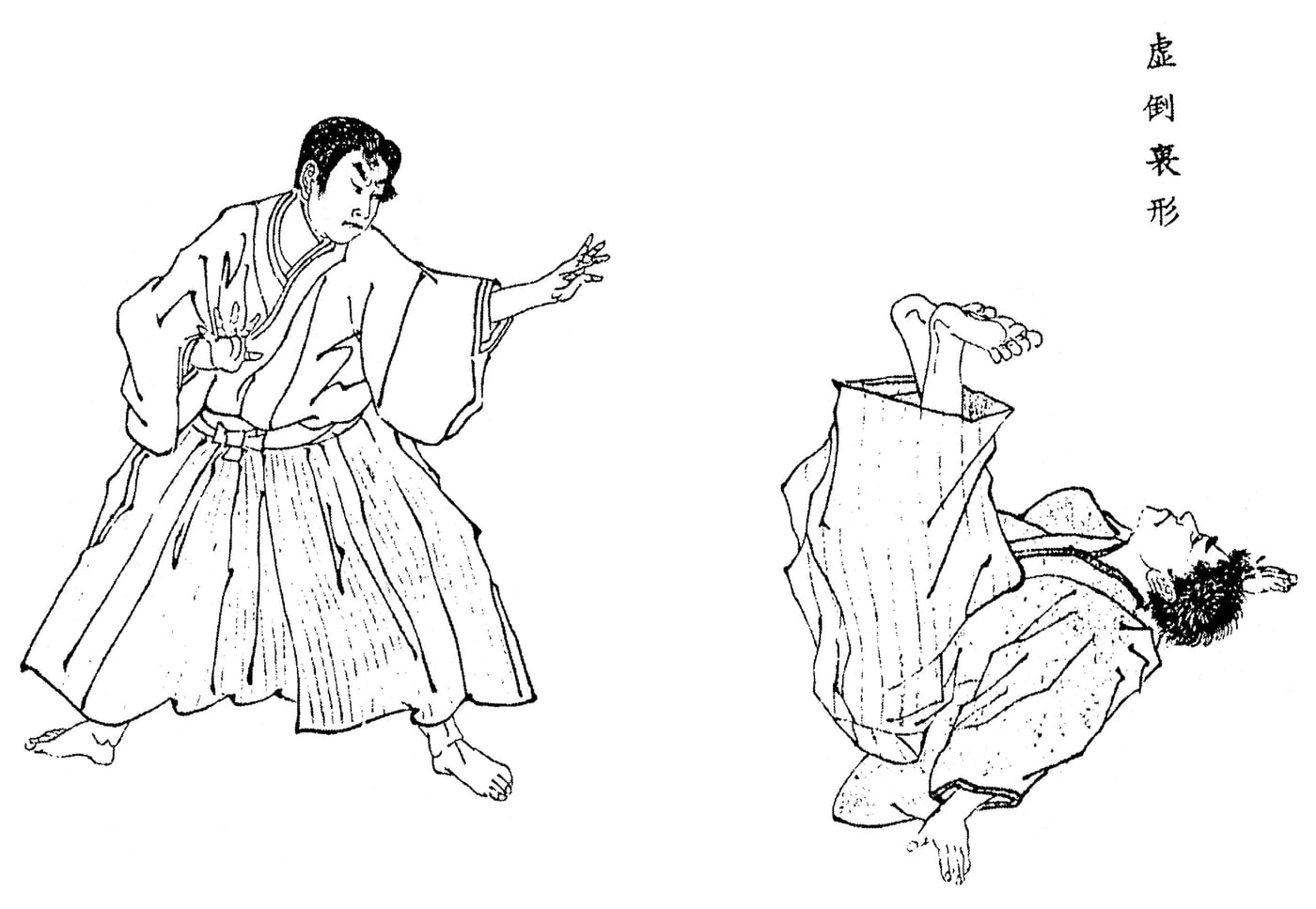
The name itself sets out the principle. To raise an opponent, to break their posture upward so that their feet are no longer firmly under them, and then to bring them down: this rhythm of rising and falling is the heart of the method. The school trains throwing above all, and behind the throws lies the idea that came to define the whole family of Japanese grappling arts, that of yielding to and redirecting an opponent's force rather than meeting it head on. Many of the forms were practised, in the older tradition, as though the combatants were wearing armour, which gives the throws their broad, committed shape.
A fight turns on the moments when balance is gained and lost; work with those moments and a smaller person can throw a larger one.
Origins and the question of China
The early history of Kitō-ryū is genuinely uncertain. The school took form in the seventeenth century, but the often-repeated story that Japanese jūjutsu as a whole descends from a Chinese émigré named Chen Yuanbin, said to have taught grappling to three rōnin in Edo, is a legend that careful scholars, Kanō Jigorō among them, have always treated with caution. There may have been some Chinese influence on the wider world of jūjutsu, but the claim that it founded Kitō-ryū cannot be demonstrated, and the school is better understood as one of the native grappling traditions that flourished in early Edo Japan.
A documented Edo tradition
What is not in doubt is that Kitō-ryū became a well-established art of the Edo period. It is recorded in a substantial body of densho, the handwritten transmission scrolls, a number of which survive in the National Diet Library and date from the early nineteenth century, and it was taught in several domains across the country. This documentary record, rather than the founding legend, is the firm ground on which the school's history stands.
The school that shaped Judo
Kitō-ryū's lasting importance comes from a single student. In the 1880s the young Kanō Jigorō studied the school under Iikubo Tsunetoshi, one of its teachers, having already trained in the jūjutsu of the Tenjin Shin'yō-ryū. When Kanō built his own system, Judo, he drew its grappling principles from these two schools, and he preserved the throwing forms of Kitō-ryū almost unchanged as the koshiki-no-kata, the "forms of antiquity", which remain a part of Kōdōkan Judo to this day. Through Kanō, the rising-and-falling principle of Kitō-ryū passed into a discipline now practised across the world.
What survives
As an independent school, Kitō-ryū is today very rare, kept alive by a small number of dedicated lines. Its real survival, however, is hidden in plain sight: every Judo student who learns the koshiki-no-kata is performing the throwing forms of Kitō-ryū, handed down through Kanō from the older art. Few extinct or near-extinct koryū can claim so living an afterlife.